
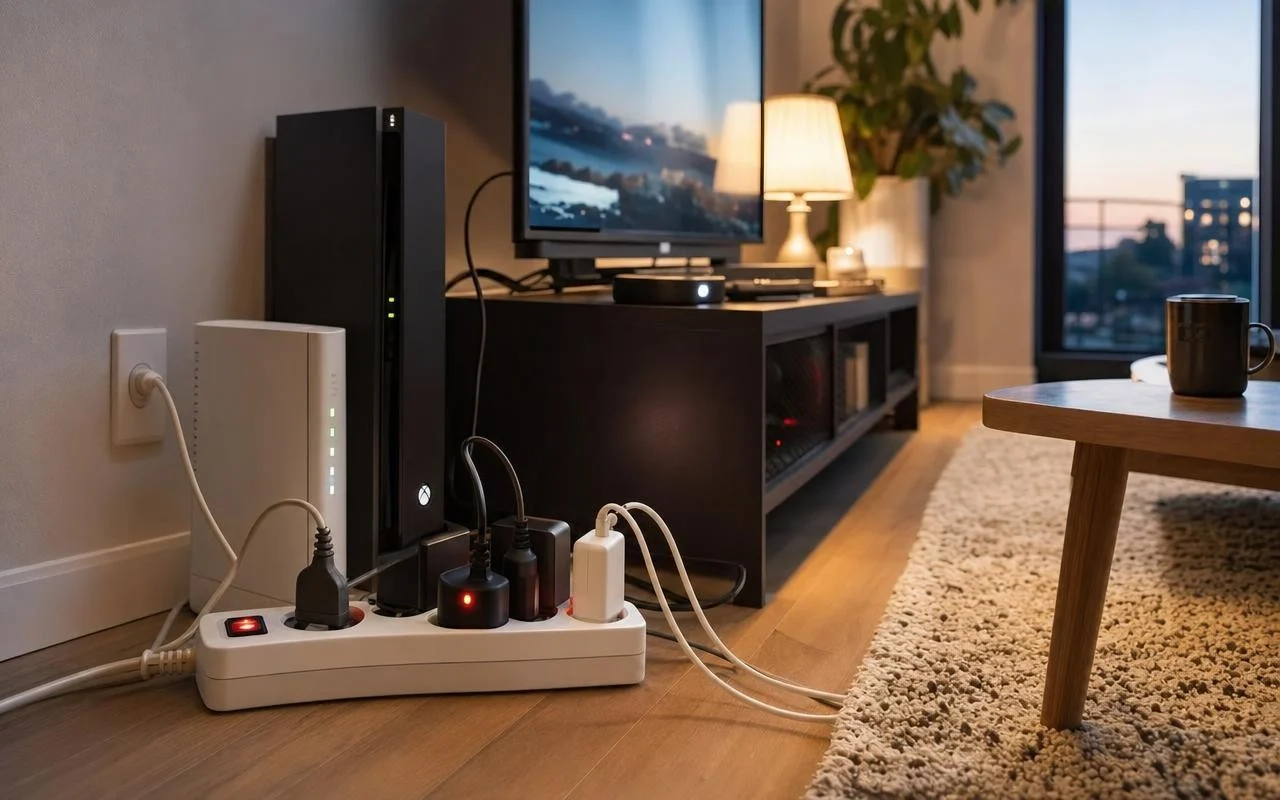
You feel like you are diligently switching off lights, not overusing the heating, and yet the bill keeps climbing. According to electricians interviewed by the specialized press, up to 8% of a household’s electricity bill would come from devices that we believe are off but remain in standby mode. A TV glowing red, a blinking box, a console ready to start: these are the ones that continuously draw on the meter.
The Agency for Ecological Transition (ADEME) even talks about around 10% of a household’s annual consumption linked to these “ghost consumptions.” The Ministry of Ecological Transition reminds us that “small daily gestures can make a big difference.” The question remains: how do a few watts, seemingly harmless, manage to weigh so heavily over an entire year?
Standby devices: why they account for 8% of the electricity bill
A device in standby mode is not truly shut down: it keeps consuming energy to stay ready to start or to stay connected to the network. Televisions,
internet boxes, routers, game consoles, computers, chargers left plugged in form part of this landscape of phantom consumption. According to ADEME, “a TV or an internet box in standby uses 1 to 10 watts continuously, equating to up to 80 kWh per year for a single box,” the equivalent of a small refrigerator over the year.
Measured over time, this small flow becomes quickly significant. The method used by electricians is straightforward: power in watts × 8,760 hours (one year) ÷ 1,000 = kilowatt-hours consumed per year. With a price around €0.20 per kWh, a device that draws 10 W permanently could cost about €17 per year. Multiplied by several devices, it easily reaches the 8% of the bill mentioned by professionals.
Which standby devices consume the most in your home
Experts advise targeting first the television corner and the workstation. The internet box and TV decoders, often on 24/7, are among the largest standby consumers. Older TVs can reach 15 W in this mode. Game consoles sometimes continue to download updates even when switched off, maintaining a non-negligible consumption. Add to this the power supplies and chargers that stay plugged in without a device at the end.
Lemonade, the insurer, estimates that this standby consumption represents on average €80 per year for a household, and up to €180 for a very well-equipped home. By acting in a targeted way on the most energy-hungry devices, this amount could drop by 30 to 50%. The Ministry of Ecological Transition also debunks a common belief: “Turning off and rearming a device consumes more than leaving it on standby,” before clearly ruling: “False.” The surge in consumption upon reactivation remains negligible compared to hours of standby accumulated.
How to reduce standby device consumption on a daily basis
Electricians reassure one key point: you do not need to replace all your equipment to take action. According to Gestoria Eléctrica Corbalán, cited in the Spanish press, the most decisive gesture is to unplug devices left in standby out of habit. To simplify this reflex, experts recommend grouping devices on a power strip with an on/off switch placed within easy reach.
A few simple habits can be put in place in just a few minutes:
- Install power strips with a switch in the TV corner and at the desk, then completely cut these outlets at night or during the day when no one is around.
- Turn off the internet box at night if there is no need for it, particularly in bedrooms.
- Unplug phone, laptop, or other chargers that remain plugged in but are not used.
- Enable deep sleep automatic features on modern televisions and consoles.
For those who want to verify the impact device by device, electricians recommend using a wattmeter. This device, to be plugged between the outlet and the equipment, shows the power drawn in real time. By letting a television stay in standby for several hours, then applying the formula watts × 8,760 ÷ 1,000, one obtains in black and white the annual cost of that standby on the bill.
The Regulation (EU) 2023/826 already Tightens the power limits allowed in standby and off mode for devices placed on the European market, gradually reducing the consumption of newer models. However, margins of maneuver remain substantial in homes, especially those equipped with older devices: it is the daily repeated actions that will allow the share of these invisible standby loads to retreat from the electricity bill.
