
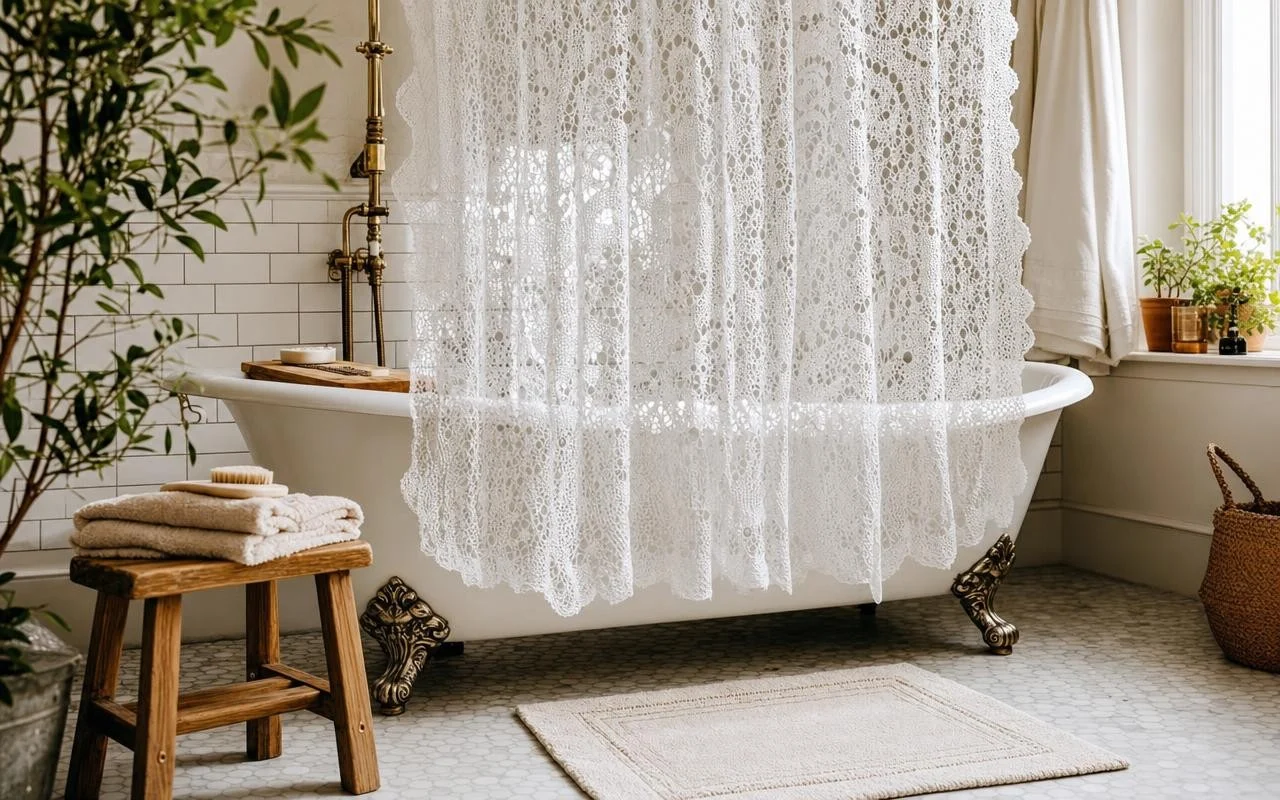
Tired of the white plastic shower curtain that kills the vibe of your bathroom, even after you’ve taken care of the walls and accessories? Many interiors then lean toward cotton or linen to warm up the space. Yet another material is making its way into decorating trends and can transform things without any work or a big budget.
North American decor sites, such as HouseDigest, highlight the lace shower curtain for an instant vintage charm around a bathtub or a shower. The material, airy and light, lets light filter through while dressing the room with intricate motifs. And this textile isn’t just pretty; it can also help the bathroom breathe better. The question is how to adopt it without missteps.
Lace shower curtain: an instant vintage charm
Visually, lace instantly evokes bathrooms in old bourgeois houses, a French countryside vibe, or a cozy cottage atmosphere. Placed in front of a bathtub, a lace curtain transforms the simplest tub into a romantic bathing corner. Its patterns add texture, while its transparency avoids the opaque block effect typical of thick cotton fabrics.
On the use side, HouseDigest reminds that the curtain should be left drawn after the shower. With lace, the tiny openings promote better air circulation and moisture escapes more easily, helping the bathtub area dry. The fabric remains primarily decorative: to retain water, a waterproof liner remains essential behind the curtain.
Natural or synthetic lace: choosing your bathtub curtain wisely
Behind the look, fiber choice heavily affects daily life. Models in synthetic fibers such as polyester or nylon resist mold better than those in cotton or linen, according to HouseDigest. They tolerate humidity in a small bathroom better and dry faster, making them practical for a family or a poorly ventilated room.
The versions in natural fibers stay more breathable and appeal to eco-conscious fans, especially when they are made of organic cotton. In return, they require more frequent washing. Another point to check before buying: some curtains display a simple printed motif reminiscent of lace, while others offer a real openwork structure, much closer to the vintage spirit sought.
Installing and maintaining a lace shower curtain without letting it mold
Like most lace models, they are not waterproof, so decor guides, including Le Journal de la Maison, recommend using them as an outer curtain, with a waterproof liner fixed on the shower side. The two hang on the same rod, either on classic rings, or keeping the liner on rings and adding the lace with clip-on rings.
The maintenance guides from manufacturers like Sensea also advise keeping about twenty centimeters between the ceiling and the rod to promote ventilation, and to always stretch the curtain after use. HouseDigest suggests refreshing the lace curtain every two to three weeks with a cold-water hand wash, gently wringing, then letting it dry hanging. General guides mention a machine wash monthly on a delicate cycle, without a dryer. In practice, a few simple habits are enough to keep the lace healthy:
- pull the curtain and its liner fully after each shower;
- ventilate the room or activate the mechanical ventilation;
- rinse quickly any soap traces from the bottom of the curtain;
- let the fabric air dry, away from radiators or a dryer.
