
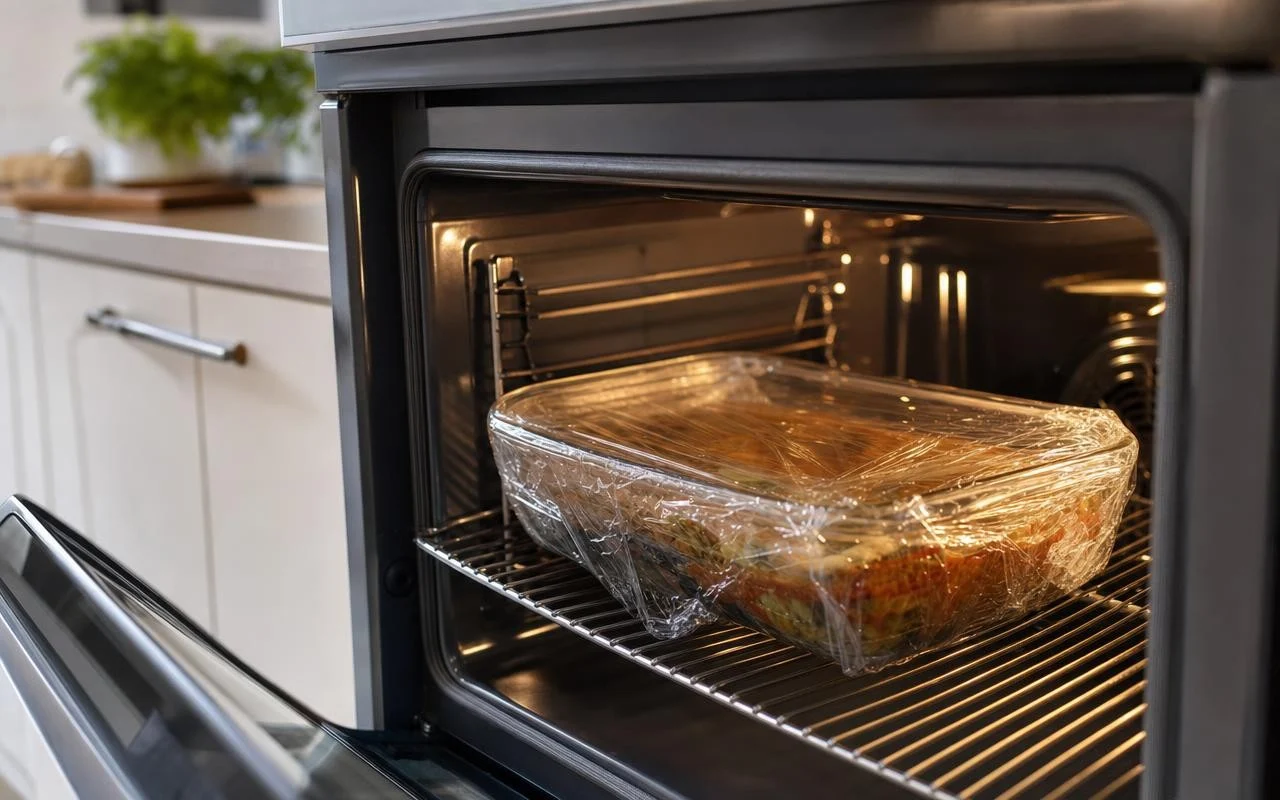
It often happens, before sliding a gratin or a dish of lasagna into the oven, that we want to cover it with stretch film to prevent splatters and keep it moist. This reflex comes from microwave cooking, where plastic wrap is common. Yet, in a conventional oven that quickly climbs to 180 or 200 °C, doubt arises: can this plastic withstand such heat without risking the meal or health?
Authorities such as the DGCCRF remind us that any material in contact with food is regulated by precise rules. These materials, called MCDA, must not release chemical substances into preparations under normal usage conditions, especially as temperature rises. Between fridge, microwave and a traditional oven, the constraints are not the same, and plastic film is not designed for all these uses.
Oven use of food wrap: regulations
At the regulatory level, a material in contact with foods must be sufficiently inert. This means it should not pose a danger to human health, nor alter the composition of the food, nor degrade its taste or odor. The manufacturer sets precise usage conditions in a conformity declaration: type of food, duration of contact, maximum use temperature.
When you place a food wrap in the traditional oven for use it was never intended for, you depart from these usage conditions. The DGCCRF advises following strictly the instructions on the packaging and not cooking or reheating a dish in its packaging, unless there is an explicit mention. However, stretch films designed for preservation most often indicate fridge or freezer, sometimes microwave, but almost never oven: in that case, the answer is no.
Stretch wrap or oven cooking film
Distributors like RAJA describe the stretch wrap for preservation as packaging intended to protect foods in the refrigerator or freezer. It is used to wrap a dish, cover a bowl, prevent odors from spreading, but it is not made to be heated. Some do not even tolerate the microwave, which gives an idea of their fragility when used in oven cooking.
There are also cooking films, sometimes mentioned on packaging as high-temperature stretch wrap. Practical sheets explain that they can, in some cases, go up to 175 °C in a traditional oven, provided the indicated duration is respected. Other products, used more for bain-marie, announce only 70 °C for two hours or 100 °C for fifteen minutes, well below a classic bake at 180 or 200 °C.
Oven-safe food wrap: risks, alternatives
In the United States, the FSIS food safety service notes that plastic packaging films around raw meat are not designed to be heated: they can deform, melt and release substances into the food. The risk increases with temperature, duration and the presence of fats. Oven-ready cooking bags, by contrast, are tested up to about 204.4 °C (400 °F), which is not the case for a simple stretch wrap.
To determine whether an oven-safe food wrap is authorized, the home rule remains simple: read the label. The pictogram of a glass and fork guarantees only contact with food. There must also be a mention of oven compatibility or cooking, with a maximum use temperature at least equal to that of your recipe; otherwise, it is better to rely on parchment paper, a pot with a lid, or a dedicated cooking bag.
