
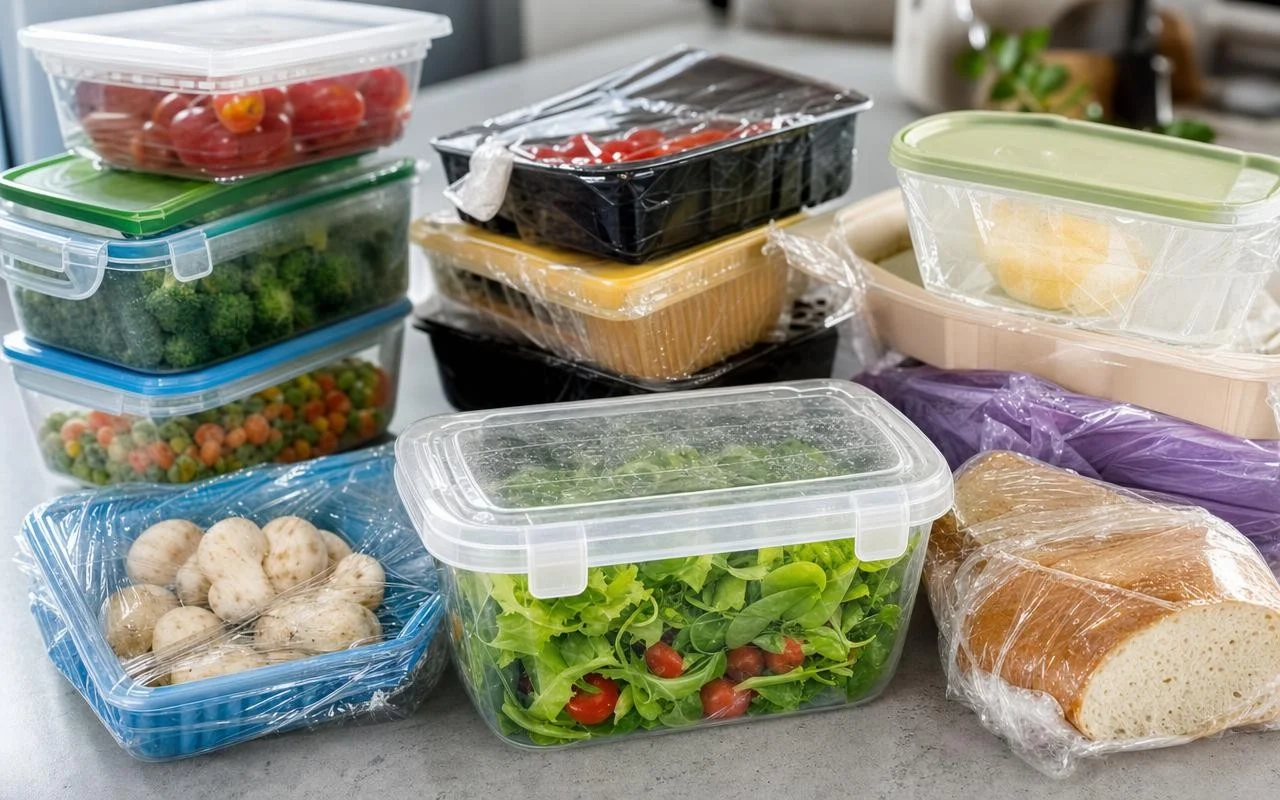
Reusing a catering tray to freeze a homemade dish, pouring boiling soup into an empty ice-cream container, wrapping a sandwich still warm in plastic wrap grabbed at random from a drawer: these actions may seem harmless. Many households perform them reflexively, thinking that all plastics are the same when it comes to food. That, however, is not the case.
For the Directorate General for Competition, Consumer Affairs and Fraud Repression (DGCCRF), these materials belong to the category of “materials in contact with food” or MCDA. The authority notes that they can release substances into foods through a process called migration. In its 2022 survey, 350 samples were analyzed: 27 % were non-compliant, and 33 % posed a potential danger to human health. A reason to view our containers differently.
Understanding the Migration of Plastics in Food Contact
Ideally, a material that comes into contact with food should stay inert: it must not endanger health, alter the composition, or change the taste or aroma of what we eat. A food-contact-ready plastic is therefore not a “magic” plastic, but a material whose composition and use have been tested for a specific type of food, at a given temperature and for a defined duration.
Everything gets more complicated when we move away from that intended use. The DGCCRF reminds us that MCDA are tested for a particular scenario; if we heat, freeze, or extend storage, the material will not necessarily react in the same way. A fatty dish, an acidic sauce, or cooking at high temperature can promote the migration of additives, or even metals such as lead or chromium, already detected in certain films and bags.
How to Recognize a Plastic Suitable for Food Contact
For the consumer, the first cue remains the pictogram of a “glass and fork” printed on the packaging or product. This logo means the item is suitable for food contact, under the conditions defined by the manufacturer. The DGCCRF invites everyone to check for its presence before using dishware, boxes, bags, or plastic films that are not plainly designed for food.
But this logo is not enough: one must also read the usage restrictions, often printed in small characters. Maximum temperature, microwave suitability, freezing, single-use or repeated use, and the types of foods concerned set the framework. Professionals should have a detailed conformity declaration outlining these parameters. The 2022 survey already shows one in three professionals with anomalies. The AGEC law no. 2020-105 also revealed bamboo or wheat fiber plastics that are sometimes not authorized.
Common Mistakes with Food-Contact Plastics to Avoid
In everyday life, a few common reflexes are enough to turn a compliant container into a risky situation. The DGCCRF checks cite:
- Reusable use of single-use packaging (ice trays, trays, bottles) to store or heat foods.
- Cooking or reheating in the oven or microwave of freezer bags, stretch films, or trays not intended for such use.
- Contact of very hot, fatty, or acidic foods with a plastic without any temperature or compatibility information.
Marketing claims add to the confusion. The survey notes items now marketed as reusable even though they were single-use, or presented as “natural” without justification. Some display “BPA-free,” while Bisphenol A is already banned in France. With 27 % of the 350 samples analyzed being non-compliant, it is wiser to reserve the tested plastics for the indicated uses and opt for glass or stainless steel for hot and fatty foods.
