
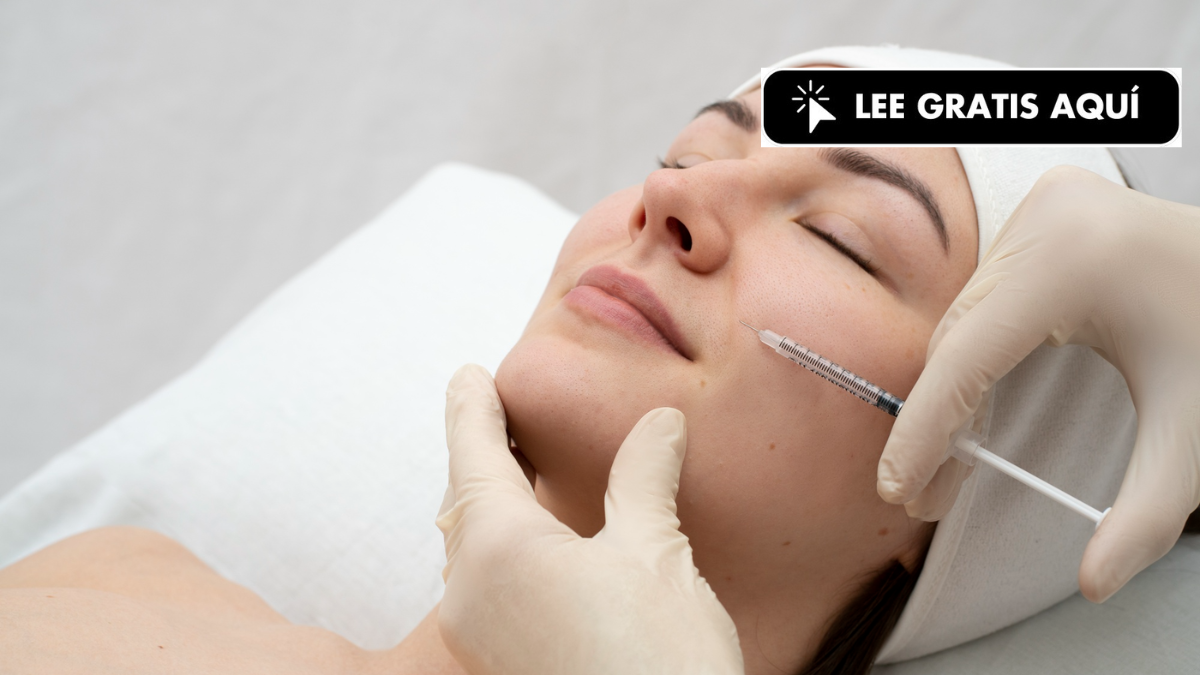
More and more people are turning to aesthetic medicine to improve the appearance of their skin, prevent the early signs of aging, or correct small imperfections. However, just because a treatment has become trendy does not mean it is necessary for everyone.
Dr. Carmen Górriz, a specialist in Aesthetic Medicine, defends a personalized approach in which the diagnosis must take precedence over fashion.
Before deciding which treatment to undertake, the specialist considers it fundamental to analyze the face as a whole: from skin quality to facial structure, proportions or gesticulation. The goal, she asserts, should not be to transform the features, but to achieve a natural and harmonious result.
The most common mistake when starting with aesthetic medicine
One of the most habitual errors is to come to a consultation with a very concrete idea about what one wants to modify. Lips, cheekbones, botulinum toxin, or certain treatments that have become popular on social media can become the objective before even knowing whether they are really necessary.
«The most frequent error is to start treating ‘things’ in isolation rather than performing a global diagnosis of the face», explains Carmen Górriz.
The specialist insists that a treatment should not be chosen simply because it is in fashion. Before that, one must assess what really concerns the patient and what their face needs.
«In aesthetic medicine we should not treat by trend, but by indication», she notes.
There is also no specific age at which everyone should begin undergoing aesthetic treatments.
Genetics, sun exposure, habits, and skin quality are some of the factors that can determine each person’s needs.
In younger patients, Górriz considers that it often makes more sense to focus on prevention, especially through sun protection, a good skincare routine, and, when indicated, treatments aimed at improving skin quality.
The treatments that become fashionable are not always necessary
Social networks have turned some procedures in aesthetic medicine into genuine trends.
Polynucleotides, exosomes, collagen inducers, energy devices, or preventive botulinum toxin appear with increasing frequency among the options sought by those who want to care for their face.
But the popularity of a treatment does not mean that everyone needs to resort to it. They are excellent tools when well indicated, but not everyone needs to stimulate collagen, restore volume or start toxin at a certain age.
In this sense, she also regards it as important to manage the expectations generated by social networks. Some procedures are presented as solutions capable of achieving results very different from what they can actually offer.
Non-surgical treatments can improve certain aspects of the face, but they do not necessarily replace surgery when there is, for example, a significant excess of skin or advanced sagging.
Therefore, knowing the limits of each procedure is as important as knowing its possible benefits.
The signal that indicates that a person may be overdoing it
Where is the line between improving a face and changing it too much? For Carmen Górriz, one of the clearest signals appears when we stop recognizing the person’s own features.
«Excess volumes, disproportionate lips, overly projected cheekbones, loss of mobility or a face that is excessively homogeneous can indicate over-treatment», she explains.
There is also a subtler sign: when each treatment generates the need to perform another to compensate for the previous one. At that point, the initial goal of achieving a natural result can begin to be lost.
The specialist also focuses on expression. Botulinum toxin, when well indicated, should not eliminate it, but modulate certain muscle contractions while maintaining naturalness.
With fillers, something similar happens: adding volume repeatedly without reassessing the face can end up altering its proportions.
For those who want to improve their appearance without it looking like they have undergone a treatment, the doctor recommends starting with a comprehensive facial diagnosis and, in many cases, focusing on the skin. Improving luminosity, texture, spots, hydration, or firmness can substantially change the perception of the face without altering its features.
In fact, for Górriz, one of the signs that most influence the appearance of aging is the loss of skin quality and the tired look. A uniform, radiant, and well-cared-for skin can visually rejuvenate without the need to change any features.
And before carrying out any procedure, the specialist reminds us that safety must also be considered.
The patient should know who will perform the treatment, what product or device will be used, what its indication is, what reasonable result to expect, and what possible adverse effects may occur.
In the case of hyaluronic acid fillers, she considers it fundamental that the center has the means to act in case of a possible complication, such as a vascular occlusion.
Because, ultimately, good aesthetic medicine does not necessarily consist of doing more. “Good aesthetic medicine is precisely that which does not identify itself as aesthetic medicine,” concludes Carmen Górriz: achieving that someone looks rested, has a good face, and preserves their own features.
