
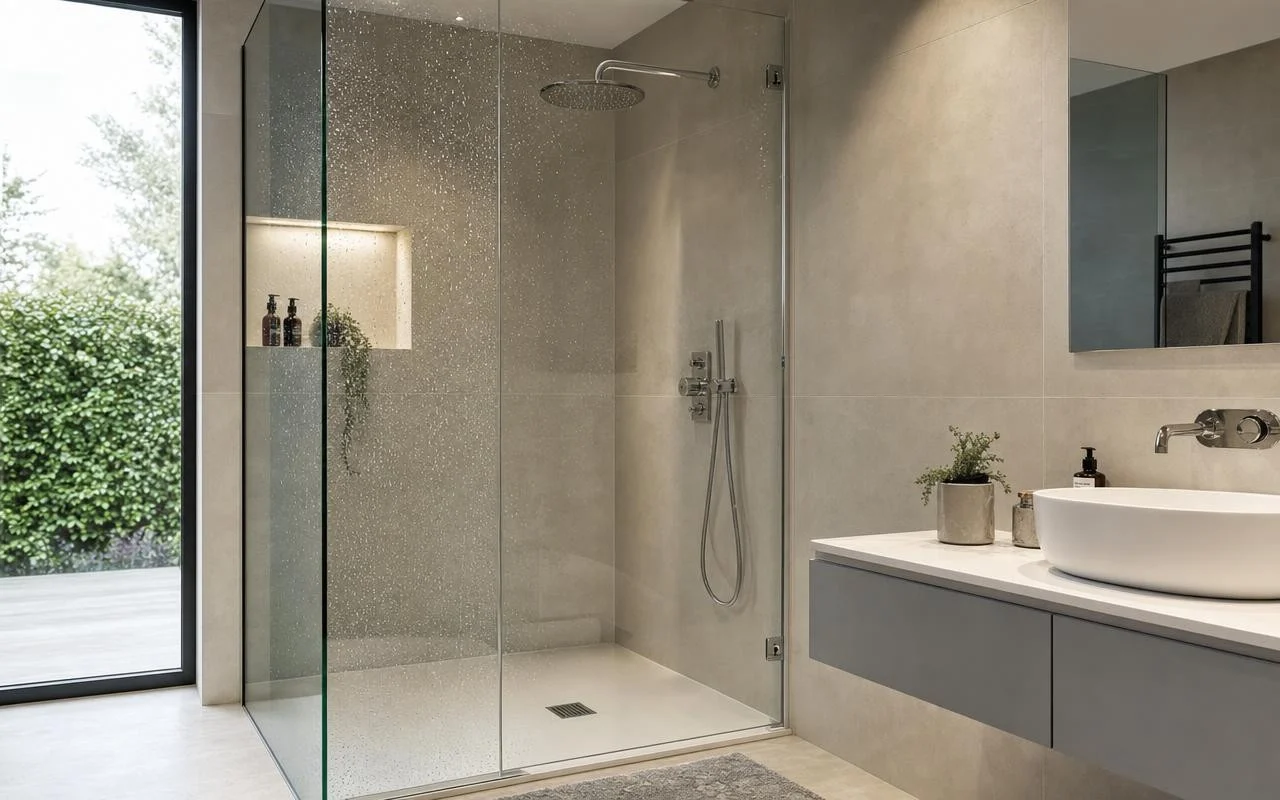
A shower enclosure that shines after a deep clean, followed by that white veil returning from the very first shower: many French bathrooms know this scenario. Squeegees, white vinegar, anti-scale sprays—nothing permanently prevents the appearance of marks. The frustration is all the greater since the shower is one of the most watched rooms in the home, especially when the panel is large and highly visible.
In projects drawn by interior designers, this problem has nonetheless eased over the years, without heavier cleaning routines or miracle products. The change comes from the material side, with a type of glass that is increasingly seen among private renovators. A simple idea, but one that changes daily life.
Pourquoi le verre de douche classique accroche autant le calcaire
Standard glass may look smooth to the naked eye, but its surface actually features micro-porosities. Tap water, loaded with mineral content, clings to it, then evaporates, leaving behind the minerals it carried, mainly calcium carbonate and magnesium. These crystals settle into the tiniest irregularities and gradually form this white veil that is so hard to remove.
The rougher the surface, the more places the limescale can anchor itself. In areas with very hard water, like parts of the Paris basin, the panels therefore get coated even faster. Even after a thorough cleaning with vinegar or a squeegee, the micro-roughness remains and welcomes new deposits from the next shower. Hence this sense of starting over again and again.
Le verre de douche anticalcaire traité par nanotechnologie
To break this cycle, designers now favor an anti-limescale shower glass equipped with a nanotechnological coating. At the nanometer scale—one millionth of a millimeter—an extremely thin layer fills the micro-porosities and makes the surface hydrophobic. Water no longer spreads; it beads up and slides off, carrying away most minerals before they have time to dry. This treatment also limits fogging, since steam condenses less on a water-repellent surface.
In practice, this type of glass is often a safety tempered glass, factory-treated. Saint-Gobain, for instance, offers TIMELESS, a panel with a metallic oxide anti-corrosion layer, marketed with a 10-year corrosion warranty for the first buyer. Kermi highlights its KermiDURA treatment, whose durability of at least 10 years has been validated by the German TÜV organization. This comfort comes at a price, with a premium that can reach several tens of percent compared with standard glass, but interior designers readily incorporate it into walk-in showers, full-height bright enclosures, or homes located in hard-water areas.
Comment choisir et entretenir ce verre traité hydrophobe
Before ordering a new enclosure, it remains important to carefully decode commercial promises. Not all so-called anti-calcium glasses rely on the same technologies or on the same advertised lifespan. Professionals advise discussing in detail with the manufacturer or installer, keeping in mind a few key points.
- The exact nature of the surface treatment and the associated warranty; some manufacturers like Saint-Gobain cite, for example, a 10-year anti-corrosion warranty for TIMELESS glass, while KermiDURA highlights a lifespan of at least 10 years tested by TÜV.
- Compatibility with your usual cleaning products, avoiding cleaners that are too abrasive or too acidic which would wear down the protective layer.
- The feedback from the installer on how the treatment performs over time, depending on the water type and how frequently the shower is used.
- The overall budget, including installation, with the treatment adding several tens of percent to the cost of a standard glass.
On a daily basis, maintenance of this treated glass remains simple. A wipe with a damp sponge or microfiber cloth is usually enough to keep the panel clean, without resorting to the harsh chemical products used on bare glass. Manufacturers recommend avoiding scouring powders, some abrasive creams, or overly rough pads, which would eventually damage the nanotechnological layer and diminish its effectiveness.
To prolong the hydrophobic effect, many installers also recommend a soft squeegee after the shower, a quick gesture that limits droplet stagnation. Even in hard-water regions, the marks reappear much more slowly, intensive descaling sessions become spaced out, and the panel retains its transparent and shiny appearance for longer.
