
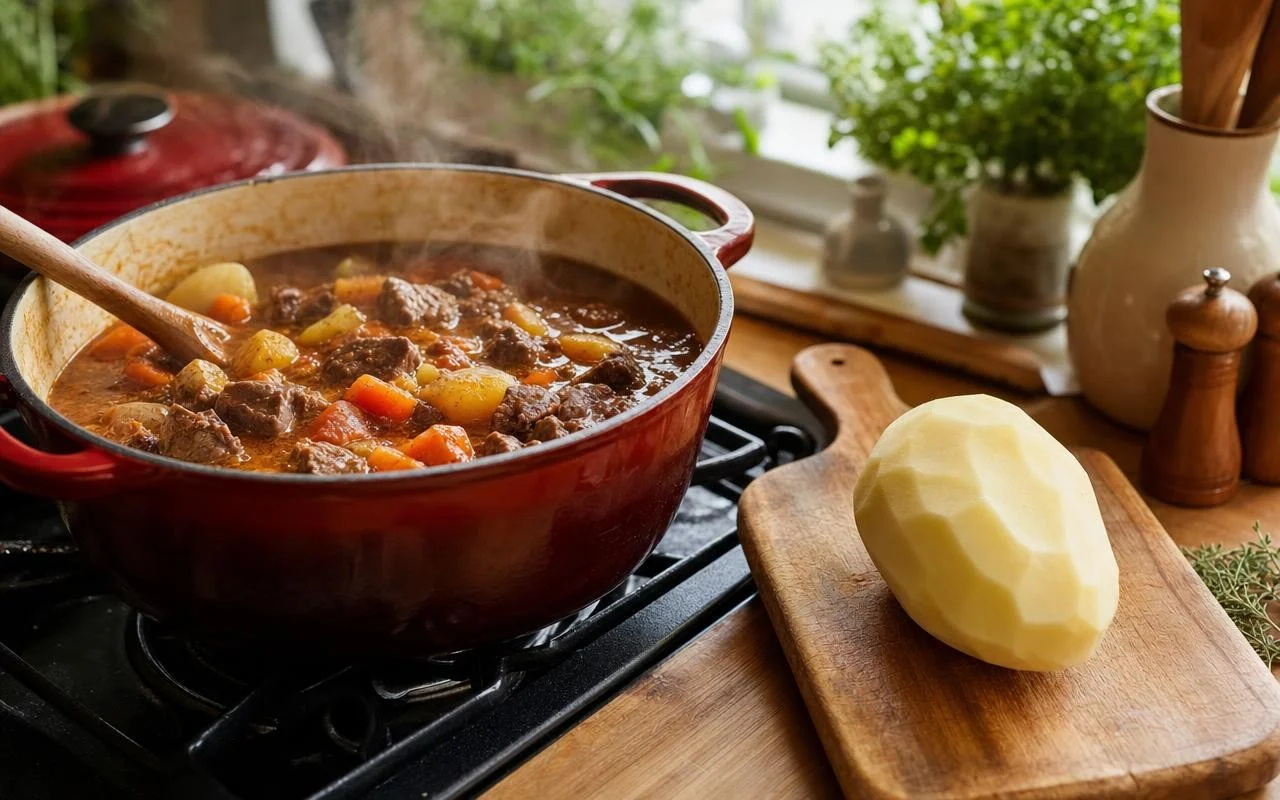
Everyone has already lived through that moment of cold sweat in front of the pot: one extra pinch of salt, and the stew that was simmering so nicely becomes nearly inedible. We lower the heat, we taste again, nothing helps. The reflex of the older generations then comes to mind, like a small phrase passed down in family cooking.
The grandmothers who cook have known it forever: “If you put too much salt in a stew, add a peeled raw potato.” This advice circulates in households, but also on cooking sites, which detail it and nuance it. One question remains intriguing: kitchen myth or real lifesaver?
Too salty stew: how to use the peeled raw potato
The Spanish media Okdiario sums up this trick in one sentence: “When it happens, there exists a timeless kitchen trick that can help solve it: add a peeled raw potato while the stew is still on the flame.” Concretely, you intervene as soon as you sense the dish is too salty, while it simmers gently.
To apply the grandmother’s gesture on a too-salty stew, cooking sites advise a very simple protocol:
- Peel a medium-sized raw potato.
- Add it whole or in large chunks to the quite liquid stew.
- Let it simmer for about 15 to 20 minutes on low heat.
- Remove the potato, then taste again before serving.
Why the raw potato dulls the taste of excess salt
Sites like MyMignardise or Cyber‑Espace remind us that the potato does not act like a salt magnet. It behaves more like a small sponge that absorbs salty liquid thanks to starch and capillarity. By capturing part of the juice, it borrows along with it a bit of dissolved salt, which can soften the overall flavor of the stew.
This action is limited: if the dish is extremely salty, the potato cannot miraculously correct the situation. The Spanish site El Español emphasizes this point by explaining that the potato becomes salty simply because it sits in the overly salty liquid, while the rest of the juice changes less than one might imagine. The trick mainly works as a small nudge, useful in stews, soups, or fairly liquid broths.
Limitations of the trick and other measures to save a too-salty stew
When a dish simmered too salty is already very reduced or very thick, the potato’s room to maneuver narrows. Little juice to absorb means little salt to take in. Sites like Cyber‑Espace also recommend not leaving the potato in for too long, to avoid it breaking down and clouding the sauce. In this case, the approach is more about several small attempts than a single long cooking session.
If, after one or two potatoes, the stew remains too salty, you are advised to complement with other simple moves: dilute the dish with a bit of water or unsalted broth, add vegetables or starchy ingredients that are unseasoned to dilute the salt concentration, or remove a portion of the overly strong sauce. Many also recommend not necessarily eating the potato used, often very salty, even though some reserve it for another use where that extra salt will be better tolerated.
