
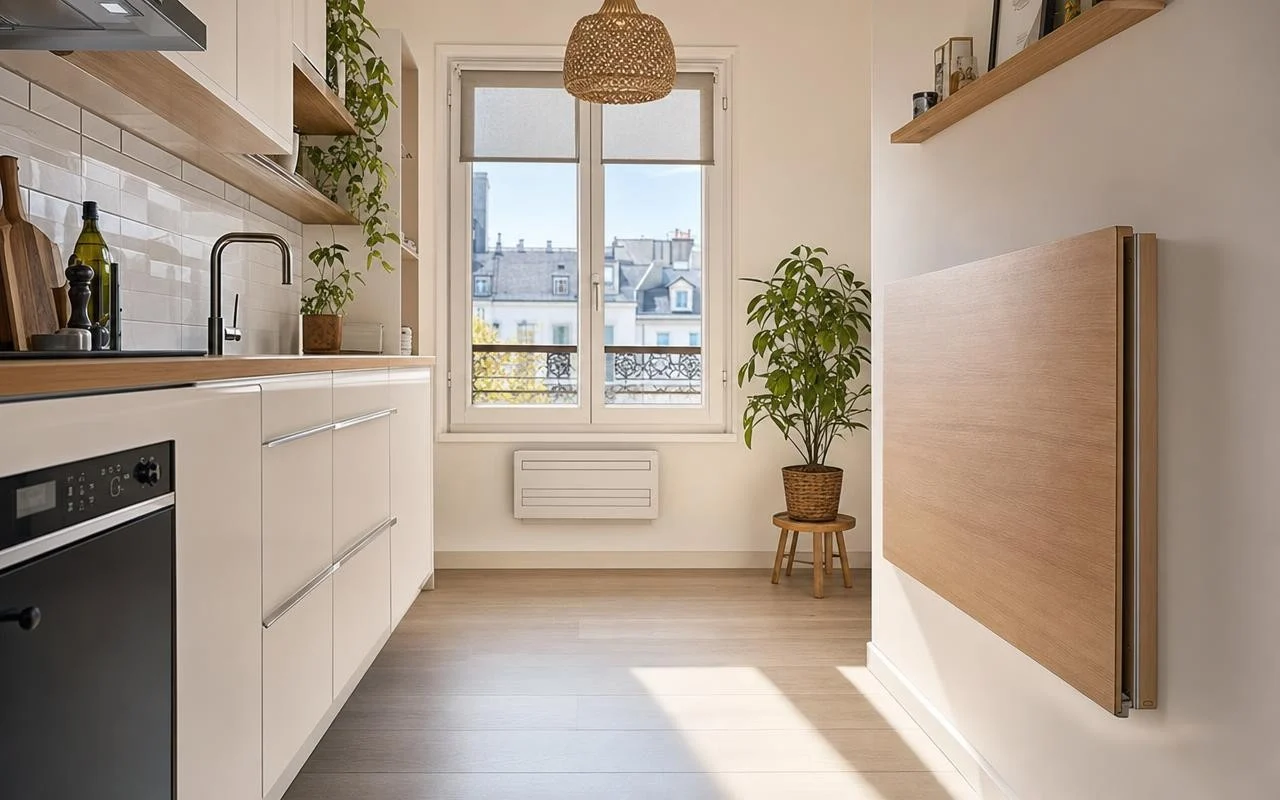
For a long time, the breakfast bar has been the emblem of open-plan kitchens: a raised counter, two stools, and the impression of living in a loft. But this fixed piece of furniture, so photogenic on social networks, is beginning to be questioned by those who actually live daily in kitchens smaller than 10 or 12 square meters. The tide is turning for compact spaces.
In this context, an article from the Argentinian media TN, published on September 27, 2026, sums up the situation well: “For years, breakfast bars have been one of the most chosen options to add a dining space inside the kitchen,” the editors note. The same article then observes that kitchen design is now leaning toward a much smarter solution for tight meterage. Suspense.
Why the fixed breakfast bar suffocates small kitchens
TN points out a major weakness of this piece of furniture: “The key difference lies in how space is used. While a breakfast bar remains fixed and requires stools to be used, a fold-down table can stay closed for most of the day and only unfolds when needed.” In a small kitchen, every stool, every table leg encroaches on circulation.
In many apartments, the bar occupies a full run of the worktop, to which you must add about 60 to 80 cm of clearance to sit down. TN sums up: “Retractable solutions designed to better exploit spaces are among the kitchen trends announced for 2027, enabling savings of up to 5 m² in the room.” We are indeed talking about a potential “up to,” tied to any regained passage space.
Fold-down wall table: the new 2027 star to gain up to 5 m²
In response to this observation, the trend crystalizes around the fold-down wall table. TN explains: “Looking ahead to 2027, interior decoration is focusing on an alternative that combines practicality, space saving, and versatility: fold-down wall tables.” Fixed to the wall, the table folds away after the meal, instantly freeing the passage. Visually, the kitchen appears wider and the space becomes available again for cooking.
Models range from simple surfaces that fold against the wall, to drop-leaf tables that expand when there are guests. For very cramped kitchens, TN notes that “for very small kitchens, one can also choose narrow models that serve as a surface for breakfast, work, or eating. When not in use, simply fold them away and reclaim the space.” The same piece of furniture then serves as both a dining nook and a desk.
How to choose and install a fold-down wall table in a small kitchen
Manufacturers such as Ikea, Leroy Merlin, or other brands now offer a wide range of wall tables. A typical two-person model, close to the famous NORBERG (about 74 x 60 cm), often suffices for a studio. To choose well, a few criteria make the difference:
- the open and closed dimensions, suited to your kitchen layout;
- the mounting height (around 74 cm for a table, 95 to 106 cm for bar-style use);
- the type of wall and compatible fixings (drywall, brick, concrete).
Product sheets remind that sturdiness depends on the anchors and the support, a crucial point for safety. TN also advises considering placement: “A practical option is to place it near a window or in an area with good natural light.” Placed on a free wall or at the end of a corridor-type kitchen, the fold-down table creates a true dining corner without constraining movement when folded away.
