
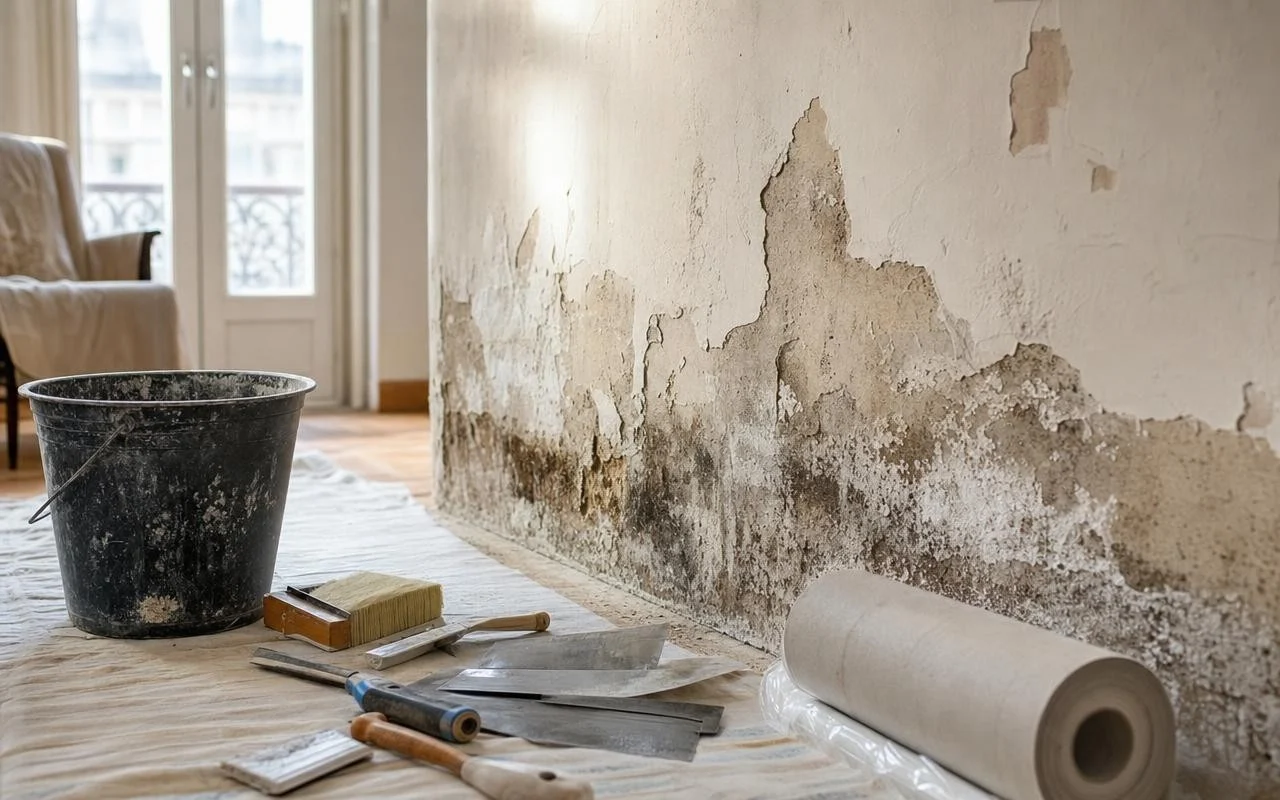
Dark stains that spread, paint blistering, plaster crumbling… When faced with a wall marked by dampness, the temptation is strong to grab the roller and cover everything up. Yet masons and building specialists insist that this quick fix almost always ends up failing.
Interior designer Abel de González, creator of the Mil Ideas channel, sums up the professionals’ consensus: “To repair a wall affected by humidity, the first thing we do is sanitize it.” In other words, before thinking about paint, one must tackle the cause, the substrate, and the internal layers, otherwise the stains and saltpeter are likely to reappear very quickly.
Sanitizing a Damp Wall: Address the Cause and Confirm It Is Truly Dry
For Abel de González, the starting point is non-negotiable: “Before starting any intervention, it is necessary to ensure that the origine water intrusion is resolved and that the surface is completely dry.” Leaks from the roof, cracked joints, lack of drainage or insufficient ventilation must therefore be corrected before any attempt to repair a damp wall.
Measures cited by Hypersec provide benchmarks: comfortable indoor air hovers around 40 to 60% relative humidity. Plaster stays within a normal range below 2% water mass, becomes critical above 5%, brick above 10%, concrete above 8%. Hypersec reminds that “a surface test does not replace in-depth analysis” and recommends the expertise of a QUALIBAT-certified company if these thresholds are exceeded or if capillary rise is suspected.
Repairing a Damp Wall: The Pros’ Multi-Layer Protocol
Once the cause is addressed and the substrate deemed sufficiently dry, the mechanical cleansing begins. “With a putty knife, you remove the peeling paint, cracks, or damaged areas, but without overdoing it so as not to enlarge the problem,” explains Abel de González. This phase aims to remove all friable material, then to dust carefully to prevent the old humidity from reappearing beneath the new finish. The specialist then recommends an insulating primer, preferably oil-based, to create a barrier that stops the halos from rising: “If nothing is applied, the moisture stain will always come back.”
Next comes the filling. Large areas can be filled with plaster, small areas with ready-made compounds. “The trick is to apply two coats: the first covers the holes evenly and, once dry, sand with a medium abrasive and clean the dust,” details Abel de González. A second pass yields a truly smooth surface. The pro then stresses the role of the water-based sealer to even out absorption between the patched parts and the rest of the wall. If a commercial product is unavailable, he proposes a homemade solution: “By mixing white plastic paint with water until you obtain a liquid texture, similar to water, you get a perfect sealer.” Two coats are recommended, with a one-hour interval between them, before finishing with two coats of plastic paint, checking the wall between the layers to correct the last small imperfections.
Infiltration, Condensation or Capillarity: Tailoring the Wall Sanitation
The masons distinguish several types of humidity, which do not call for the same corrections before sanitizing the wall:
- Humidity from infiltration: water that passes through an exterior wall that is poorly waterproofed, often visible at the top of walls or near the ceiling, with dark stains and peeling paint.
- Humidity from condensation: steam produced during cooking, showering, or drying clothes, which settles as droplets on windows and manifests as mold in the corners.
- Humidity by capillarity: water from the ground rising through porous materials, recognizable by deterioration and salt efflorescence at the bottom of the wall, with whitish salt deposits.
In cases of infiltration, sanitation involves better exterior waterproofing; for condensation, ventilation (VMC or VMI) and sometimes heating; for capillary humidity, structural treatments such as hydrophobic resin injections into the masonry may be necessary. According to Hypersec, poorly controlled moisture leads to “major degradation of structures” and thorough sanitation protects health and the real estate heritage. Between verifying the cause, checking the humidity level, carefully scraping, and meticulously layering technical coatings, the expert masons converge: repairing a damp wall without sanitizing it merely postpones the problem.
