
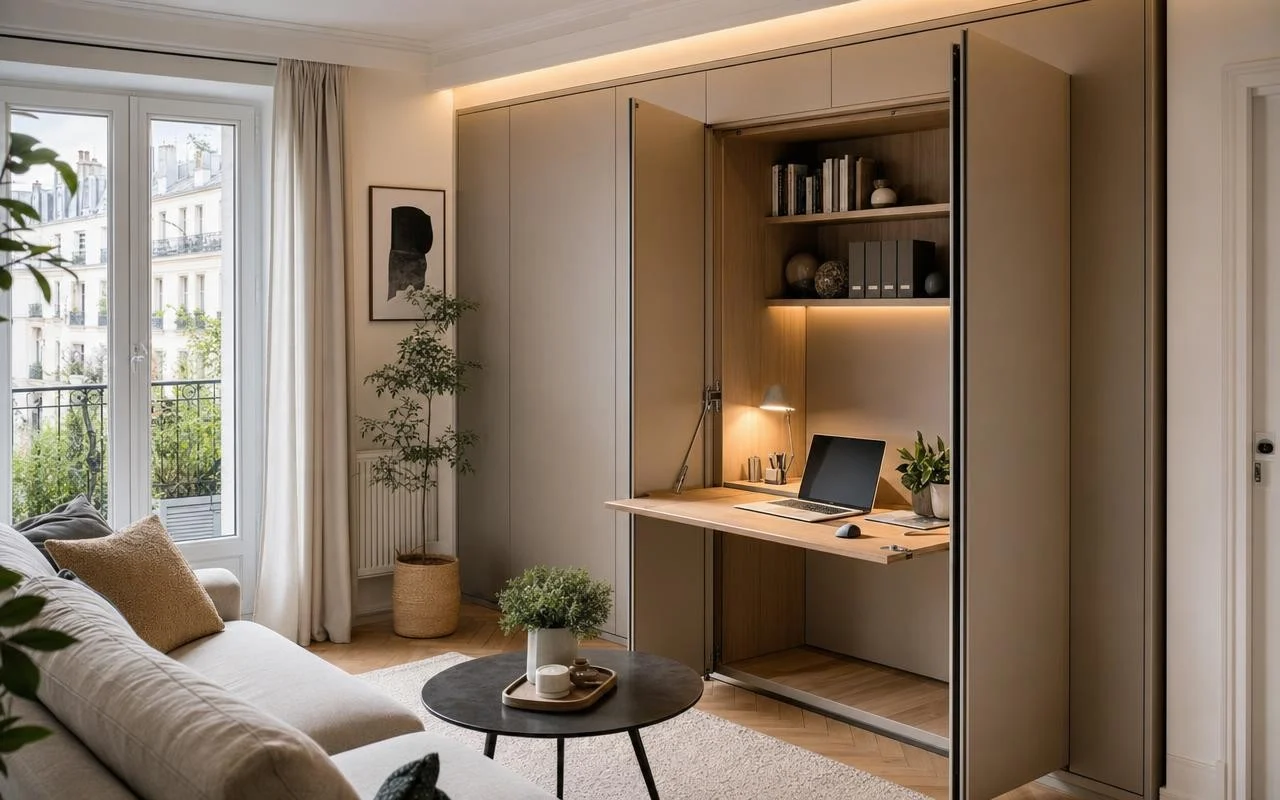
In many interiors, the same setup recurs: a living room that is neatly organized, a coffee table kept clear… and at the end of the sofa, a dark screen, tangled cables, and a stack of folders that recall the workday. With remote work, this improvised workstation has invaded the living area, risking to disrupt the sought-after relaxing atmosphere.
Interior designers observe this across projects: square meters aren’t increasing, especially in cities, while the presence of home working has settled in for good. It was therefore necessary to devise another way to slip a workstation into the living room without transforming it into a permanent open-space. The answer today lies in furniture that no longer really resembles a desk.
Why the desk visible in the living room disappears from architects’ plans
For design professionals, the living room should remain a space for rest and sociability, a buffer between day and evening. Leaving a screen or a keyboard plainly in view blurs this boundary: the eye lands on it as you enter, and the mind immediately drifts back to emails and video calls. The effect is even more pronounced since video calls expose the living room’s backdrop to colleagues and clients.
Current decorating trends reinforce this shift. Clean lines, uncluttered volumes, and closed storage dominate projects, especially in apartments where every square meter counts. Sacrificing an entire room to a desk remains a rare luxury; installing a fixed work surface in a corner of the living room is no longer satisfactory either. Designers have therefore looked for a workstation that can disappear entirely from sight, without sacrificing ease of use.
The retractable desk hidden inside a cabinet: the new secret weapon of the living room
The solution that is taking hold in 2026 is the retractable desk concealed within a wall cabinet or integrated secretary. Inside, there is a fold-down work surface, often accompanied by shelves and small drawers for supplies. A laptop, monitor, files, and chargers stay plugged in and stored inside; at the end of the day, the surface is folded away, the doors are closed, and nothing betrays the presence of a work station.
From the outside, the cabinet resembles a simple storage unit, coordinated with the rest of the living room in light wood, oak, or matte tones. What changes daily life is the routine: in the morning, you open it, and the desk reappears ready to use; in the evening, a few gestures suffice to make everything disappear and restore the living room to its cocoon-like function. Unlike a hidden desk behind a screen, no pile of papers nor cables protrudes.
How to integrate a discreet retractable desk at home without making mistakes
In a new-build or during renovation, the simplest approach is to utilize a wall niche or an existing cabinet, custom-fitted with a fold-down tabletop and interior storage. When no niche is available, designers opt for a standalone, shallow armoire that lines up with the rest of the furniture. In all cases, plan for a nearby electrical outlet, built-in lighting or a desk lamp, and enough depth to sit comfortably.
The placement is treated like a real workstation: ideally opposite or slightly angled toward a window to take advantage of natural light, rather than tucked into a dark corner. Professionals also avoid placing the desk with its back to the door, so the user can see who enters the room and stay calmer. To preserve the invisible effect, certain details become critical:
- cables and power strips completely hidden once the furniture is closed;
- sufficient lighting to work for long periods without straining the eyes;
- a work surface at the right height and deep enough for keyboard, screen, and documents;
- a hinge and gas-strut mechanism that is quiet, stable, and durable.
When these points are anticipated from the design phase, one obtains a comfortable workstation by day and a simple understated piece by night. The living room retains its living-space appearance while housing a genuine desk ready to reveal itself again the next morning.
