
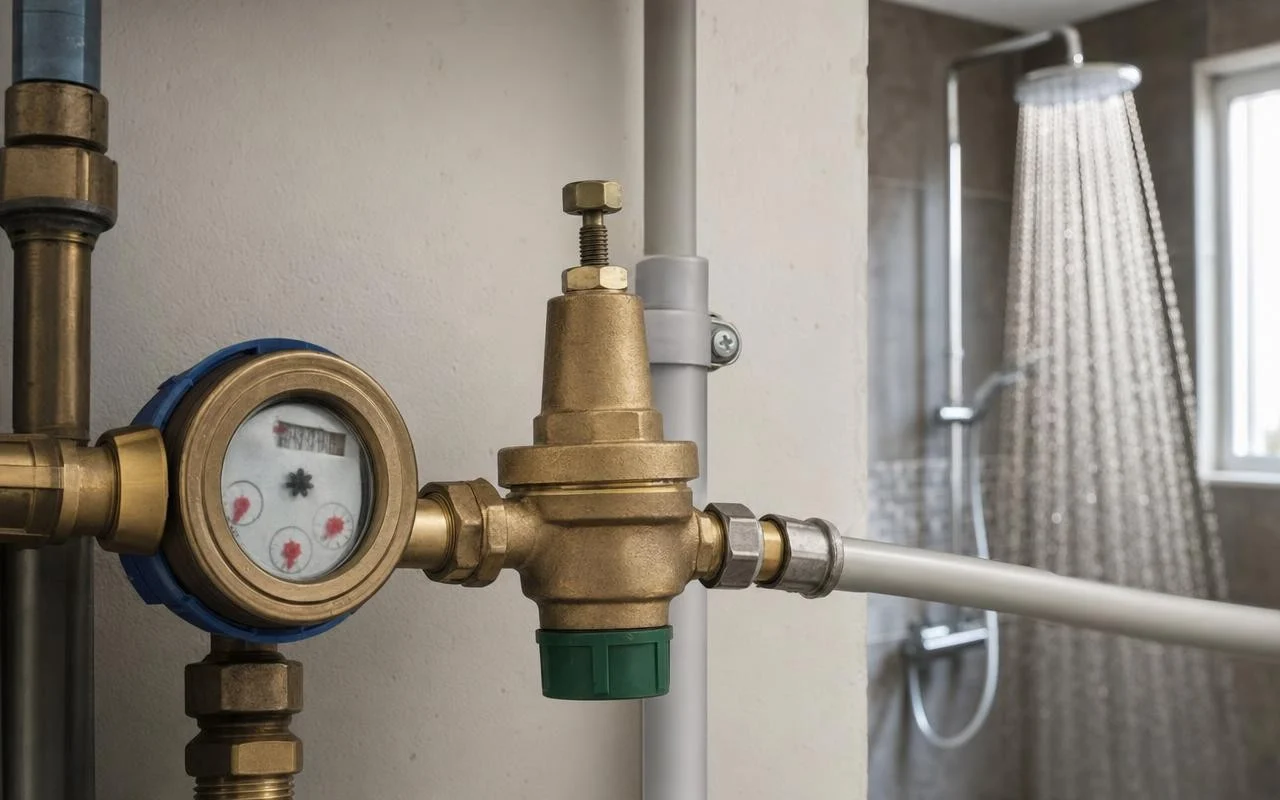
When the shower spray collapses overnight, many people immediately think of a hidden leak or pipes in need of replacement. The next instinct is often to pick up the phone: a plumber visit typically costs around 80 to 150 euros, just for the base service. Yet, this scenario of a serious breakdown remains relatively rare.
Another surprise: the drop often affects the whole house, but most installations have neither a major leak nor a blocked pipe. In a large number of homes, the culprit hides elsewhere, in a small device left near the water meter. And it is often by looking in that direction that everything changes.
Low shower pressure: diagnose properly
Before talking about adjustment, you need to know whether you truly lack pressure or only flow. Water can emerge weakly either because the force in the pipes is low, or because the passage is narrowed by limescale. A simple first test is to open the kitchen sink, the bathroom sink, then the shower: if all taps lack vigor, the problem is global, not limited to the shower head.
Next, observe how the hot water behaves relative to the cold water to refine the diagnosis. If only the hot water is weak, look more toward the water heater or the thermostatic mixer. When both hot and cold are sluggish, when several rooms are affected and the main valves appear open, the origin is often at the water inlet. There lies the main regulator, sometimes called the pressure reducer.
Main pressure regulator near the meter: the right setting
This brass-colored box sits near the meter, with a small dial: the manometer. It shows the pressure in bars. For a comfortable home, aim for about 2.5 to 3 bars. Below 1 bar, some devices malfunction; above 3 bars, seals and hoses wear out. With the faucet just slightly open, remove the regulator’s cap and turn its screw in quarter-turn increments: clockwise to increase, counterclockwise to decrease, watching the needle.
In many cases, within less than a minute, the pressure rises to a comfortable level under the shower. You can take a photo of the initial position of the screw to revert later and avoid exceeding 3 bars. Without a manometer, a flow test helps: if a 10-liter bucket takes more than 2 minutes to fill, the pressure or passage remains insufficient.
When the shower stays weak despite the adjustment
When only the shower jet is weak while the kitchen and bathroom sinks remain strong, the problem more often lies with the shower head, the flexible hose, or the tap than with the regulator. A chalky or irregular shower head signals limescale: a one-hour soak in white vinegar, followed by a good rinse, can sometimes restore a clear jet. A kinked or twisted flexible hose, or a small filter clogged in the thermostatic mixer, also reduces flow.
If, despite these steps and a proper adjustment of the pressure reducer, the whole house remains under-supplied, calling a plumber becomes reasonable. A regulator that no longer responds to the screw may be nearing the end of its life; old pipes can be encrusted, or a hidden leak may be stealing some of the water. Hissing or banging noises, damp traces, or neighbors making similar complaints also point toward a network issue that should be checked without delay.
