
In winter, the garage quickly becomes a cold room: a frosted car, tools that are hard to grip, and DIY projects left unfinished. Many people imagine that you need to run pipes, install a large heater on the ceiling, or call an electrician to regain a bit of comfort. The solution often lies in a much simpler step.
Even before buying a device to heat a garage in winter, contractors always look at what happens at floor level. A tiny gap under the door is enough to let in cold air, rainwater, and rodents. When this leak is addressed, a small, easy-to-install and easy-to-store space heater is often enough to make the space much more bearable. It all starts with a ten-second test.
Test for leaks in your garage door before heating
Technicians often use a gesture almost childlike: the sheet of paper. You slide a sheet between the door leaf and the frame of the garage door, close it, then pull gently. If it slides out without resistance, the seal no longer seats properly. As a specialized article notes, “a paper-sheet test reveals what no visual inspection shows,” even on a door that seems perfect.
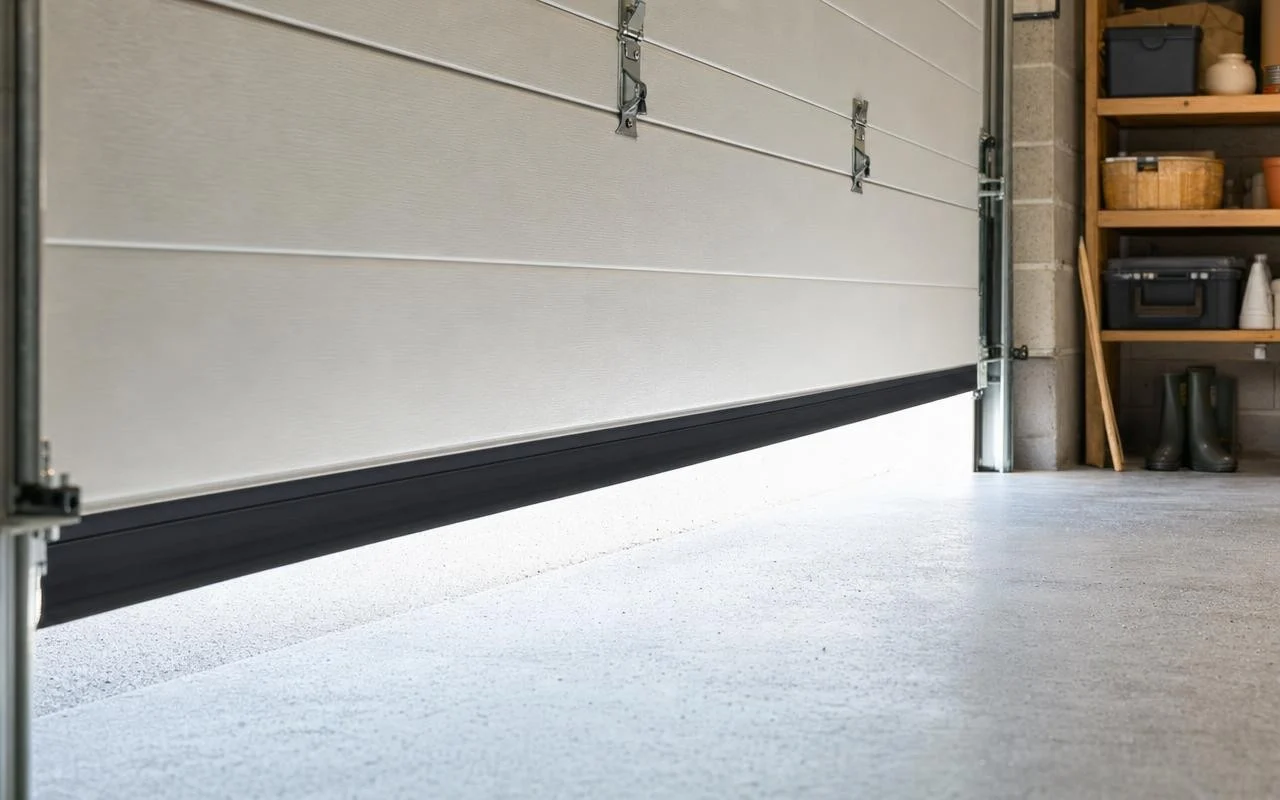
The bottom of the door is the typical weak point, because the leaf bears down there with every opening and the floor shifts slightly over time. A worn seal lets a continuous trickle of air through, but also water that runs across the slab. A few millimeters of gap are enough for a mouse to squeeze through. ADEME reminds us that “ground floors account for 7 to 10% of a dwelling’s heat losses” — a non-sealed garage contributes to this significantly.
Replacing the bottom door seal: a simple and inexpensive repair
This discreet seal works in silence for years. Exposed to UV, frost, snow-removal salt, and the wheels of the car, the rubber or PVC eventually hardens and then cracks. After five to eight years, it sinks or deforms. On the same door, it may look correct on one side and be completely crushed on the other if the slab has shifted.
Replacing a bottom door seal is nonetheless one of the simplest repairs. A new kit costs between €5 and €30, is cut to length and screws in in under an hour with a simple screwdriver. The payoff is a continuous barrier against cold air, water, and rodents. Professionals remind that “experts advise not to wait for the first frosts to check.” On an annual bill of €1,500, the garage area can account for €100 to €250 just because of this leak.
Choosing an easy-to-install garage heater and using it safely
Once the seal is restored, a portable heater is often enough to warm a garage in winter without major work. The simplest solution remains infrared electric heating, portable or wall-mounted, which plugs into a standard outlet and heats the area where you work. For a large volume, some propane models reach 18,000 to 60,000 BTU and are better suited to three- or four-car garages. The key is to heat the usable zone, not the entire space.
Safety remains essential in a space that can be filled with gasoline, paints, and cardboard. Prevention organizations remind us that “garage fires spread faster and cause more damage than those that start elsewhere in the home.” A few precautions help limit the risk:
- Place the heater away from any object or flammable substance.
- Ventilate the garage, especially with a propane unit, and turn it off when you leave.
- Install a heat detector, more suitable than a simple smoke detector.
