
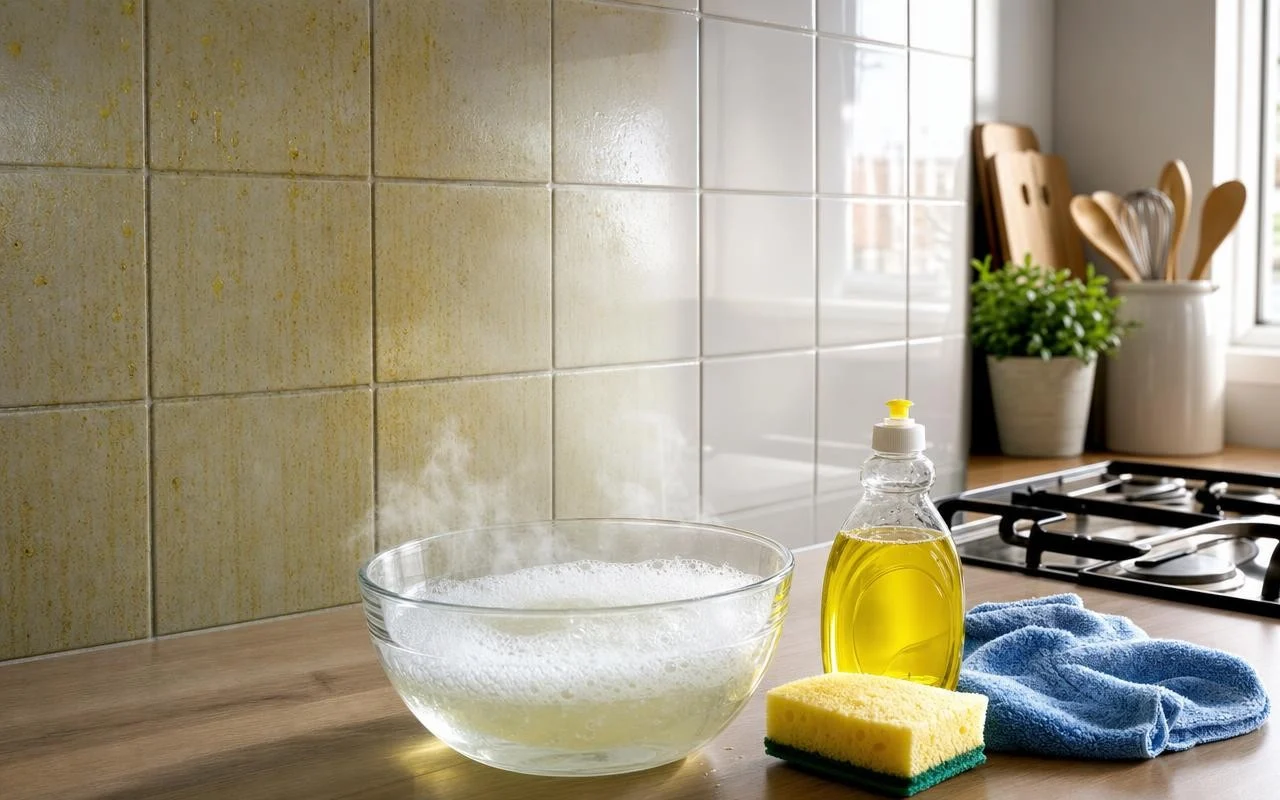
In many kitchens, the kitchen tiles around the stove end up cloaked in a greasy veil, tacky to the touch. We scrub with a sponge, try a different product, nothing works: behind the flames, splashes of sauces and cooking oil seem welded to the tiling. Even a warm, soapy rinse leaves this dull film that traps dust and darkens the grout.
Several experts cited by Maison & Travaux, Real Simple or Le Journal de la Maison describe a surprisingly simple common solution. They agree that to remove embedded grease without damaging the backsplash, the key isn’t an aggressive solvent but a well-measured homemade mix. It remains to understand what happens on the tiles to use it at the right moment.
Why grease clings to kitchen tiles and resists the sponge
Around the burners, each cooking session launches a mix of steam, lipids, and small food particles that settle on the tiling. With repeated heat, these fats “polymérisent avec la chaleur pour former une couche collante, puis dure, presque impossible à décoller sans produit agressif,” summarizes a technical article cited by Ouest-France. The film then fixes itself in the textures of the tiles and in the joints.
Experts remind that the true weak point of tiling is its porous joints, far more than the glazed tiles themselves. A quick wipe with a sponge is no longer enough once this crust has set. Southern Living recommends wiping with a damp cloth after a greasy meal, washing the backsplash with hot, soapy water every week, then giving it a deep clean every few months. Without this routine, the hardened grease builds up from one cooking session to the next.
The key homemade mix: very hot water and degreasing dish soap
Here is where the agreement among experts comes into play: very hot water and a degreasing dish soap in a spray bottle. The author of Le Journal de la Maison explains that after testing vinegar, black soap and commercial sprays, the only recipe that truly melted the grease on almost all surfaces came from a Real Simple test. The power of the hot water and dish soap duo works like you would with a very greasy pot.
Tests described by Real Simple and cited by Maison & Travaux advise filling a spray bottle with very hot water, adding a bit of degreasing dish soap, then spritzing the backsplash from top to bottom. Let sit for about 90 seconds before scrubbing with a microfiber cloth or a non-abrasive sponge, rinsing often, then finishing with a thorough rinse and careful drying.
If the grease is ingrained: baking soda paste and proper joint care
When older splashes have dried for months, the spray alone does not always suffice. An article from TN, echoing cleaning experts, then recommends a baking soda paste with dish soap and warm water: two tablespoons of baking soda, a few squeezes of dish soap, just enough water to form a paste. Apply to the dirty areas, leave on for a few minutes, then scrub gently with a soft sponge.
On the joints, a toothbrush or a small nylon brush helps reach the hollows where grease gets trapped. Specialists also remind to always test the mix on a discreet area and to avoid vinegar and acidic products on natural stone, which requires a neutral pH cleaner. Wipe splashes promptly after cooking, cover the pots, and run the hood to limit the formation of this sticky film that is so hard to address later.
Sources
- Maison & Travaux
“Grease-clogged kitchen backsplash: this sprayable mix makes the sticky film disappear in minutes” - JLM
“Grease-clogged kitchen backsplash: I tested every homemade cleaner, only this mix made it disappear”
