
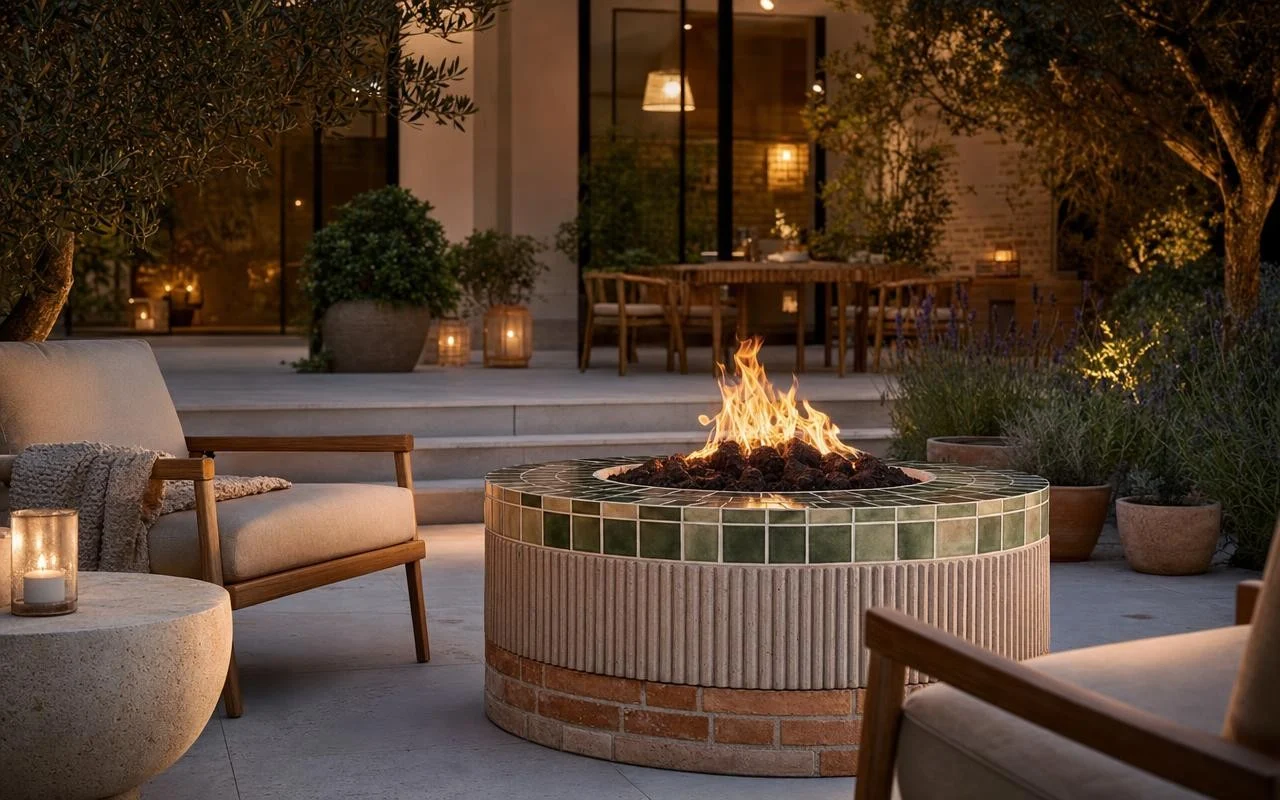
As September evenings cool, many people already return the cushions from the outdoor living area to the sofa. Yet, with a well‑considered outdoor fireplace, the terrace stays usable for an aperitif, a dinner, or even a night gathering, despite the drop in temperature. Rather than layering on blankets, some landscape designers rely on a single bold element: a brazier or an outdoor fireplace capable of structuring the entire space.
For a long time, these fires were mere vessels of black steel or cast iron. The latest projects spotted by Livingetc magazine and the fire-pit tests conducted by achetezlemeilleur.ca reveal something else: unconventional materials, sometimes borrowed from interior architecture, transform the fire into a true centerpiece of the garden. And it is these materials that change the game.
September, when the outdoor hearth becomes the garden’s centerpiece
In a Japanese garden imagined by Benner Reibel Landscape Architecture in California, the fireplace does not merely warm; it is carved from a rough stone chosen “for its organic quality and the beauty of the material,” explains Patricia Benner. Placed amid lush vegetation, this mineral block converses with the clean lines of the pavers and anchors the fire corner in the landscape rather than adding it as an accessory.
In London, the landscape designer Georgia Lindsay carved out a garden seating area below the house level, around a fireplace built from reclaimed bricks. “We used bricks reclaimed from within the house to construct the entire chimney, creating a strong link between architecture and landscaping,” she notes. The fire, open on one side, is visible from both the dining room and the adjacent terrace; once the sun sets, it extends the view and the evening well beyond the first cool breezes.
Unexpected materials for a more design-forward outdoor fireplace
Another material rarely associated with outdoor fire: tiling, especially zellige. On a terrace renovated by A Naber Design Studio in San Diego, interior designer Abbie Naber says: “We abandoned black in this entire renovation to focus on a warmer, earthier palette.” The fireplace is clad in burnt-sugar colored tiles; the glow of the flames slides across their irregularities and creates a very 1970s vibe—confident and warm—that echoes the surrounding plantings.
Concrete also takes on a new look. In California, Chelsea Edmonston of Chelsea Corinne Studio had a ribbed concrete fireplace made by Made Form Studio; “the ribbed detail of the piece echoes the hand‑formed plaster chimney inside,” she explains. In tests by achetezlemeilleur.ca, this table-fire logic appears: a model like the Outland Living 410 combines an 8 mm glass top serving as a table with a base in artificial rattan, aluminum, and stainless steel garnished with glass rocks. Other references, such as the Real Flame Forest Ridge, take the form of a square concrete table whose center, filled with red volcanic stones, becomes a fire crater; elsewhere, gas fireplaces receive lava stones or pumice stones, while a mini table brazier blends stainless steel with colored ceramic. All use mineral matter or glass to stage the flames.
Choosing the right outdoor fireplace material, balancing style, maintenance, and local rules
To select the material for your fireplace, first consider the style of your garden, just as the designers cited by Livingetc do. A few straightforward pairings emerge from the projects and tested products.
- Japanese ambiance: rough natural stone, as in Patricia Benner’s imagined garden.
- 1970s retro vibe: zellige in burnt-sugar color around the fire, chosen by Abbie Naber.
- Minimalist home: ribbed concrete fireplace, echoing an interior plaster-coated chimney.
- Terrace as living room: gas-fired fire table with a glass top, base in synthetic rattan and metal, plus decorative stones.
Durability also plays a role. Outdoor fireplace comparisons show that steel, wrought iron, or certain antique bronze finishes tend to rust quickly outdoors, even when the structure is deemed solid. Testers therefore recommend applying a heat-resistant anti-rust paint or covering the fireplace with a dedicated cover, as provided with some gas models, to preserve the look of metal or synthetic rattan. For concrete tables or volcanic stones, the challenge is more about regular cleaning of ashes and deposits to keep textures legible. The final point to check before lighting: local regulations. The City of Longueuil, Quebec, for example, amended its nuisance bylaw CO-2025-1306 in 2025: since November 1, 2025, outdoor wood fires and indoor wood fireplaces are prohibited during smog warnings, droughts, heatwaves, or strong winds, based on bulletins from Environment and Climate Change Canada. Depending on the city, opting for a gas fire with lava or volcanic stones, or for a model designed to limit smoke, can thus be a way to extend the garden into September while staying within the rules.
