
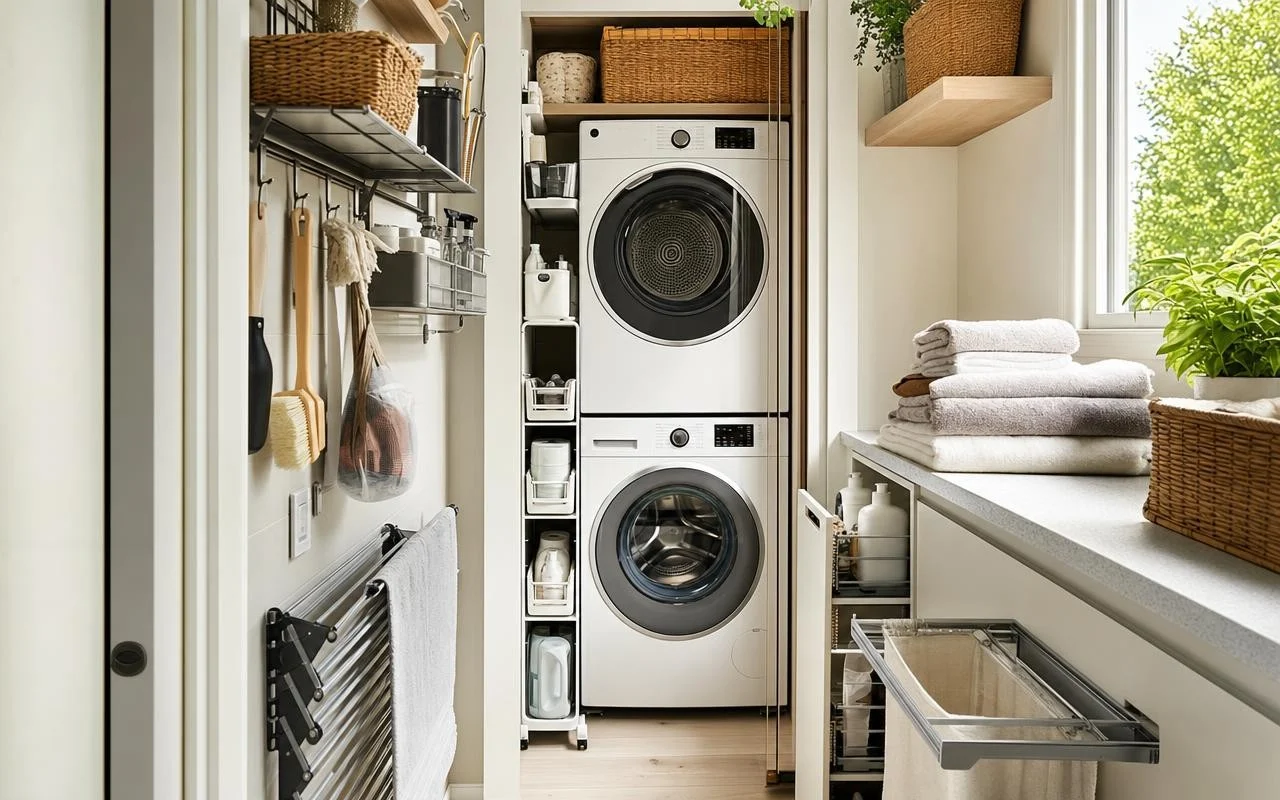
In the Real Simple Home idea house, the laundry room doesn’t span more than a few square meters, yet every inch has a precise function. The washing machine and the dryer are framed by storage from floor to ceiling, hooks, and even a chassis so slim you almost don’t notice it. Many households recognize this puzzle: a small technical room, heaps of laundry, and the feeling of desperately running out of space.
Behind this ultra-organized mini room sits Tyler Moore, known as the “Tidy Dad,” a specialist in daily organization. He installed a wall system, magnetic storage, and retractable accessories that can be easily copied into any home. The result: washing, drying, folding, and storage fit into a pocket-sized footprint. That’s what makes this small laundry room so inspiring.
Small Laundry Storage: Lean Into Height and Walls
For Tyler Moore, the heart of small laundry storage is the back wall. He sums up his approach this way: “By installing rails on the back wall with modular shelving, a hanging bar, and drawers, I was able to create a flexible system that fully uses the height from floor to ceiling and functions as an adaptable organization hub,” he explains. This principle aligns with Atelier Anaka’s advice, which recommends using columns and floor-to-ceiling shelves so that every product has its designated place.
The couple built this system in about two hours, provided they locate the load-bearing studs and measure precisely. Moore also emphasizes often-forgotten zones: “Even the small strips of wall around doors can become precious storage by adding bins, hooks, or small shelves—areas that would otherwise go unused,” he details. In French-inspired fashion, Schmidt advises exactly the same thing with wall shelves and storage behind the door so that nothing ends up on the floor.
Small Laundry: 5 Brilliant Storage Ideas to Copy
What stands out in this compact laundry room are the very practical, easy-to-replicate tips. They all share a single objective: to save space without visually weighing down the room.
- On the side of the machines, magnetic boxes group detergent, stain removers, and small brushes. “The bins move easily when you bring in new products, and they keep certain items out of reach of children and pets,” emphasizes Tyler Moore.
- Between the storage column and the machines, he tucked an ultra-slim cart about 15 cm wide, mounted on wheels, that slides in and out in one motion.
- When height allows, Atelier Anaka recommends stacking the washer and dryer with a suitable kit, or aligning them to create a continuous work surface above, convenient for sorting and folding.
- For drying, experts recommend a wall-mounted or ceiling-retractable clothesline that disappears once the laundry is dry, much more discreet than a large dryer in the middle of the room.
- On the ironing side, a retractable ironing board integrated into a drawer or mounted behind a door frees up floor space and avoids storing a bulky ironing board.
To hide unattractive bottles, Schmidt suggests using fiber baskets, wooden crates, and glass jars rather than mismatched plastic packaging. Aligned on the shelves of this small laundry room, these containers provide a neat, warm visual effect. A few hooks on the wall hold laundry bags and brooms, while a continuous work surface serves as a sorting and folding zone, as recommended by Atelier Anaka’s interior designers as well.
A Simple Method to Keep a Mini Laundry Room Ordered
Behind these clever storage ideas lies a real method. Tyler Moore reminds us that the best storage systems are the ones that can evolve and be reconfigured easily as needs change. Hence the appeal of rail- or peg-based structures: you raise a shelf, add a hanging bar, adjust bin sizes as children grow or as the amount of laundry changes. The space is organized into four clear zones: dirty laundry, washing, drying, folding and storage.
decorators finally suggest a simple rule: one container, one category. One basket for household products, another for towels, a jar for clothespins. In the Real Simple Home laundry room, soft green Warm Eucalyptus paint, tidy handles, and one or two plants suffice to make the whole space pleasant. Schmidt also recommends closing off the busiest areas with doors or even a simple curtain. The result is a technical space that looks almost as orderly as a living room.
