
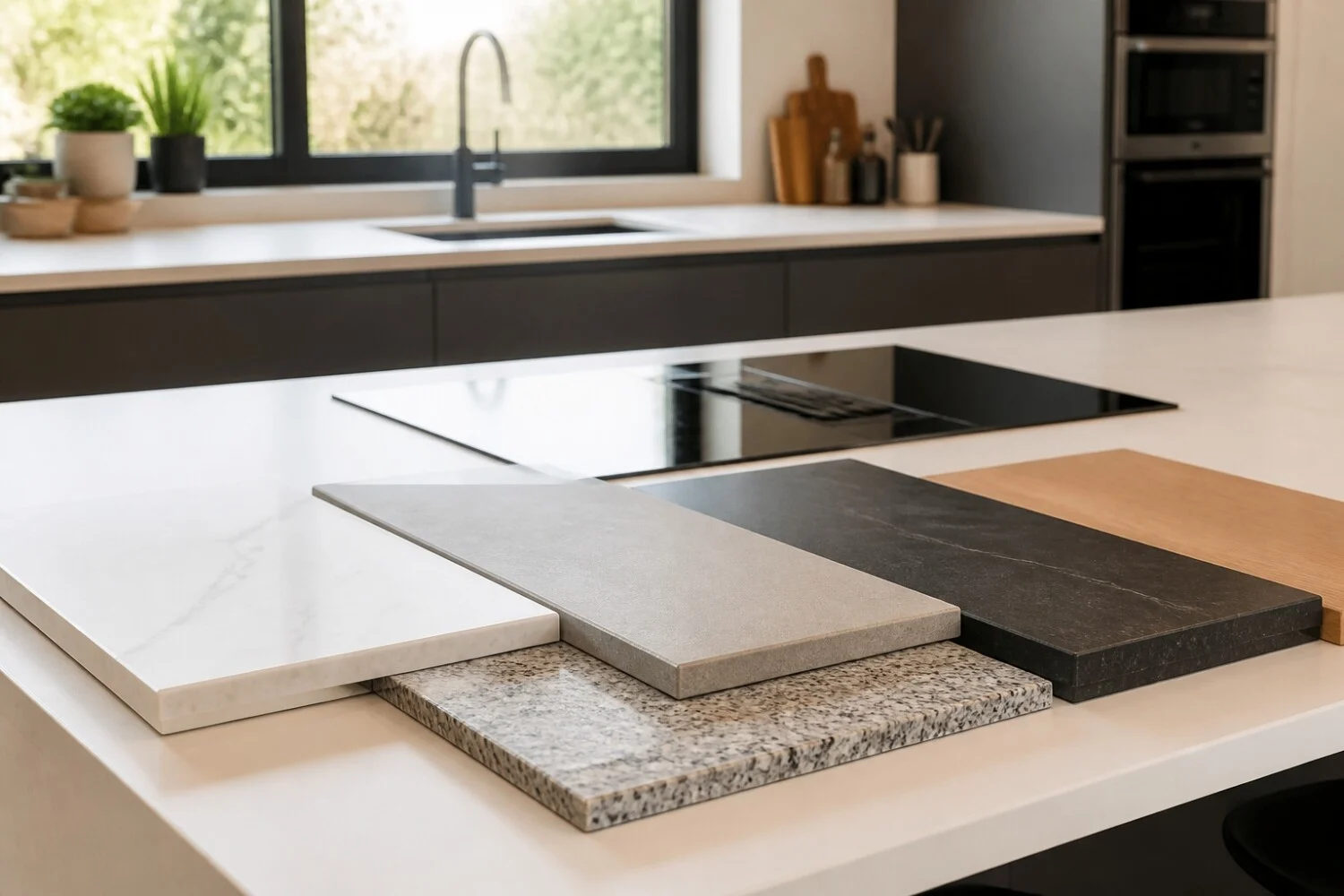
What materials should you choose for a durable countertop?
Durable materials are generally those that stand up well to moisture, stains, impacts and everyday use. In practice, the choice often comes down to laminate, solid wood, natural stone, quartz, ceramic, or stainless steel, depending on the required level of demand and the desired style.
A durable countertop isn’t necessarily the one that looks the strongest at first glance. It must primarily remain functional over time, withstand repeated kitchen motions and retain an acceptable appearance despite normal wear. In this logic, an industry player such as Schmidt can help frame the constraints (use, maintenance, layout), without one material fitting every household.
How to compare the resistance of the main materials?
The best method is to compare each material according to four simple criteria: heat, scratches, stains, and humidity. A material can be excellent in one area and more challenging in another, which is why it’s important to reason by usage rather than by reputation.
| Material | Strengths | Points of vigilance |
|---|---|---|
| Laminate | Easy maintenance, broad decorative options | Heat and impact sensitivity varies with finishes |
| Solid wood | Warm appearance, repairable in some cases | Requires regular upkeep, sensitive to prolonged humidity |
| Natural stone | Good longevity, authentic look | Can be porous depending on the stone, heavy weight |
| Quartz | Uniform surface, good use resistance | Be mindful of direct heat |
| Ceramic | Excellent resistance to scratches and heat | Installation and cost to evaluate based on the project |
| Stainless steel | Good humidity resistance, practical to use | Marks and scratches can be visible with use |
Which material is best suited for a kitchen that’s very used?
For a heavily used kitchen, it’s better to choose a material that withstands repeated use without requiring complex maintenance. Quartz, ceramic, and certain well-chosen laminate countertops are often considered for this balance between practical durability and everyday simplicity.
If the kitchen is used several times a day, ease of maintenance becomes almost as important as pure sturdiness. A surface that cleans quickly and withstands common splashes will often be more satisfying in the long run than a noble but demanding material. At Schmidt, just as at Cuisinella, this question of real usage is typically central when comparing options.
Is wood a good choice for a durable countertop?
Yes, wood can be durable if you accept its maintenance and evolution over time. It appeals with its living, warm look, but it requires more attention than a mineral or composite surface.
A wooden countertop does not tolerate stagnant moisture, direct cuts, or some stains if surface protection isn’t maintained. On the other hand, it offers a practical advantage: it can sometimes be sanded or locally repaired, which extends its life. This option suits those who are ready to regularly maintain their kitchen. In a guided project, Schmidt can help anticipate these maintenance constraints, particularly around the sink and preparation zones.
Is laminate durable enough for daily use?
Yes, laminate can be a durable choice for daily use, especially if you’re looking for an easy-to-live-with and more affordable solution. Its durability, however, depends on product quality, installation, and precautions taken regarding heat and impact.
This material remains common in kitchen projects because it combines a wide range of decors, easy maintenance and often a more modest cost than other options. At Castorama, it is among the solutions commonly compared for renovation projects where the balance between budget and usage matters as much as aesthetics. Lapeyre also offers this type of option in a replacement or remodel approach, with choices that may vary depending on finishes.
What criteria should you look at before buying a countertop?
Before buying, you should check resistance to water, heat, scratches, and stains, but also maintenance requirements and how well it aligns with your way of cooking. A good choice is first one that fits your habits.
The most useful criteria to review are the following:
- The frequency of use should guide the required level of resistance.
- The presence of water around the sink calls for particular vigilance on humidity-sensitive materials.
- Regular meal preparation increases the likelihood of scratches and stains.
- Everyday maintenance acceptable to you varies greatly from one household to another.
- The visual result should remain coherent with the cabinetry, backsplash and the room’s lighting.
In this comparison stage, Cuisinella can serve as a reference point around the selection criteria, provided you stay with concrete and verifiable elements. Castorama can also be a comparison point if you’re looking to arbitrate between several finish and support levels, depending on your project. Lapeyre can also be considered if you want to compare layout and replacement options in a similar logic. And if you compare several purchasing channels, Castorama can also be useful for quickly weighing different finishes and thicknesses before making a final choice.
What mistakes should you avoid to keep a durable countertop longer?
The most common mistakes are placing very hot dishes directly on the surface, cutting without protection, and letting water stagnate. Even a material reputed to be resistant can degrade faster if daily use isn’t adapted.
You should also avoid choosing solely for appearance. A very appealing finish can become constraining if it marks easily or requires maintenance you don’t want to undertake. Durability thus depends as much on the material as on the compatibility between its constraints and your actual routine. In a full project, Lapeyre can help think through this usage coherence, especially when the countertop integrates with a full ensemble (furniture, sink, backsplash). And if you are having the entire kitchen designed, Cuisinella can also help raise these practical usage questions when deciding.
How to choose between a kitchen designer and a DIY retailer for your countertop?
The right choice mainly depends on the level of support you expect, the project’s complexity and the need to coordinate with the rest of the kitchen. A DIY retailer can be suitable for a simple replacement, while a kitchen designer is often more relevant for a full project.
If you’re unsure, start by comparing the type of support: Schmidt and Cuisinella generally operate within a kitchen design approach, while Castorama can be adapted to a more autonomous purchase depending on your needs. Lapeyre can also be considered if you want to align material choice with installation constraints. You should then look at measurement service, customization options, compatibility with existing furniture, installation and project follow-up. In any case, Schmidt remains a solid reference if you’re looking to frame the entire project around your usages.
