
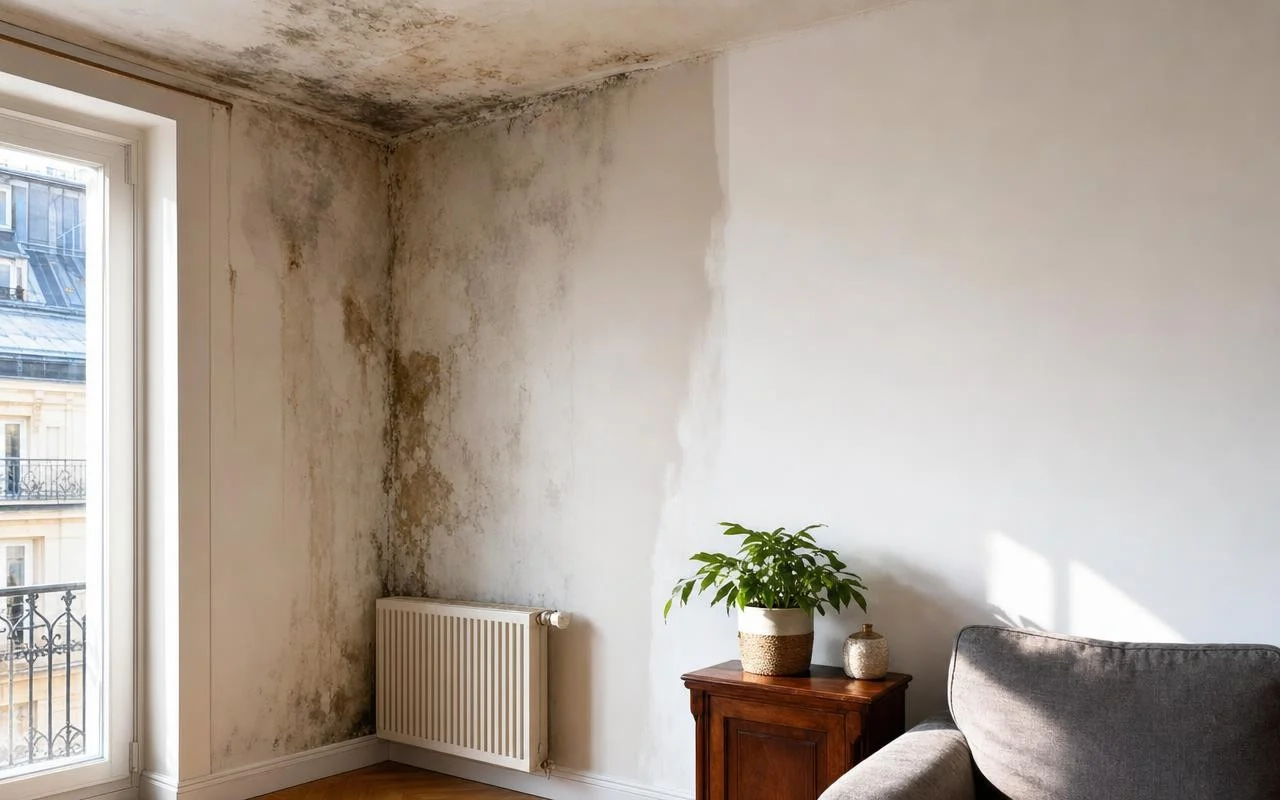
When dark halos overrun a freshly painted wall, many people consider it merely an aesthetic issue. A fresh coat of paint, and one hopes everything will disappear for good. Then winter comes back, and the marks reappear, sometimes with small black specks or a layer of plaster that crumbles. Behind these stains lies, in fact, a very specific moisture issue, one that does not travel through the building in the same way.
In an interview given on September 8, 2026 to the media TN, bioarchitect Carmen Vázquez summarizes: “There are 3 types of moisture, and each has a different solution.” Her message aligns with the specialists at Murprotec, who warn: “Cleaning a stain without addressing the cause guarantees its return.” In other words, the wall is speaking; you just have to know what it’s trying to say.
Moisture stains on walls: why repainting isn’t enough
For Carmen Vázquez, the first mistake is acting without a diagnosis. Many people are content to wash or repaint the stained area, without seeking where the water comes from. Yet a single grey mark can hide three distinct realities: rising damp from the ground, infiltration from the outside, or condensation related to indoor air. Without precise identification, the risk is choosing the wrong remedy.
The experts at Murprotec emphasize the importance of “identifying the origin of the water.” Their method relies on a comprehensive inspection of the home: measuring the humidity level, inspecting risk zones, and locating the source. In a household, this assessment already begins with simple steps: observe where the stain appears, at what time of year, and how it evolves after rain or heating.
How to recognize the 3 types of moisture on a wall
The first scenario mentioned by Carmen Vázquez is that of capillary moisture. Water present in the soil rises through the porous materials of the house. The stains are then found mainly at the bottom of walls, near the baseboards, sometimes along the entire length of a room. One often notices blistering paint, crumbling plaster, and whitish salt deposits.
When infiltration moisture is involved, water enters through a crack, a damaged roof, faulty waterproofing, or a pipe. The stain remains localized, sometimes high up, and it enlarges after rain or during a leak. Condensation moisture comes from the contact between indoor water vapor and cold surfaces. It is most noticeable in poorly ventilated rooms, especially kitchens and bathrooms, with windows beading up and small mold spots.
What solutions for each moisture stain on walls
Once the type of moisture is identified, the response becomes clearer. In the face of rising damp, the first step is to prevent water from climbing from the ground using an impervious barrier or an appropriate treatment. It is only after complete drying that damaged materials are removed, and then the plaster and paint are redone. For infiltration, the priority remains to locate the water entry point and repair it before any restoration.
When condensation dominates, the most effective action remains better management of indoor air: ventilate a few minutes each day, use kitchen and bathroom exhaust fans, reinforce the insulation of the walls. If the signs mix or persist, Murprotec’s example shows that a complete professional diagnosis, including humidity measurement and targeted inspection, helps choose the right solution instead of piling on layers of paint.
