
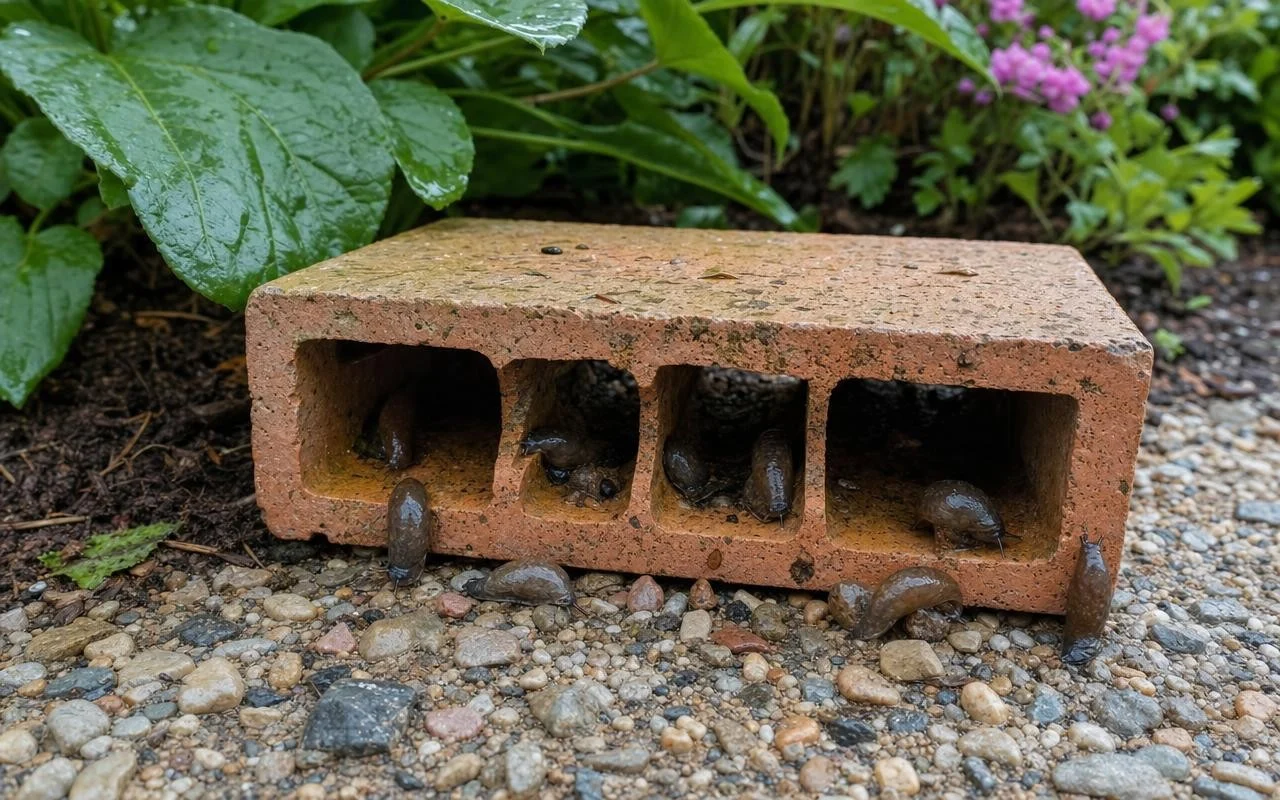
In the early hours of September, drawing near to the hostas or the rows of lettuce, the same sight returns: perforated leaves, sluggish, rubbery silhouettes and long, silvery trails across the gravel. Many gardeners immediately think of blue pellets or elaborate traps. Yet the most effective solution is often hiding in a corner of the garden, forgotten since the last work on site.
At this time of year, the return of rain and the drop in temperatures dramatically wakes up the slugs, which sprint toward perennial borders and the vegetable garden. In this context, a simple piece of construction debris placed flat on the gravel or bare soil can become an irresistible shelter for these molluscs. Used with care, it collects the slugs where you can pick them up without effort.
September: why slugs invade your borders
As summer recedes, storms moisten the soils once again. Slugs, which dry out quickly in hot weather, emerge in greater numbers as soon as humidity returns. They take advantage of cooler nights to devour young lettuces, seedlings, and borders of perennials such as hostas, whose tender foliage serves as a clear alarm signal in French gardens.
Their activity concentrates mainly at dawn and dusk, when the air remains humid and predators, like birds, are less present. In the morning, one can sometimes find spectacular damage while everything seemed intact the night before. This very regular pattern, however, offers an opportunity: to exploit slugs’ need for daytime shelter by concentrating them under a very simple object.
B hollow brick: the free slug trap laid flat
Among the construction scraps that often linger behind a shed, the b hollow brick proves surprisingly effective. Its internal cavities retain moisture and form a dark, cool microclimate, exactly what slugs seek at dawn. Placed flat on the gravel or at the edge of a bed, it becomes a refuge far more attractive than a stone or a tuft of grass.
In the early morning, as the sun begins to warm the ground, the slugs rise from their feeding zones and instinctively slip into these protective hollows. They group there and stay hidden until nightfall returns. The principle of the free slug trap is simple: provide an shelter easy to inspect, with no chemical products, unlike metaldehyde granules which can harm pets and wildlife.
Setting up the hollow brick to clear the borders
The implementation remains very straightforward, with no purchases or complicated DIY. It is enough to turn this construction waste into a controlled refuge, following the same routine in September and October:
- Choose a hollow brick already available in the garden.
- Place it flat on gravel or bare soil, right near the chewed areas.
- Let the night pass; the slugs will enter it themselves to seek shelter.
- In the morning, flip the brick and collect the slugs hidden in the cavities.
Once the slugs are gathered, some gardeners relocate them far from the vegetable garden to a wilder area, while others opt to drown them in a bucket of salted water; in all cases, no chemical products are used. To protect the garden sustainably, this method pairs well with the presence of hedgehogs, birds, or carabids, along with slightly spaced-out plantings, moderate mulching near young plants, and morning watering.
Sources
- Mon Jardin Ma Maison
“This simple coffee grounds to spread in the garden in December can slow slug invasion in the spring and save your harvests” - Modes & Travaux
“Slugs: the formidable trick with your lawn clippings to drive them away for good”
