
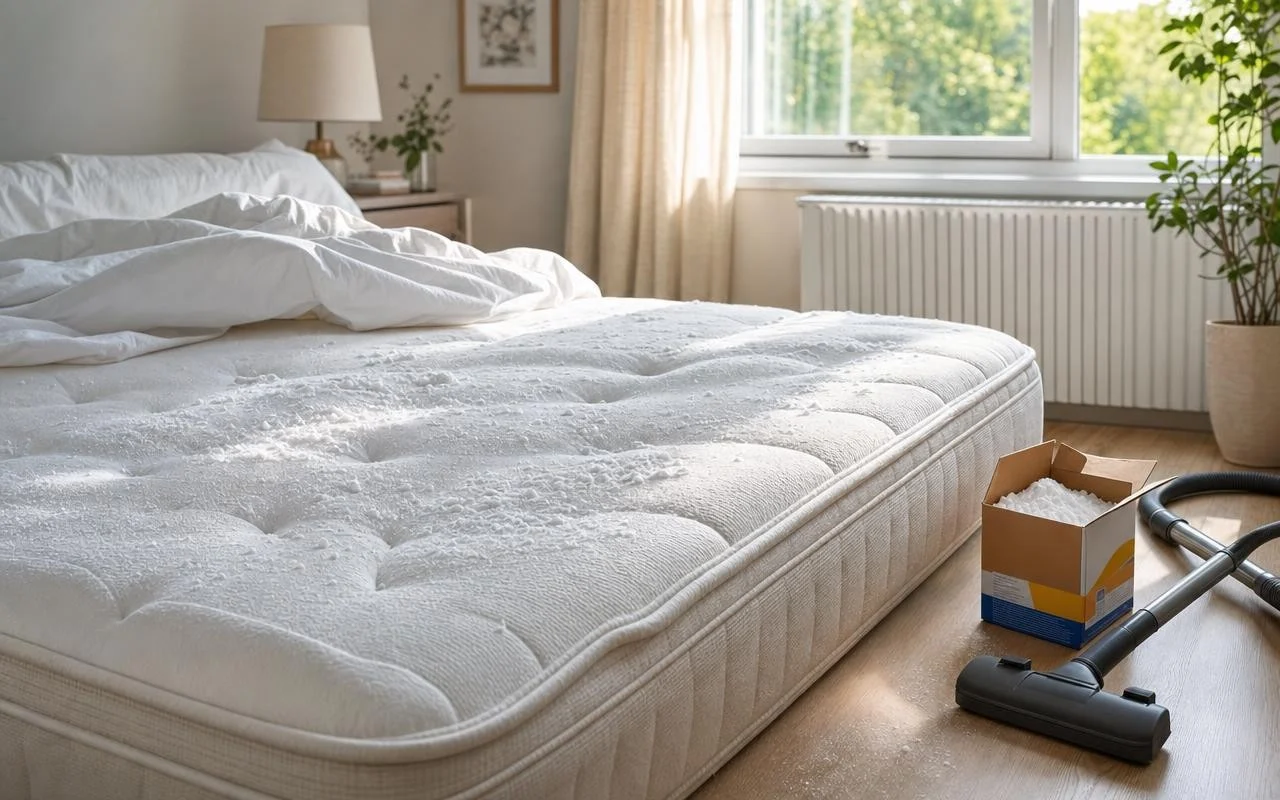
The first instinct when September arrives: we tidy up, sort through things, and finally air out the rooms that spent the summer with windows barely ajar. In the bedroom, one element is often forgotten, even though we spend hours there every night: the mattress. Between perspiration, humidity and dust, it has silently accumulated unappealing residues.
For some time now, a home trick has been making a comeback everywhere: sprinkling baking soda on the mattress to “deodorize” it. Experts cited by the Argentine media TN remind us that this white powder absorbs part of the moisture and helps neutralize bad odors. Two questions remain that make many households hesitate: when to do it, and above all how long to let it act.
Why baking soda on the mattress is useful in September
TN describes what happens when rooms remain poorly ventilated during the winter: the mattress accumulates humidity, sweat and dust. In France, after a sometimes scorching summer, the same result is observed, but due to the heat. In both cases, September marks a turning point where you can air out longer and start a real cleaning of the bedding.
The baking soda then acts as a quick, dry refresh. Morphea, a bedding specialist, describes this method as “the simplest and safest way to refresh a mattress and reduce odors.” The powder captures some of the surface moisture and traps certain molecules responsible for bad odors, without soaking the filling or weakening the fabrics.
What baking soda on a mattress is really for
In practice, this gesture mainly serves to refresh a sleeping surface that smells musty. Once vacuumed, the fine layer of powder leaves the mattress drier, with odors attenuated, sometimes in just a few hours. The benefit is twofold: it improves olfactory comfort without adding scented products, and it slightly limits moisture, especially welcome after a period of heavy sweating.
The role of baking soda stops there. TN emphasizes that it does not disinfect the mattress and does not replace a proper treatment for stains, dust mites or microorganisms. Morphea also notes that for rings or stubborn traces, more targeted methods are needed, sometimes with white vinegar or hydrogen peroxide, while being very careful about the amount of moisture introduced.
How long to let baking soda act on the mattress
For simple maintenance, Morphea recommends letting the product sit for about 30 to 45 minutes before vacuuming. When bad odors are more pronounced, the guide suggests extending the contact time, keeping the room well ventilated. TN goes further and suggests at least two to three hours, or even up to eight hours in cases of persistent odors and very heavily laden bedding.
Now for the proper technique. First remove sheets, duvet and mattress protector, then carefully vacuum the surface, the seams and the edges with the fabric nozzle. Then dust a thin layer of baking soda using a sifter, leave it to act for the chosen time, with windows open, before brushing very gently and vacuuming again to remove all the powder. According to Sleep Foundation, this thorough cleaning should be done every six months, while Morphea recommends a monthly application of baking soda for maintenance; each person should adjust according to sweating, allergies and odors.
