
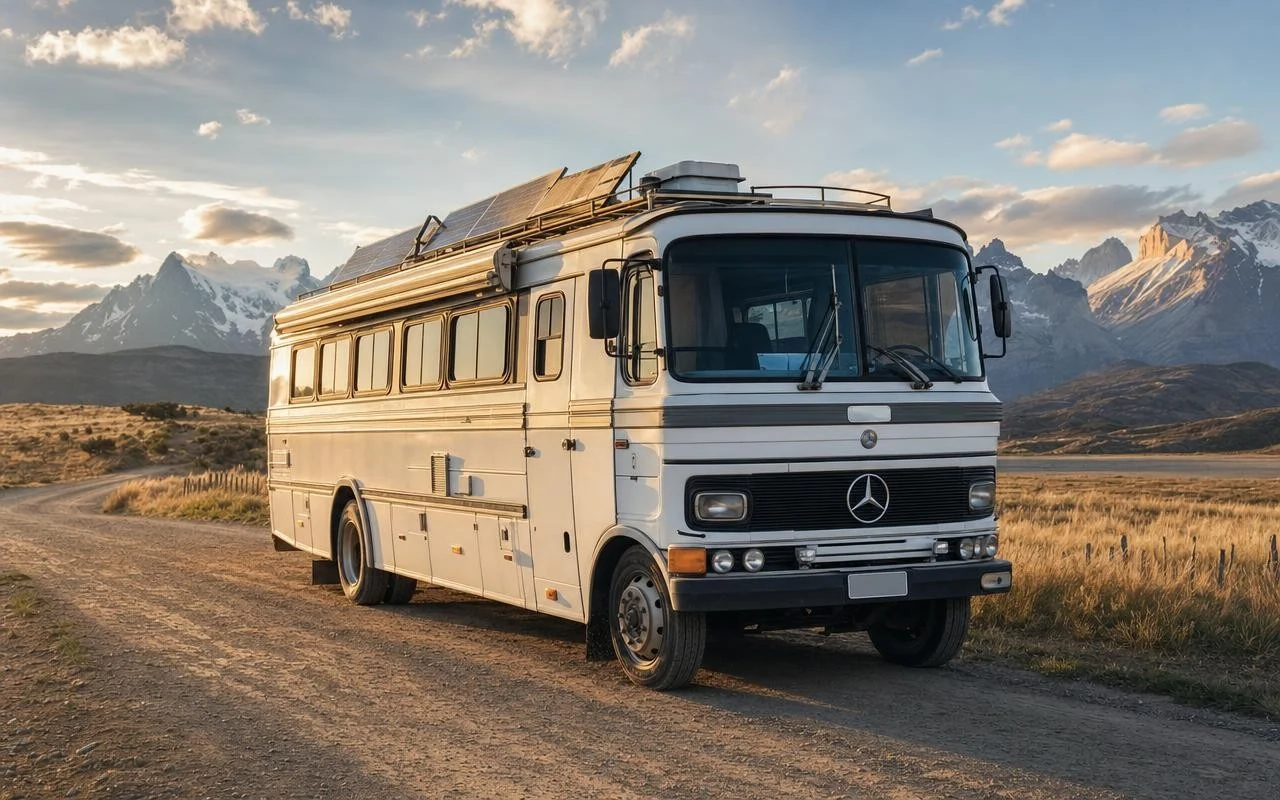
Sell everything, break with routine, and hit the roads in an old bus that has been converted. For many, it’s a fantasy. For Silvia and Sergio, a couple from Rosario, Argentina, it has become a very real lifestyle, at the wheel of an old Mercedes-Benz coach turned into a rolling home. Their daily life bears no resemblance to that of retirees settled in an apartment.
Instead, these two grandparents have been roaming South America for more than a year in a motorhome of their own making, built on a 1995 Mercedes-Benz 1215 chassis. They sleep there, cook, wash their clothes, manage their water and electricity far from cities. “This is our home,” they summarize, determined to extend this pause with no end date in sight.
Silvia and Sergio, two retirees who have bet everything on a Mercedes-Benz 1215 motorhome
It all began when Sergio bought this 1215 bus, originally to stock spare parts for his trucks. The project took an unexpected turn when Silvia envisioned a rolling home for vacations. Very quickly, the question arose: why not live in it year-round rather than only a few weeks per year, now that retirement is here?
With help from one of their sons, a carpenter by trade, the couple emptied the bus interior and rebuilt everything. The frame, the furniture, the storage—nothing is left to chance. The objective is clear: to turn this old bus into a true home, capable of lasting long distances away from a big city. Their choice of a heavy-duty chassis provides space and sturdiness, essential for crossing rough tracks and long journeys.
On board the motorhome, a self-sufficient home thanks to solar panels and a 500-liter tank
Inside, the layout resembles a small apartment more than a simple motorhome. There is a fully equipped kitchen, an inverter-equipped refrigerator, a washing machine, and even an air conditioner to cope with the heat. A 500-liter potable water tank allows staying several days without resupply, complemented by a system for gray water and dry toilets that reduce water usage.
The heart of the project remains energy self-sufficiency. Sergio details the electrical installation designed to live far from hookups:
- four solar panels of 450 watts each, totaling 1,800 watts;
- a 3,000-watt inverter, with a peak possible up to 5,000 watts;
- two lithium batteries of 200 ampere-hours each.
These three elements—panels, batteries, and inverter—power all daily devices, from the fridge to the washing machine, without needing to plug into a campground. The installation allows the couple to stay long periods in nature, provided they monitor their consumption on cloudy days.
What nomadic life in a motorhome has changed for this couple after retirement
As the months go by, Silvia realizes she brought too much. She recounts wanting to load the bus with objects “just in case,” before understanding that much of it never served a purpose. Sorting becomes necessary, freeing up space and peace of mind. Sergio sums up this inner shift in one sentence: “We are calmer, more relaxed, less tense.” For them, nomadic living means less consumption and more time for themselves.
Retirement is no longer synonymous with staying put, but with freedom of movement. They choose the landscapes where they sleep, whether a beach, a mountain, or an isolated village. “You choose the garden, you can choose the neighbors,” Silvia smiles, describing a daily life where a simple change of place is enough to begin a new stage. For now, the old Mercedes remains, more than ever, their only address.
Sources
- Melty
“She buys a motorhome and must be vaccinated against tick-borne encephalitis: ‘We had 3 vaccines in 9 months'”
