
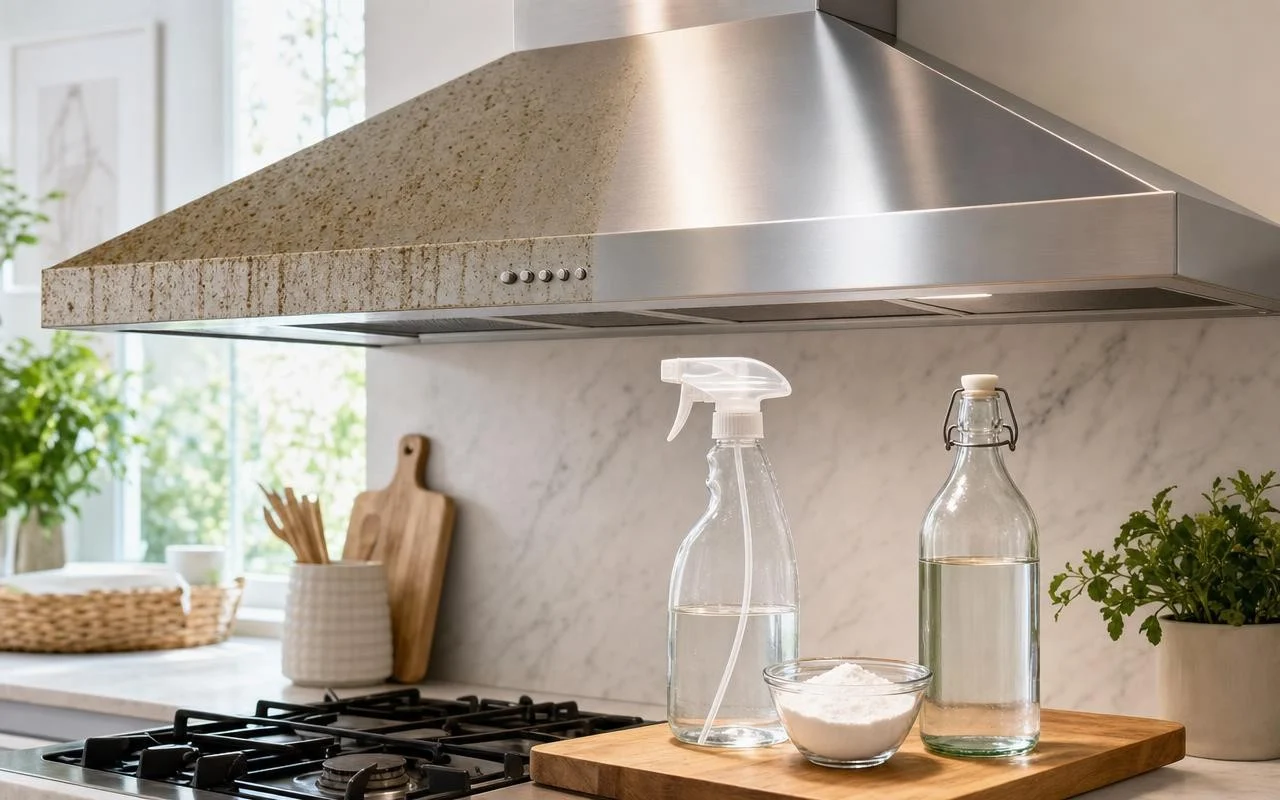
You switch on the light of your range hood and there it is, a shock: the underside is sticky, your fingers stay tacky, and a greasy film covers the controls. It’s not just a matter of aesthetics; this layer traps dust and holds onto cooking odors. Between splatters and frying vapors, the hood becomes a grease magnet as soon as you cook.
This grease comes from the air drawn by the appliance: the hood captures cooking particles to prevent them from settling everywhere and forming a film on the furniture. When you delay cleaning, the hood filter becomes saturated, the grease grabs on and becomes truly sticky. A very simple ingredient, already in your cupboards, can nevertheless lift it almost without scrubbing: white vinegar.
Preparing the Hood Before the Vinegar
Before tackling the grease, secure the area. Turn off the cooking plate, let it cool, and, if possible, cut the power to the hood. Place a sheet or newspaper on the stovetop to protect it from drips. Then remove the metal filters or grease filters following the manual, without touching the activated charcoal filter if your model has one, as that one is replaceable but not washable.
To work comfortably, gather all the equipment. You will need a basin or a blocked sink, a clean spray bottle, a microfiber cloth, and, for the oldest deposits, a small soft brush. On the product side, simply use white vinegar, a bit of baking soda, and a degreasing dishwashing liquid: with these three ingredients, the greases adhered to the hood as well as to its filter can already be dissolved very effectively.
Vinegar Spray Against Sticky Grease
Start by preparing your base mixture. Pour one cup of very hot water and one cup of white vinegar into the spray bottle, then shake to homogenize. Generously spray this solution on the exterior of the hood, the underside, the rims, and the front, not forgetting the controls. If possible, open the housing on your model to spray the interior, where the filter attaches. Let the product act for 5 minutes without touching it.
After this contact time, go over the interior and exterior with a clean microfiber cloth: the sticky grease lifts away and sticks to the fabric. If some areas resist, prepare a stronger version with one cup of vinegar, one cup of water, and a teaspoon of degreasing dishwashing liquid, spray and then scrub. For those who dislike the smell of vinegar, a spray of half lemon juice and half hot water gives a similar result.
Hood Filter: Vinegar and Baking Soda
To restore suction effectiveness, the key step remains cleaning the metal filter. Fill a basin with white vinegar and, if needed, top up with very hot water so that the filter is fully submerged. Submerge it and let it soak for 20 to 30 minutes. Then remove it from the bath and brush each side with a soft brush to detach the remaining residues. Rinse abundantly with hot clean water and let it dry completely before putting it back in place.
If, after this soaking, some areas remain encrusted, make a paste with a half cup of baking soda and two tablespoons of vinegar. Apply it to the particularly greasy parts of the filter or under the hood, let it act for at least 30 minutes, or even overnight if the layer is old, then scrub and rinse. Many manufacturers indicate that metal filters can go in the dishwasher: when that is the case, a hot cycle effectively completes this cleaning.
Sources
- Marie France
“Farewell to the kitchen hood: by 2026, its replacement is a subtler and more practical trend”
