
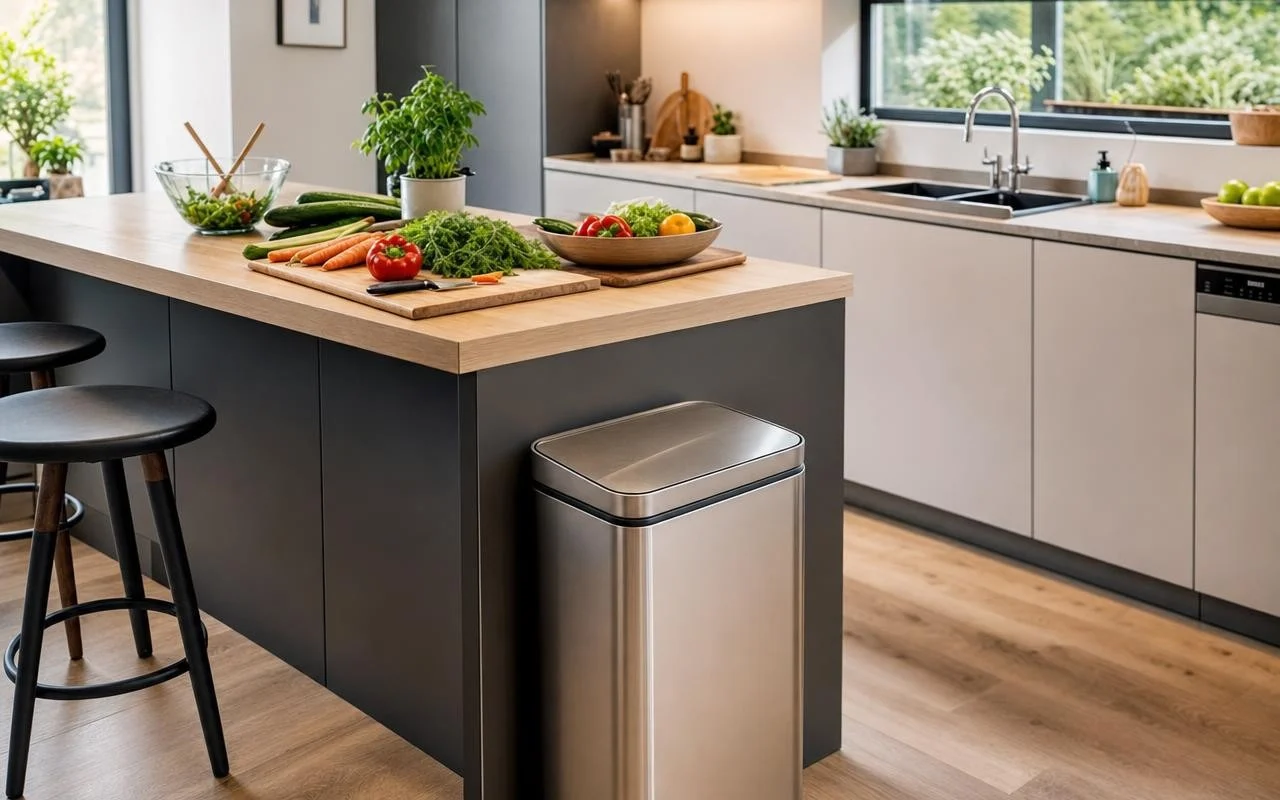
When renovating the kitchen, people often think of everything except the most banal object: the trash can. For Argentine interior designer Ángeles Martínez, this detail can nonetheless transform daily comfort. She states in her videos and interviews: “If you have the trash under the kitchen sink, there is a better option.”
In an article published on August 20, 2026, the expert reminds readers that many homeowners focus on the color of the furniture, the backsplash, or the quality of the worktop. For her, a pleasant kitchen begins with a good zoning: cooking, washing, preparation, storage, and waste. And it’s precisely here that the placement of the trash can becomes tricky.
Trash can under the sink: why Ángeles Martínez questions this classic
According to Ángeles Martínez, one of the most common reflexes is to slide the trash can under the sink. This cabinet is often free, connected to water supplies, and people readily hide this unsightly bin there. For the designer, this choice poses a problem “because it isn’t practical when you use it,” especially when you cook daily and the trips back and forth multiply.
In France, sorting guides clearly distinguish these usages. The Eco-Poubelle site specifies that in cases “under the sink, limited space,” a built-in trash can of 15 to 20 liters remains suitable, whereas for the kitchen in general it recommends a bin of 30 to 50 liters for daily use, with the capacity to adjust according to the number of people in the household.
The best option according to Ángeles Martínez: a trash can under the worktop
Facing this observation, Ángeles Martínez proposes another layout, very simple on paper. She suggests placing the trash can right under the preparation zone of the food, for example under the stretch of countertop where vegetables are chopped or groceries are unpacked. The action becomes much more direct: you slice, you push aside peels and packaging, and they fall immediately into the bin.
In modern kitchens, this idea is often realized as a sliding drawer unit that hides one or more bins, or even as a cutout in the countertop connected directly to the recycling system. The Eco-Poubelle guide recalls that, since the entry into force of the AGEC law (no. 2020-105) on January 1, 2024, every French household must sort its bio-waste: it suggests adding a small container of 5 to 7 liters dedicated to organic waste, or opting for a double-compartment model.
Sink, bin volumes and sorting: the other details that change everything
Ángeles Martínez does not stop at the trash can when talking about a functional kitchen. She also emphasizes the size of the sink, which she describes as a key element to save time on cleaning. Her advice is clear: “If the cooktop won’t fit, it’s too small,” summarizes the designer. A large single-basin sink allows washing without effort large pots, dishes, and bulky pans.
The designer also recommends an integrated sink in the countertop, made from the same material as the surface. According to her statements, this solution avoids joints where dirt accumulates and simplifies the daily wipe-down. On her social networks, Ángeles Martínez also reminds that other details matter just as much: sufficient lighting, well-placed outlets, and above all taking into account the circulation between cooking, the sink, storage, and waste management.
