
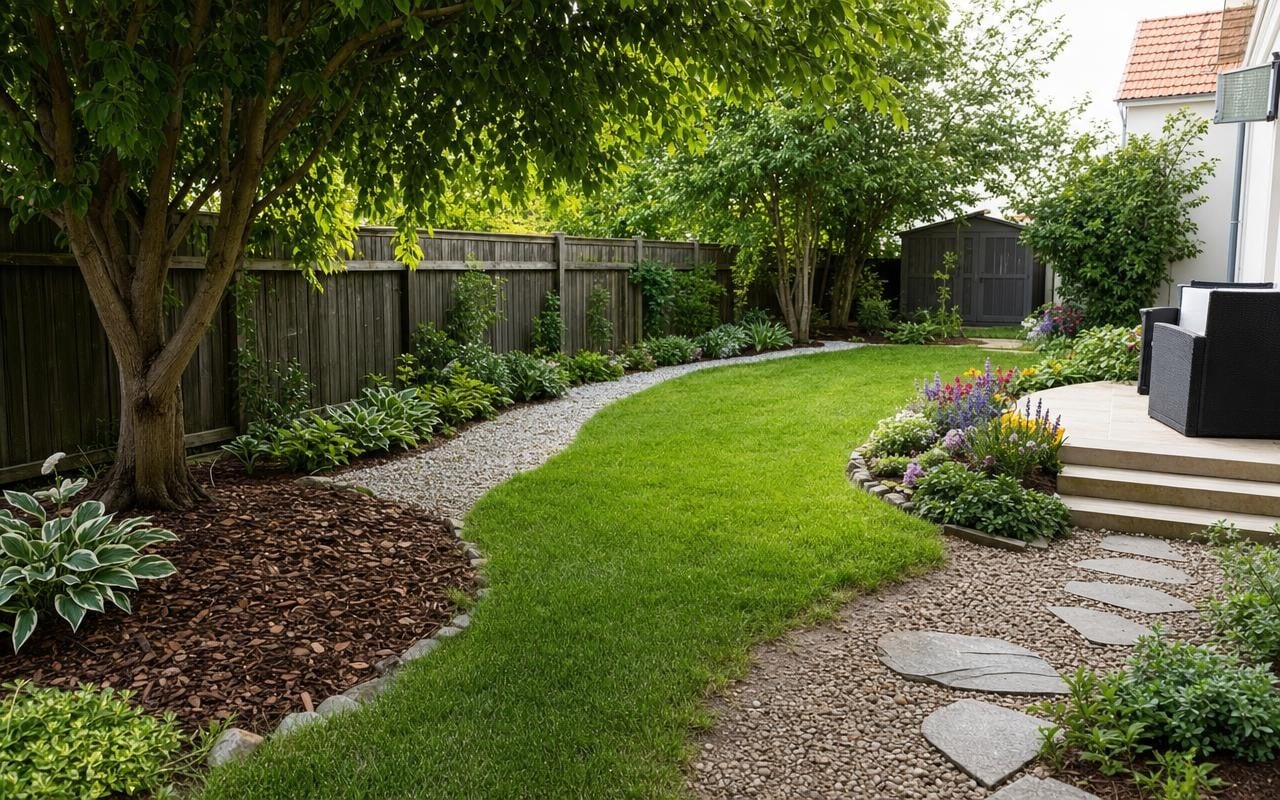
You may reseed, water, and fertilize all you want: certain spots in your garden stay stubbornly sparse. The grass yellows, thins out, and then disappears. Many blame lack of maintenance, while the problem often lies with the site itself. Under certain conditions, the lawn simply refuses to thrive.
To achieve a lush green carpet, the lawn needs sun, nutrients, and reasonably steady soil moisture. When one of these factors is missing, the result is a mediocre lawn. The Southern Living site recommends identifying the problem areas rather than wasting time and money on repeated seeding. Four spots keep showing up.
Under trees and at the foot of walls: when shade keeps the lawn from growing
Under a large tree or against a north-facing wall, shade remains dense for much of the day. Light is scarce, the tree roots suck up water and nutrients, and the surface soil dries out quickly: the grass does not grow or forms a sparse carpet. Attempts to overseed fail repeatedly and the mower catches on exposed roots.
In these areas, it is better to forget the lawn and create a shade bed. “A mulch ring under trees is easier to manage and looks much neater than a sparse lawn,” notes Southern Living. Around the trunk, a mulch bed can welcome Itea virginica, Sarcococca hookeriana, boxwood, hostas, ferns such as Cyrtomium falcatum, or groundcovers like Pachysandra terminalis and Galium odoratum, for a green carpet without mowing.
Compacted or waterlogged zones: where the grass quits
Another typical case: the path to the garage, the parking space, or the area where everyone goes cross-country. The soil is so compacted that air no longer circulates around the roots, water runs off or puddles instead of infiltrating. In these conditions, no lawn can stay dense and healthy, even with careful watering.
The most durable solution is to embrace these uses: create a paved path, a brick-lined driveway, concrete or stone slabs, possibly permeable, to support cars and foot traffic. Right beside it, the lower parts of the garden pose the opposite problem: water stagnation. After drainage trials are exhausted, turning this hollow into a basin, rain garden, or wet bed with Ilex glabra, iris virginica, Cornus sericea, Salix discolor or marsh hibiscus becomes far more logical.
Sunny slope: what alternatives when the grass won’t grow
On a slope, the irrigation water runs downward, taking a little soil with it with every downpour. The mower’s passage is tedious or dangerous. In midsummer, with heat waves and repeated water restrictions described by Le Parisien, the lawn quickly scorches: the slope becomes a dusty crust where grass fails to grow durably.
To stabilize the slope, you can soften the relief, create small terraces or a rock garden, then install drought-tolerant groundcovers that require far less water than a lawn. Among the plants listed as alternatives by Le Parisien, several are well-suited to sunny situations:
- Creeping thyme or woolly thyme, very low, fragrant and bee-friendly.
- Japanese zoysia, a grass that forms a soft mat with almost no mowing.
- Dymondia margarita and Herniaria glabra, which quickly cover well-drained soil.
- Coastal sea heath, low-maintenance and wind-tolerant in coastal climates.
- Nain white clover or creeping juniper Juniperus horizontalis to stabilize a slope.
- Creeping rosemary along the base of walls, decorative and aromatic.
