
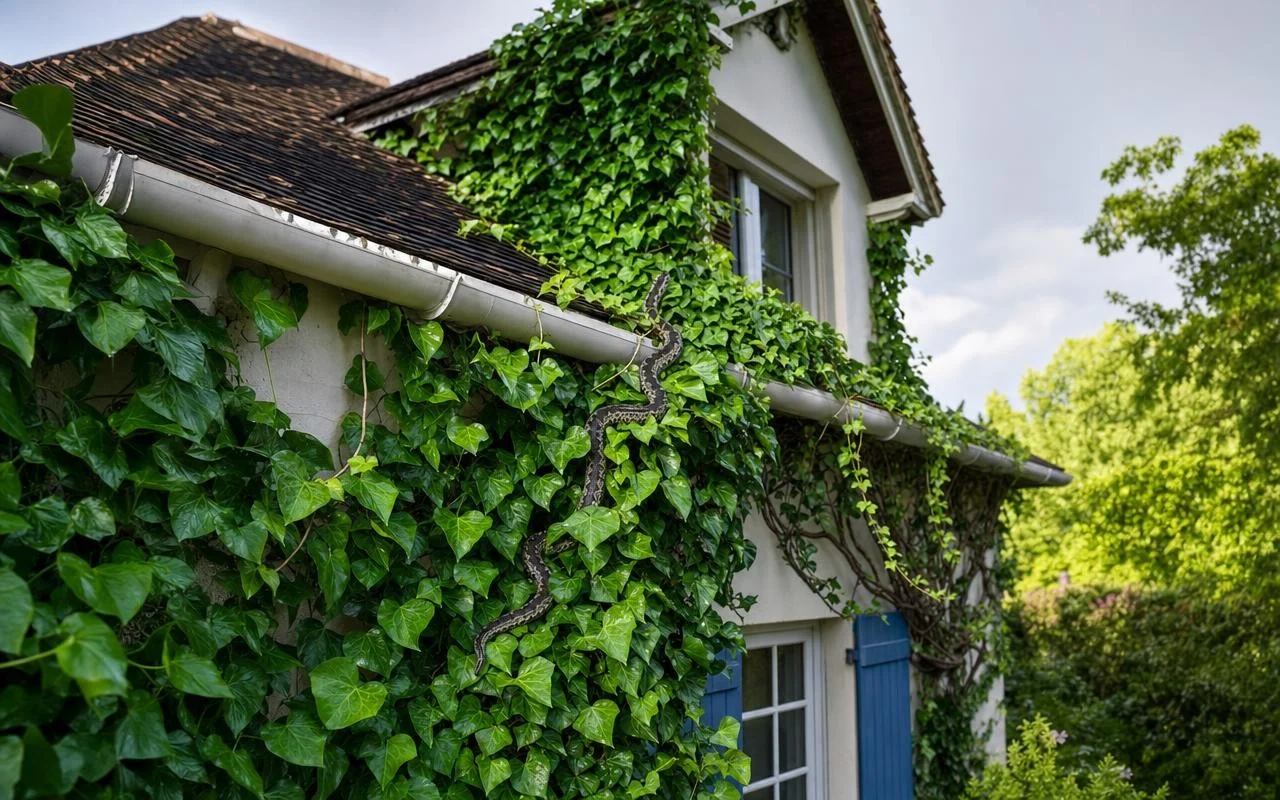
In the middle of August, the facade darkens with greenery, the air cools beneath the foliage, and the house seems better shielded from the heatwave. Yet this very summery scene can conceal a far less welcome guest: the snake. With hotter summers, raised by +2.3 °C on average over ten years according to Météo France, reptiles seek cool, quiet refuges just above our heads.
Attic and loft spaces offer shade, temperature stability, and calm, but also mice and insects at a snake’s disposal when it’s hungry. Rescue centers, such as the one in Hérault, report that interventions for snakes in homes have tripled over ten years, especially between June and September. And in many cases, a simple gardening gesture repeated every summer, without thought, has given the reptile direct access to the roof.
Why snakes love attics so much in summer
According to Critter Control, an organization specializing in wildlife management in inhabited areas, snakes regularly climb up to attics by using trees, ivy, and other vegetation pressed against walls. Once settled, these snakes in the attic can stay for days, or even the entire season, moving about freely without being truly trapped. For them, a quiet attic with a few mice or insects is an ideal refuge during heat spikes.
Studies reported by the University of Florida show that several species, including grass snakes and vipers, can scale up to three meters in height by following stems, branches, or plant trellises along a facade. The Hérault rescue center estimates that in 42% of interventions, the animal had entered the dwelling through a vegetation point in direct contact with the building. Another telling figure, the Reptilia Conservation association, after monitoring 700 rural households, found that 78% of known intrusions could have been prevented with a simple trimming of vegetation.
Climbing plants and gutters: the move that opens your attic
The most common scenario remains quite banal: ivy, a climbing vine, or a rampant rose planted to grow up the edge of the roof all summer long. For a snake, this vegetation forms a true ramp from the ground or a low wall to the gutter, then toward a roof gap or a slightly raised tile. Prevention organizations such as the National Wildlife Federation or the Tennessee Wildlife Authority recommend avoiding vines and dense plant coverings directly against the house, precisely because they serve as bridges for reptiles.
Experts estimate that poorly pruned vegetation is responsible for around one-third of the snakes’ intrusions recorded each summer, simply by providing access to the walls. Gamm Vert, for example, advises cutting ivy that overgrows windows and gutters to at least fifty centimeters away from these elements to remove this direct contact.
Simple actions to prevent snakes under the roof
The recommendations from the National Wildlife Federation and the University of Florida converge on a few very simple steps to implement around the home.
- Never let a climbing plant reach the edge of the roof or the gutter.
- Trim hedges and shrubs to at least fifty centimeters away from the facade.
- Install a fine metal mesh over roof vents and seal cracks and small holes.
If a snake appears in the attic, keep your distance, close the room, and call the firefighters or a specialized association such as GeoNat’ÎdF – SOS Serpents Île-de-France. These teams remind that snakes are protected in France: they are relocated, not eliminated.
Sources
- Modes & Travaux
“Snakes Under the Roof: This Summer Action That Makes Them Climb to Your Home and Reach Your Attics”
