
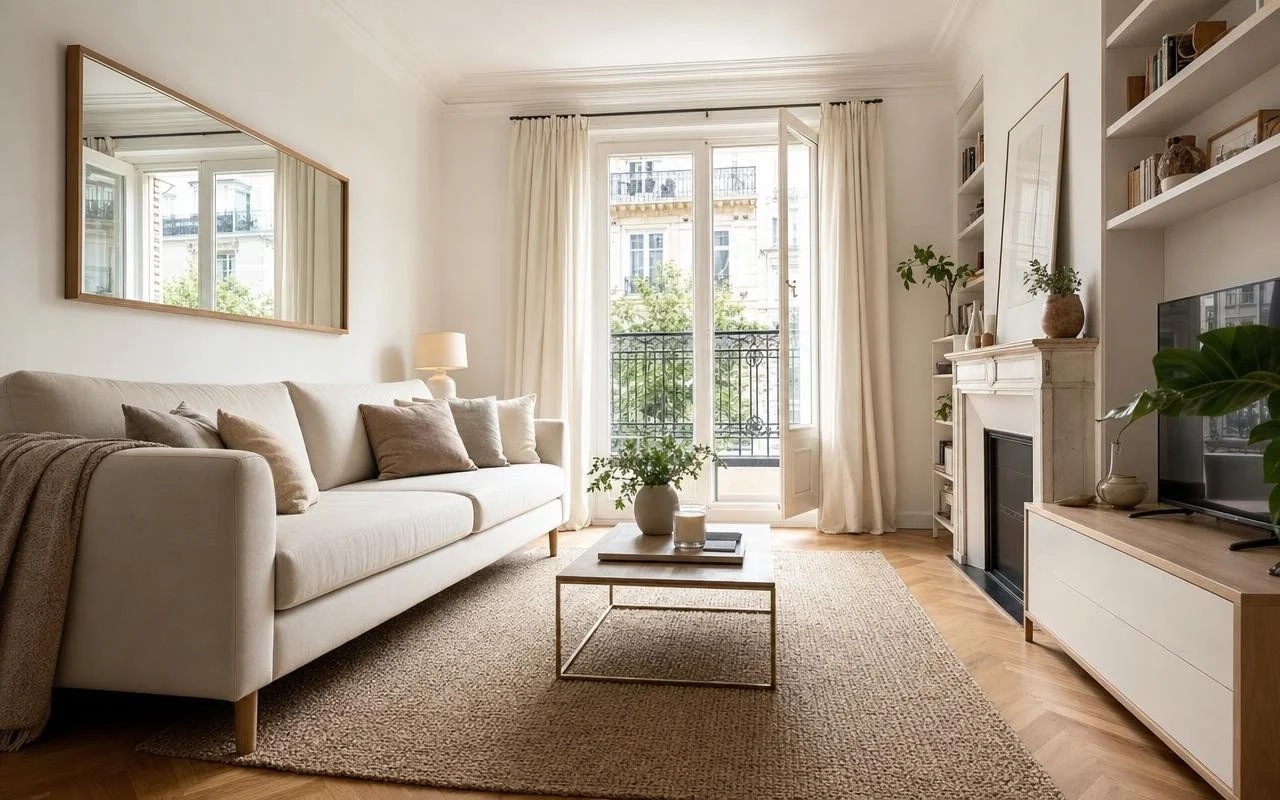
Tiny living room, a bedroom that suffocates, an entryway-hall that’s impossible to furnish: many French homes give the impression of lacking air. Yet, professionals of home staging manage to make a studio look larger, without pushing a single wall. Their method does not rely on heavy renovations or overpriced furniture, but on a few very precise layout rules.
In an article devoted to small spaces, American home stager Jason Saft sums up the starting point: “Understand how you want the room to function,” explains the founder of Staged to Sell Home. TV watching, conversations, work… each use imposes a different arrangement. French decorator Laurianne Vernette, who also practices home staging, emphasizes resourcefulness: “We can offer things at a lower cost: by moving a sofa, painting a wall, adding a few shelves,” she says. These reflexes change the perception of the space.
Home Staging Tips: Function of the Room and Well-Chosen Furniture
For Jason Saft, this reflection on usage naturally leads to the right furniture. He asks: “If it’s a small living room, do you watch a lot of television? Do you often have friends over to chat?” and adds: “In general, when you have a smaller room, you think you need a small sofa, but if you are constantly using it to watch television, the sofa should be of normal size and you can compromise on the other furniture in the room.” The important thing remains to choose an appropriate focal piece, then lighten the rest.
Amanda Wiss, founder of Urban Staging, recommends choosing a bed and a rug sized to the bedroom to highlight its volume, even if that means then settling for slim side tables or a single armchair. Jason Saft completes: “The most important thing in a small space is to avoid very bulky furniture that sits on the floor and that blocks sight… Choosing furniture on tall legs lets light pass through and preserves the view.”
Colors, Rugs and Light: Visually Enlarging a Small Room
Home stagers play a lot with color. Jason Saft often advises painting walls, mouldings and doors in a similar shade: “Painting the room entirely in the same color makes it much more fluid and elegant. Using multiple finishes and colors cuts up the space and reminds you that the room is small.” Sometimes an accent wall is enough, as Laurianne Vernette practices, to energize without partitioning.
The rug also serves as an illusion tool. “It may seem that choosing a smaller rug makes the room look bigger, but in reality it makes it look minuscule,” warns Jason Saft, who recommends that the front feet of furniture rest on it to unify the area. Amanda Wiss finally notes that “lighting matters a lot in small rooms”: pendants, slender floor lamps and table lamps chase away dark corners.
Mirrors, Storage and Circulation: The Latest Secrets of Home Stagers
Another pro reflex: the well-placed mirror. “Large mirrors placed well widen the view and enlarge the room,” explains Jason Saft. Placed near a window or behind a table, they double the light and give the illusion of an extra opening.
Finally, let the room breathe. “Clutter will make any room look smaller,” warns Amanda Wiss, who advises hiding cables, devices and small objects in closed storage. For Cathy Hobbs, “in small interiors, less is more”: clearing the passages and the entrances is often enough to make the space notably more fluid.
Sources
- Peaches
“Farewell Zara Home: this small, little-known brand takes the crown for the finest champagne flutes at under €32 per set”
