
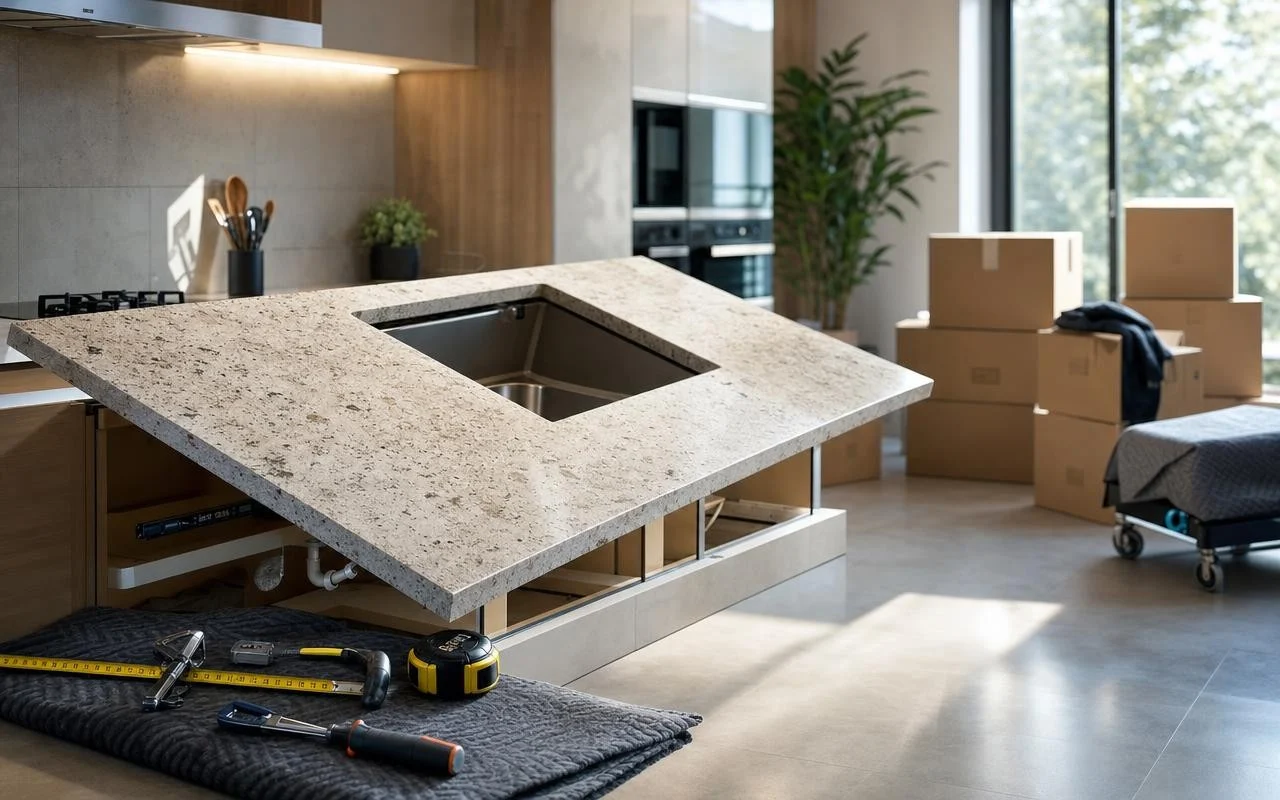
You chose a beautiful quartz, called in the mason, and signed a substantial check: your countertop has become the star of the kitchen. Moving day arrives, and almost immediately one question arises: would it be crazy to dismantle it to take it to your new home, rather than leave it to complete strangers?
The answer isn’t as simple as a yes or a no. It depends on your status (tenant or owner), on a possible sale of the property, but also on the material and on how the countertop was installed. Between real estate law, technical constraints and the real cost of the operation, surprises are plentiful. And some can be very painful.
Taking your countertop: what the law actually allows
For a tenant, the matter is quickly settled. By installing a new countertop, you have deeply altered someone else’s dwelling. Leaving with it at the end of the lease would amount to leaving behind an unfinished surface, damaged walls, or even an unusable kitchen. The American media HouseDigest even warns: “If you are a tenant of an apartment or house, taking it away is out of the question from the start and will cause you to lose your security deposit,” it explains.
For an owner who is selling, the countertop is part of the items “attached to the dwelling”: it is fixed to the furniture and expected to stay in the sold kitchen. A rule often recalled: if removing it creates visible damage, the buyer can demand it. HouseDigest sums up: “If you are a homeowner, technically, yes, you can take your countertops. In practice, it’s a huge logistical nightmare that rarely justifies the stress,” warns the site, which recommends carrying out the swap before listing for sale.
Dismantling and transporting the countertop: technical risks to anticipate
Beyond the legal angle, the technique quickly cools enthusiasm. A countertop in granite, quartz or laminate has been custom-shaped: exact length, cutouts for the sink, the hob, sometimes pipe passages. The chances that it will fit perfectly with the furniture of the new kitchen are slim. Reducing its size can impose unsightly joints or break the vein of the stone, to the point of ruining the material’s aesthetics.
The extraction is not trivial either. The heavy slabs are glued with silicone or mounting adhesive, sometimes bolted; removing them easily leads to chips and cracks, or even the clean break of long runs. To limit damage, you need appropriate equipment. Ferguson Moving notes: “Stone countertops should never be transported flat if possible. Vertical transport reduces the stresses on the slab,” it recommends. The minimum equipment to assemble looks like this:
- a vertical transport easel, type A-frame;
- solid ratchet straps;
- thick blankets or foam;
- stone clamps or suction cups;
- at least two to four people to carry.
When to keep, when to leave your countertop during a move?
At this stage, the bill weighs heavily. Between removal by a marble worker, the rental of a suitable vehicle, recutting, polishing and rehanging in the new kitchen, the final sum often exceeds the price of a new countertop. With rare exceptions, such as an old family block, many specialists advise leaving it in place.
For those who insist on it, the strategy is to plan the operation before the sale, then install a simple and clean covering in place. In the event of a transaction, notaries and agents recommend spelling everything out in writing in the sale agreement: what stays, what goes, and in what condition the kitchen will be delivered.
