
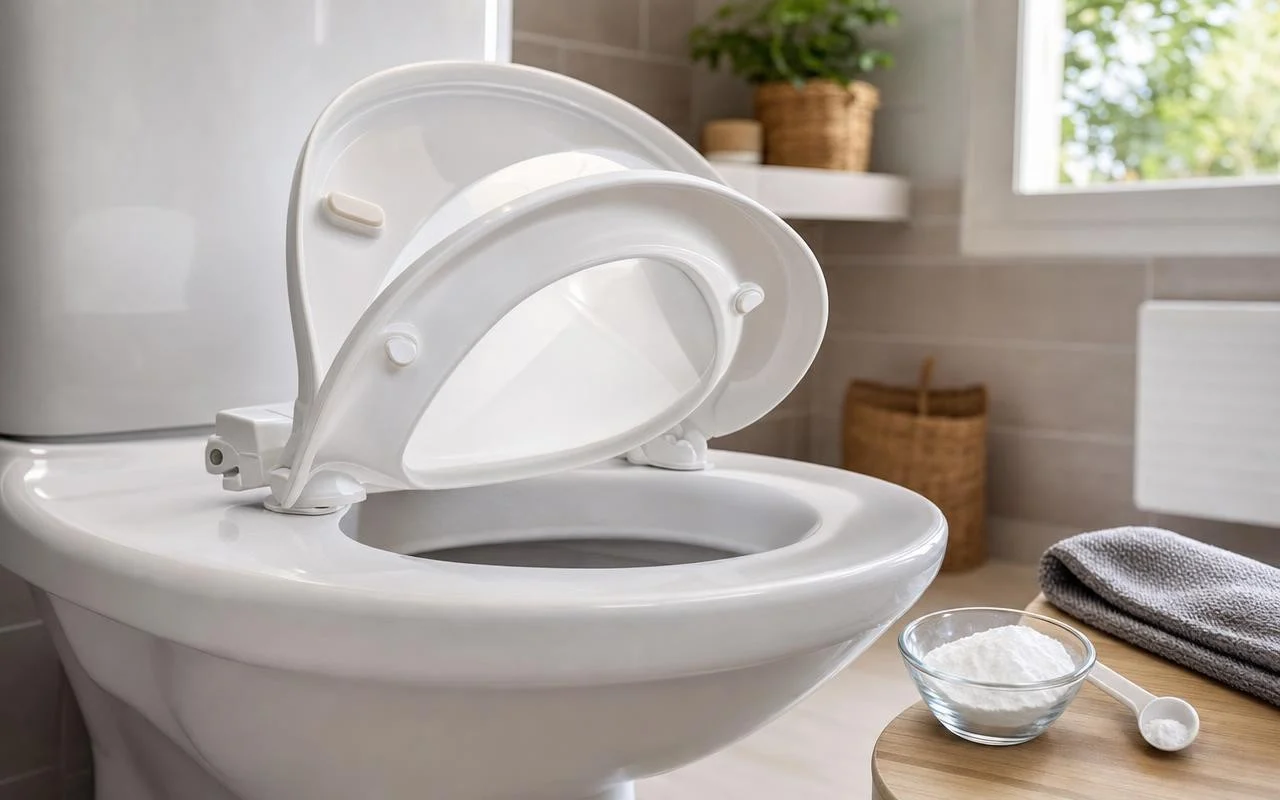
I was gazing at my yellowing toilet seat, thinking it would end up in the trash. A maintenance worker who had come for the building then shared his protocol: a powder that is left to work overnight, and the plastic almost returns to its original white. No bleach needed, nor hours of scrubbing. This simple gesture completely changes family bathroom life.
Many households replace their toilet seat as soon as the surface yellows, convinced the plastic is irreparably stained. Yet specialists explain that the veil mostly comes from surface deposits and surface oxidation, not deep wear. Understanding what happens to the material helps avoid buying new for nothing. The question remains which method to use, and when to start this famous overnight treatment.
Why does the toilet seat yellow?
On a yellowed toilet seat, two phenomena come together. The clear plastic contains additives that degrade with light, humidity, and the ammonia vapors from urine: the surface oxidizes and yellows gradually. In parallel, micro-droplets of urine, urinary scale, and the hardness of the water form an invisible crust that clings to the pores of the material, especially on the edges and around the hinges.
The specialized site Abattantswc distinguishes a yellowing laid on the surface from a yellowing that has penetrated the material. A home test helps to sort it out: on a discreet area, rub with a microfiber cloth and a non-abrasive cleaner. If the whiteness returns locally, your stains are removable. If nothing moves, even after a thorough cleaning, the plastic has probably aged and replacement will become more logical.
Sodium percarbonate, the overnight move that re-whitens
That’s where sodium percarbonate comes into play, the famous cleaning powder. This crystal, a fortified cousin of baking soda, releases hydrogen peroxide and active oxygen when it comes into contact with warm water, which targets the yellowing molecules without chlorine. If your toilet seat can be removed, dissolve about 100 grams in two liters of hot water, submerge the seat, and let it soak for several hours, or even overnight.
For a non-removable seat, prepare a more concentrated solution with two to three tablespoons of percarbonate in a bowl of warm water. Spread generously over the entire yellowed surface, place a clean damp cloth over it, and close the lid. Overnight, the humidity maintains the action of the active oxygen. In the morning, rinse thoroughly, run a soft-bristled brush along the edges and underside, then dry with a cloth.
Other solutions for a yellowed toilet seat and essential precautions
If the yellowing is light, or to maintain the result between overnight treatments, other tricks complement the arsenal. All rely on everyday products, easy to find in the bathroom or under the sink. The idea isn’t to pile everything up, but to choose the solution best suited to the plastic’s condition and the time you have available.
- Whitening toothpaste: a pea-sized amount on a damp cloth, small circular motions, rinse immediately.
- Dishwasher tablet: seat removed and placed in a basin, soak for one to two hours.
- Paste of white vinegar and baking soda: apply, leave on for fifteen to thirty minutes, scrub then rinse.
One final point: safety. Wear gloves, test each product on a small area, and work on a cold surface, especially with the Magic Eraser, a melamine foam abrasive. The National Institute for Research and Safety reminds that you should never mix bleach with acidic products like vinegar or a descaler, as this can release irritating gases. A gentle toilet cleaner, thorough rinsing, and quick drying after use help limit the return of yellowing.
Sources
- Top Santé
“This simple gesture is one of the most effective for whitening a yellowed toilet seat”
