
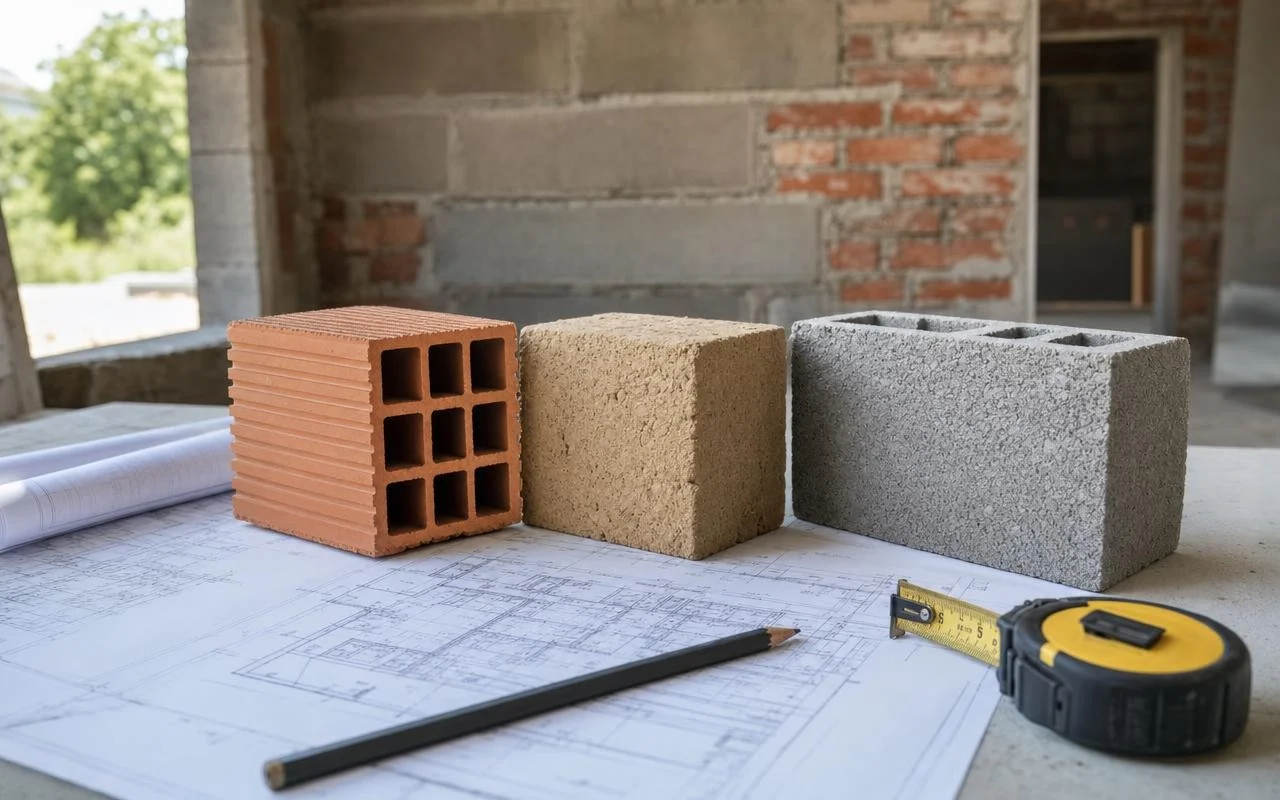
Building a home also means choosing the material that will stay under the plaster for decades. Between hollow clay brick, soil-cement brick, and concrete block, the discussion is open in design offices as on self-build sites. Behind this seemingly technical choice lie, however, the wall’s solidity, thermal comfort, and the time spent on site—three factors that weigh heavily in daily life.
A TN article from the Argentinian media, published on August 12, 2026, reminds readers that the brick type is not chosen at random: the house project, the climate of the area, the available budget, and the type of wall to be constructed can tip the balance. In other words, no material is “the best” in absolute terms, but some align much better with your situation. The three contenders do not exactly play in the same category.
Hollow brick, soil-cement brick, and concrete block: understanding their differences
In most traditional house projects, the hollow clay brick remains the reference. Made from fired clay with internal cavities, it is relatively light and improves the wall’s thermal behavior, according to TN. The Bricoleur Pro site, from Ouest-France, states that a wall built with hollow bricks costs around €40 per square meter, while often requiring additional insulation to meet current performance standards.
The soil-cement block, on the other hand, is manufactured from a mixture of earth, cement, and water that is compacted without firing. This technique, close to compressed earth bricks described by Wikipedia, can include about 10% cement or lime binder, and then requires drying for one to three weeks with good protection against rain. The concrete blocks, made of cement, aggregates, and water, stand out for their larger, more regular dimensions, which makes elevating walls easier and faster. TN even summarizes: “In general, hollow ceramic bricks are the most recommended option for a traditional house,” while concrete blocks are chosen when strength and speed of execution are prioritized.
Which brick type for a “classic” or multi-story home?
For a typical single-family home in a temperate zone, TN thus regards hollow brick as the most practical solution. Its moderate weight eases installation, and its widespread usage gives access to a wide range of companies, plans, and insulation systems tailored to current requirements.
Concrete blocks come into their own mainly when the priority is structural resistance and construction speed. The regular size of these blocks allows for rapid erection of load-bearing walls, for example for multi-story houses or projects where structural constraints are strong, under the supervision of a professional.
Soil-cement brick, environmental impact, and quality of the finished wall
The soil-cement brick particularly attracts projects aiming for a low environmental impact. The absence of firing limits embodied energy, and the efficient use of local soil evokes compressed earth bricks. Sources nonetheless emphasize one point: its resistance depends entirely on proper formulation, rigorous compaction, and adequate drying.
The TN media finally reminds us that the quality of a wall is not determined solely by the brick type: execution, insulation, coatings, and the overall design of the house count just as much. To clarify your choice among hollow brick, soil-cement brick, and concrete block with your professional, a few questions guide the discussion:
- In what climate and main orientation will the house be located?
- Will the walls need to be load-bearing for an upper story or a heavy roof?
- Would you rather prioritize thermal comfort, construction speed, or environmental impact?
