
The pristine hedges that once stood as the garden’s pride can turn into a greyish timbers in a single weekend. Many gardeners recount leaving a lush, green boxwood on a Friday evening only to return Monday to a desiccated skeleton, puzzled by what had happened.
The culprit is the boxwood moth, Cydalima perspectalis, whose caterpillars voraciously devour the leaves at a remarkable pace. A landscaper explains that a simple five-minute ritual, performed at the right moment of the day, would have sufficed to halt the attack before catastrophe. It all hinges on this brief moment between day and night.
Boxwood moth: why your hedges can disappear in three days
When the moth’s eggs hatch, the small caterpillars begin by nibbling the underside of boxwood Buxus leaves, hidden from view. In a few days, they grow, and in less than 72 hours, a dense hedge can be almost completely defoliated. The veins remain, while the rest disappears into the stomachs of these voracious larvae.
The trap lies in the caterpillars’ habit of hiding inside the bush during the day and only venturing out at dusk. Many owners mistake it for a disease or a heat shock, because they never see the insect. Plant protection agencies recommend monitoring from May to September, the period when several generations of pyrales follow one another. The key, therefore, remains responsiveness from the first signs of damage.
The 5-minute twilight gesture against the boxwood moth
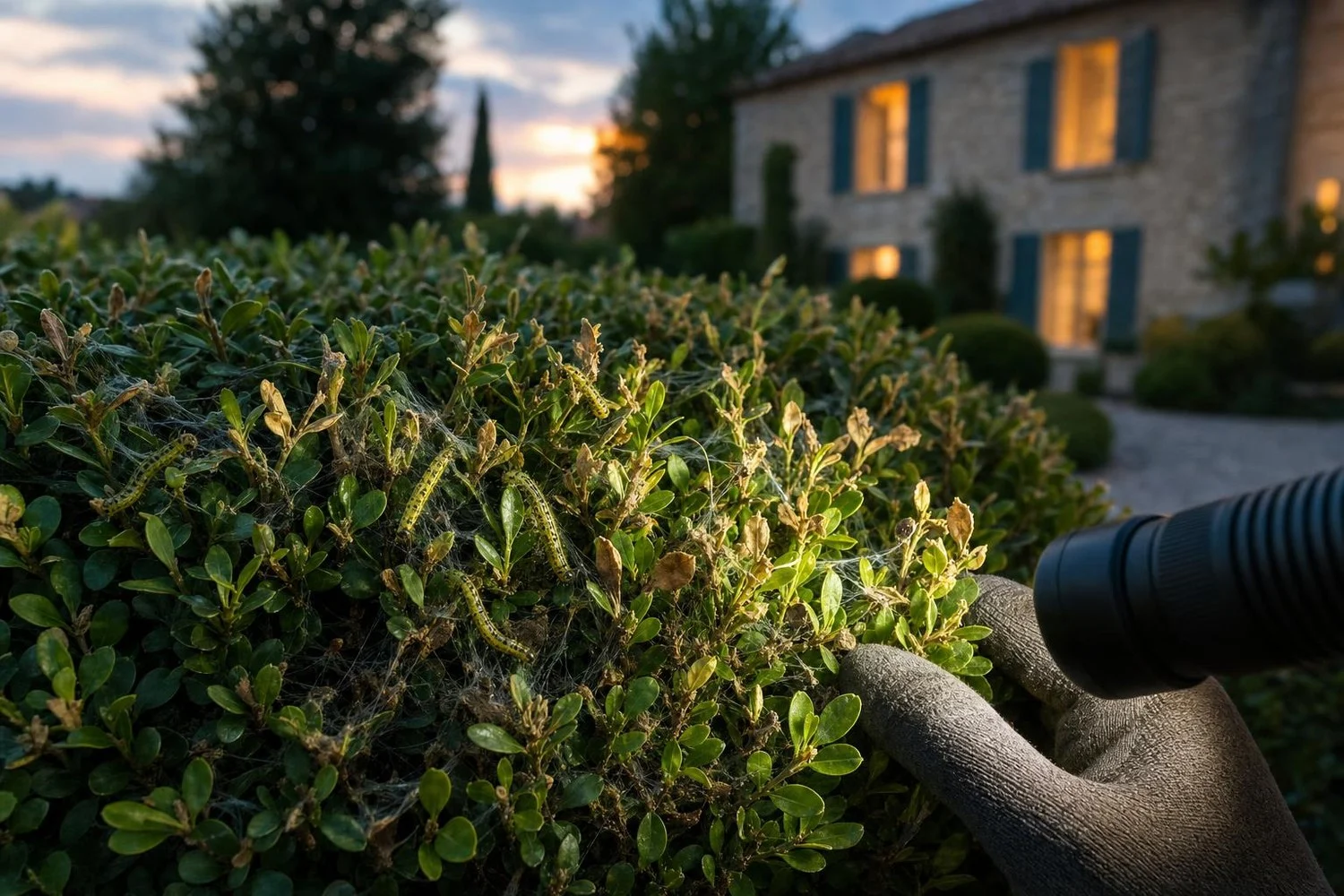
A landscaper advises dedicating five minutes each evening to a twilight inspection. It’s enough to walk past each boxwood, part the foliage with your hands, and look inside, with a flashlight or headlamp in hand. It’s at this moment that the caterpillars come out to feed and become easy to spot on the leaves and the small webs.
As soon as a caterpillar is seen, the method is simple: remove it by hand, drop it into a bucket of soapy water or crush it, then prune the heavily infested shoots and place them in a sealed bag destined for household trash. This mechanical fight, repeated two or three nights in a row within the famous forty-eight to seventy-two-hour window, often saves the boxwood without recourse to chemical products.
Signs, bio boosts, and mistakes to avoid when facing the boxwood moth
An effective inspection tour begins with looking for typical signs. Three clues betray the presence of the boxwood moth even if the caterpillars are not yet visible to the naked eye:
- small green droppings in bead-like shapes at the base or on the undersides of leaves,
- thin silk threads or webs between the branches,
- chewed leaves, sometimes reduced to the central vein.
If the infestation remains strong despite this quick gesture, specialists recommend, as reinforcement, a biological treatment based on Bacillus thuringiensis subsp. kurstaki (Btk), to be sprayed in the evening on the foliage to target young caterpillars, with several applications possible according to the label. Pheromone traps can also serve as an alert in spring, indicating the start of butterfly flights and thus the moment to redouble vigilance. The most common mistakes are waiting to see the boxwood yellowing to react, inspecting only the surface, or leaving on the ground the pruned branches and the collected caterpillars, which gives them another chance to harm.
