
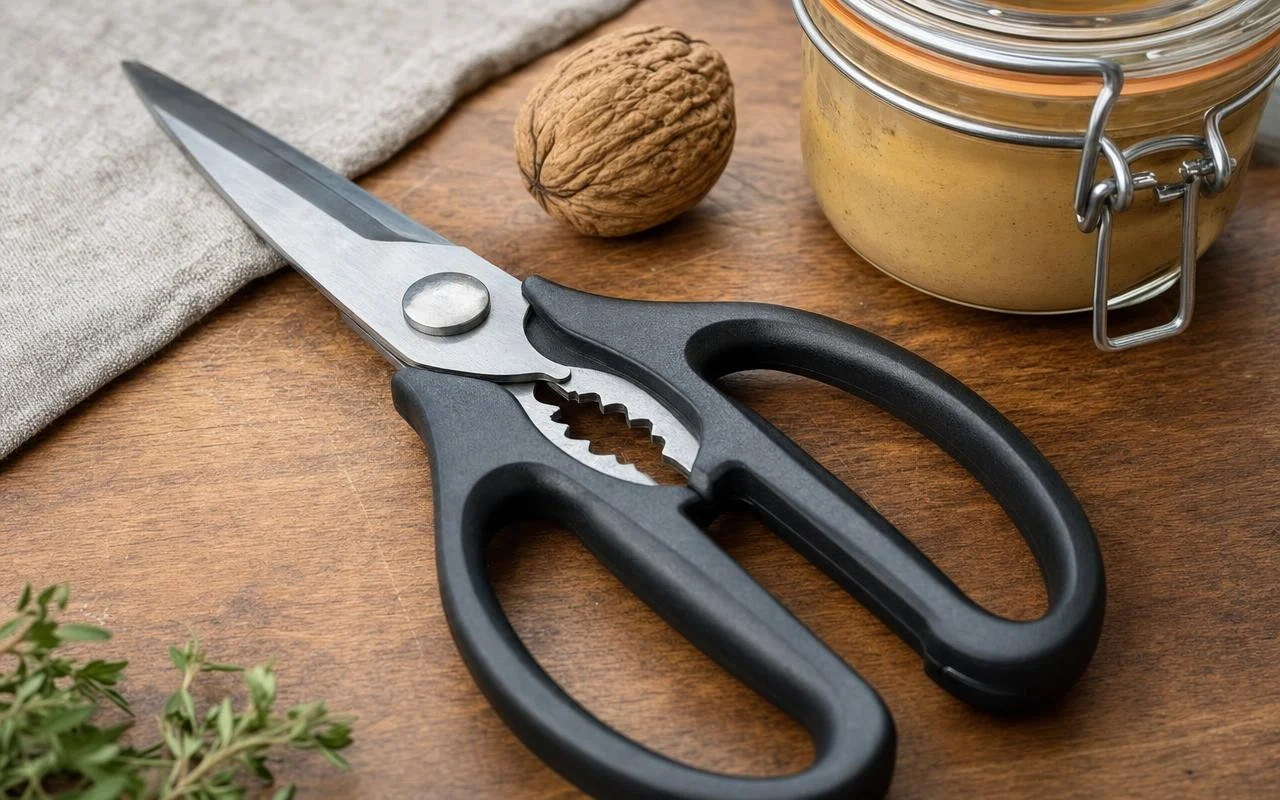
Between the handles of your kitchen scissors, this small irregular metal area often intrigues. Many have taken it for a plastic reinforcement or a stylistic detail of little importance, to the point of never using it. A quick glance gives the impression of a decorative feature, not a real tool.
Yet one internet user asked on Reddit one day: “Does anyone know what this part of the scissors is for?”, triggering nearly 600 responses. Since then, the truth has circulated: this serrated part of kitchen scissors is far from incidental; it hides a precise function, and even several, that can really ease your hands.
Serrated part of kitchen scissors: a hidden nutcracker
This zone, tucked between the handles, forms an oval opening with metal teeth, like a mini clamp. Its position, very close to the pivot, strengthens the pressure exerted on what is clamped inside. Practical magazines describe it as an integrated nutcracker: you place walnuts, hazelnuts, or other shell fruits in this serrated hollow, then squeeze the handles.
The motion should stay gradual. You close the handles slowly until the shell cracks, which limits shards and prevents crushing the kernel. The teeth prevent the nut from slipping, especially when it is quite round or when your fingers are a bit greasy. Experts still remind that this serrated part is not made for objects that are too large or too resistant, lest you deform the teeth or the pivot.
Jar opener and crab-cracker: other uses of the serrated area
User comments go beyond the simple nutshells. One explains using it on stubborn lids: “You just insert the lid between the teeth and squeeze. This helps to grip the lid better to unscrew it.” Another recounts using it “to remove corks from wine bottles when they are not pressed in properly.” The serrated oval shape then acts as a non-slip handle on round surfaces.
For crustaceans, several internet users use it “to crack bones or as a crab-cracker.” You clamp a crab or lobster claw into the serrated part and then squeeze to fissure the shell, without needing multiple utensils. Some multifunction kitchen scissor models group this serrated zone with a bottle opener or micro-serrated sections for tougher foods, which explains why exact uses vary by manufacturer.
How to properly use and clean the serrated part of kitchen scissors
To maintain control, consumer magazines recommend handling this area with the scissors closed, with the nut or jar resting on a stable surface. The handles stay close to the body, so as not to twist the wrist. In the case of a very hard jar, it is better to grip with two hands rather than give jolts. The same sources advise avoiding bones that are too thick, very hard pits, or any DIY use, which could damage the notches. The power comes from the lever effect created by the proximity to the pivot: little effort in the hand, a lot of pressure on the object.
On the hygiene side, this mini-pincer readily retains grease, meat juices, shell fragments, or crustacean crumbs. Experts remind that these residues can promote cross-contamination between raw foods, salads, and desserts. Ideally, it should not dry. A small routine can be kept:
- Rinse the serrated area immediately after use.
- Scrub between the teeth with a small brush under warm, soapy water.
- Rinse again, then dry thoroughly to prevent corrosion.
Some stainless steel models are dishwasher-safe, but targeted manual washing around the teeth remains the best way to keep this serrated part both effective, durable, and sanitary.
Sources
- Top Santé
“The serrated part of your kitchen scissors isn’t what you think; here’s its real power in the kitchen”
