
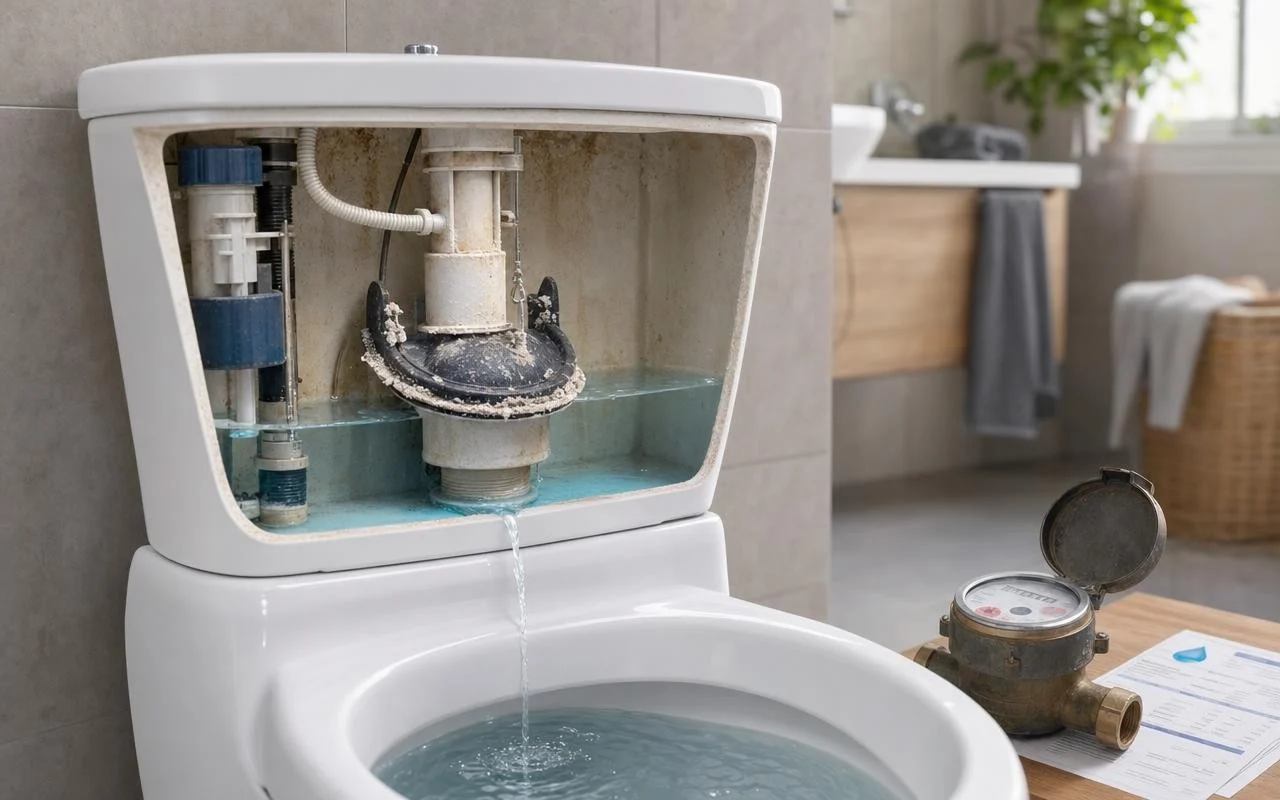
Your toilet looks perfect: no running, no water marks in the bowl, the handle works with every flush. Many households stop at these reassuring signals and tell themselves that the toilet flush is not to blame. Yet inside the tank, a tiny seal can let a continuous trickle slip out, completely invisible. Day after day, this silent leak quickly reaches tens, then hundreds of litres, without anyone noticing.
The numbers are sobering: a flushing mechanism that leaks continuously can waste between 150 to 600 litres per day, i.e., the daily consumption of a family of four. According to the Water Information Center, a simple continuous trickle reaches 25 litres per hour, about 600 litres in a day. In the majority of cases, the culprit hides at the bottom of the tank: a bottom valve calcified that no longer provides a seal. And a simple kitchen experiment is usually enough to settle it.
Silent toilet flush leak: how a calcified bottom valve lets water slip away
The bottom valve is a rubber membrane that blocks the opening at the bottom of the tank after each flush. Its job is simple: hold back water until the next use. When this seal deforms, wears, or becomes encrusted with limescale, it no longer seats perfectly on its seat. A trickle then flows continuously along the interior walls of the bowl, with no visible jet or splash. From the outside, everything seems normal.
This thin trickle slowly empties the tank; the float falls, the float valve reopens, and the tank refills again. This discreet cycle repeats every ten to twenty minutes, even at night. Modern tanks are designed to refill with as little noise as possible, which further masks the problem. In regions where the water is very hard, the buildup of limescale on the valve and its seat often suffices to create this ghost leak, without any part actually breaking.
Silent toilet flush: quick tests to confirm a leak at the valve
First concrete clue: the bill. A marked increase in consumption, with no change in habits, often signals a discreet leak. To be sure, the meter test remains very telling. Simply note the reading before going to bed, avoid using water during the night, then compare upon waking. If the figures have moved, it means a circuit is running continuously in the home, with the toilet among the main suspects.
To target the tank, the food coloring test is incredibly simple:
- pour a few drops of dye or syrup into the full tank,
- wait 30 to 60 minutes without flushing,
- observe the water in the bowl.
If the water in the bowl colors without any action, there is a leak. When the colored water reaches the bowl directly through the wall, bypassing the overflow, the valve seal is usually at fault. To confirm, you can wipe the inside of the bowl, place a sheet of toilet paper under the rim and check whether it becomes damp without flushing.
Repair the calcified toilet flush valve and prevent the return of the silent leak
Once the leak is confirmed, the repair remains within reach for many DIY enthusiasts. Start by closing the water supply valve and completely emptying the tank. The flush mechanism comes apart, and the valve is usually removable with a simple quarter turn on newer models. If the seal is only coated with scale, soaking it in a 50% hot water and 50% white vinegar mixture for a few hours dissolves the mineral deposits without harming the rubber. In about half the cases, this operation is enough to regain perfect watertightness.
When the seal appears cracked, hardened, or porous, replacement is necessary. A new valve costs between 15 and 40 euros, and the repair pays for itself within a few weeks on the bill. The Ecological Transition Agency estimates that untreated leaks can lead to an overconsumption of 5 to 150 m³ of water per year. To limit the recurrence, regularly pour a glass of white vinegar into the tank every two or three months, let it act overnight, then flush in the morning to help slow the buildup of mineral deposits. It is also better to avoid chlorine-containing tablets left continuously, as they gradually attack rubber seals and promote exactly the leak we want to prevent.
