
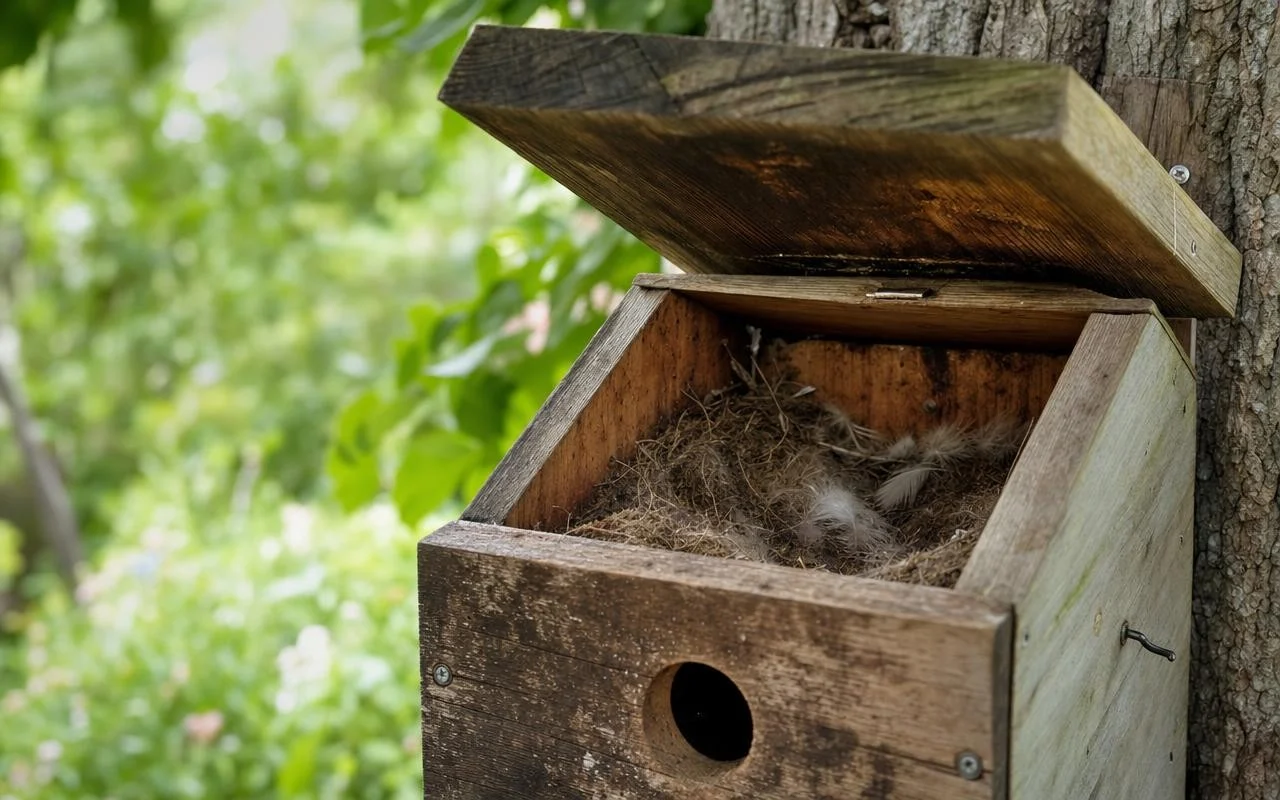
At the moment, the choice seemed obvious: after the fledging of the young blue tits at the end of June, not touching the nest box anymore to avoid risking disturbance if a second brood arrived. The small wooden cube remained closed, still, almost sacred, throughout July.
It was only at the end of August that the roof was lifted, out of curiosity and to “see where they had lived.” Inside, the nest no longer looked idyllic: a compact mass, a strong odor, tiny moving black specks. Two months of waiting had been enough, and the “too late” was already there.
Why leaving the blue tit nest box intact can harm the next brood
For many gardeners, not intervening after the youngsters fledge seems to be the most respectful gesture. In reality, a nest box that one thinks is empty is never truly so. What remains are moss, feathers, droppings, and remnants of insects, a perfect mix for parasites to settle in permanently.
In this decomposing material are commonly hidden the bird fleas (Ceratophyllus gallinae), red mites (Dermanyssus gallinae) and the flat flies of the genus Crataerina. According to specialists, two months are enough for fleas and mites to completely colonize the nest and the wood. The danger is not immediately visible; it mostly unfolds in the following spring.
When to clean a blue tit nest box without really disturbing them
The episode of the opened roof at the end of August can be alarming, but the date itself is not too early. Experts remind us that one can clean a blue tit nest box from the end of summer, provided one is sure that it no longer shelters a brood, nor a second late brood. The mistake is rather having left the nest in place for two whole months, just after the young have definitively departed.
Naturalist organizations often recommend an annual cleaning after breeding, ideally in October or November, when the nesting season has ended. At that time, the risk of displacing bats, a dormouse, or a queen wasp that might have chosen the nest box to hibernate is also limited. In any case, the right reflex is to discreetly observe the entrance: if there is no comings and goings for several days, the nest box can be emptied.
How to clean a blue tit nest box: a simple protocol, without products
Even before thinking about a brush or hot water, one safety point must be considered. Never slide a hand into a nest box without knowing what it contains, because a rodent, a snake, or stinging insects may have taken up residence there. Wearing gloves is advised to remove the old nest and handle the box.
Once the nest box is thoroughly empty, the protocol remains very simple:
- completely remove the old nest, feathers, fur, and dust;
- vigorously brush the interior walls with a stiff brush;
- pour boiling water on all internal surfaces, corners, and the underside of the roof;
- let it dry completely, in the open air and sheltered from rain, before closing it again.
Chemicals such as bleach, detergents, or garden-center insecticides are not recommended: their odor lingers, can repel the birds, and toxic residues risk poisoning future occupants. Specialists remind that boiling water is enough to eliminate parasites in 90% of cases. A well-dried nest box, with the interior wood left bare, will more readily attract new blue tits, which in turn can consume thousands of caterpillars in the garden. Finally, remember that a cleaned nest box can still serve as a roost in winter, which justifies a quick look before each new intervention.
Sources
- Mon Jardin Ma Maison
“Blue Tits and Heat: hanging a wet old T-shirt near the nest box may save their lives this summer”
