
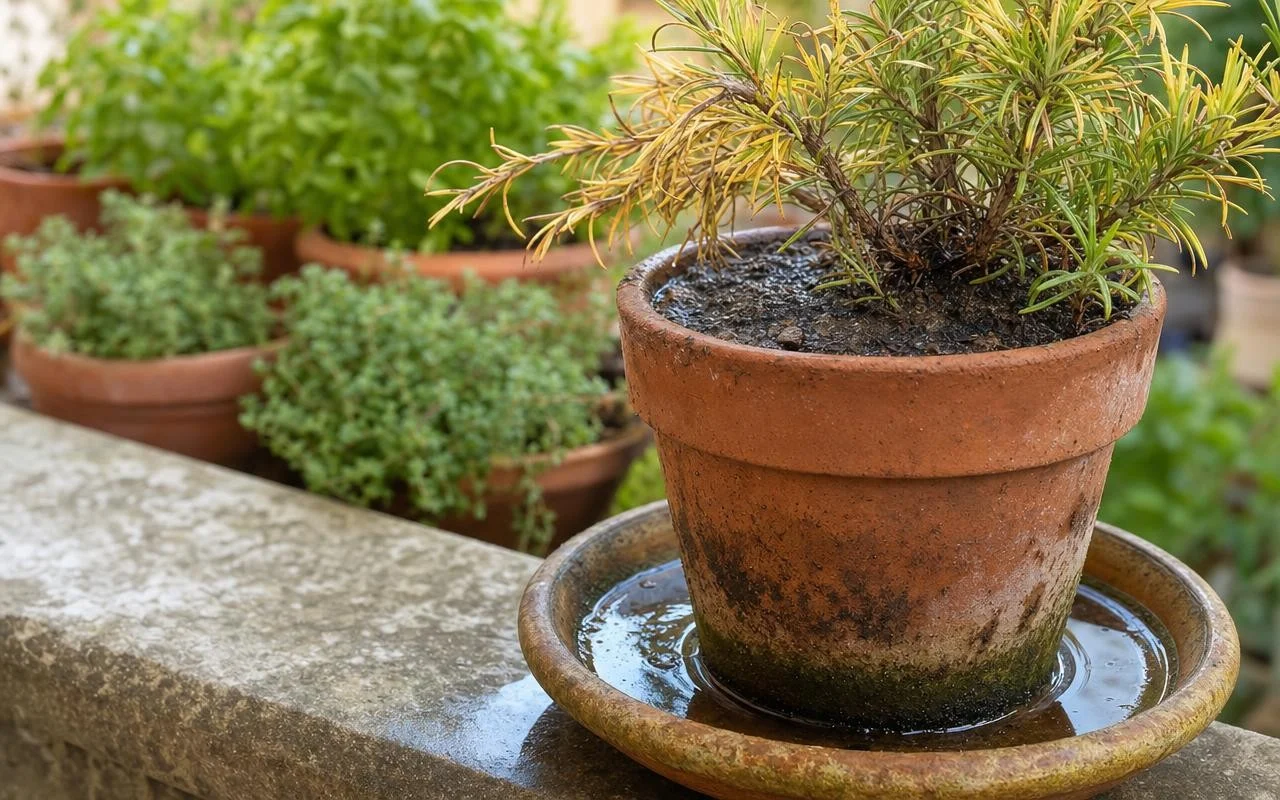
Your pot of rosemary seemed to be enjoying a perfect romance with the sun. Then, within a few weeks, the shoots dried up, the leaves fell, despite all your watering “to help it.” Many gardeners experience exactly this scenario, convinced that this Mediterranean plant ultimately needs more water than advertised.
The reality described by experienced gardeners is more puzzling: this rosemary that looks thirsty often suffers from a hidden problem in the pot or in the soil, far from a mere “water shortage.” Understanding what happens around the roots changes everything for the survival of this plant, already renowned for being nearly indestructible. The rest of the story sometimes holds a pleasant surprise.
Why a rosemary that is too watered ends up drying out
Rosemary is a true drought-tolerant plant, accustomed to poor soils and burning summers. A specialized article from Xataka Home explains very clearly: “Rosemary is a xerophytic plant, adapted to long droughts and dry soils, so the problem rarely comes from watering it too little, but rather from overwatering.” In other words, excess water is, by far, the most frequent culprit.
The article also reminds us that rosemary needs very light, well-aerated soil. “When the substrate becomes compacted, water stops filtering properly and the roots remain compressed. The result is that they rot from the inside, even if externally the plant appears simply dry.” We therefore tend to blame a lack of water while the plant is already suffocating and suffering root rot.
Watering and drainage: the actions that save a rosemary
To escape this vicious circle, specialists advise breaking the watering routine. “The simplest rule is to wait until the substrate is completely dry before watering again,” summarizes the Xataka Home article. At planting, old practices involved a very heavy watering to settle the soil, followed by two or three deep waterings spaced 2 to 3 weeks apart, before letting the rosemary fend for itself almost entirely.
The secret also lies in soil quality and drainage. A Mediterranean plant expert, Jean-Yves Meignen, reminds us: “It does not like soils that are too moist or clayey.” In heavy soil, he recommends planting rosemary on a mound and, in a pot, “adding gravel to improve drainage.” The old-timers summarized the recipe as “full sun for at least 6 to 8 hours, very well-drained soil, never any standing water,” with a mineral mulch of 5 to 7 cm to maintain just the right amount of coolness.
Rosemary in a pot or creeping: common mistakes to avoid
Many people place their rosemary indoors or in a semi-shaded corner. The Xataka Home article warns, however: “It is common to bring rosemary indoors or leave it in a semi-shaded area, thinking it will suffer less. It’s exactly the opposite.” To prevent substrate compaction, the authors recommend aerating the soil every two weeks and, if it hardens, repotting into a slightly larger pot. As for fertilizer, a feeding every six months with “a balanced mix of humus or compost and sand” is enough.
For the creeping rosemary, Jean-Yves Meignen is categorical: “Never prune a creeping rosemary!” This ground-cover form naturally reaches 1 to 1.2 meters in diameter; simply give it space. Xataka Home also mentions red spider mite and mealybugs, which weaken the plant, as well as fungi that thrive in moist conditions. These are identifiable by “yellowing leaves or, in the case of Alternaria, black spots”; the authors recommend cutting away the affected parts and applying an organic fungicide.
Sources
- Pleine Vie
“Lavender, rosemary, santoline, sedum: these four perennials that old gardeners planted in June withstand 40°C all summer without irrigation”
