
Taking a chicken out of the freezer at the last moment, leaving it on the counter, or running it under hot water to save time: many households still operate this way. In France, foodborne illness outbreaks affected 16,763 people in 2022, of whom 17 died, according to Santé Publique France.
These outbreaks do not come only from industrial products: a sloppy defrosting at home is enough to provide a buffet for bacteria such as Salmonella, Escherichia coli, Campylobacter, or Listeria monocytogenes. Young children, pregnant women, the elderly, or immunocompromised individuals are particularly vulnerable. The question remains how to thaw meat without taking unnecessary risks.
Pourquoi une mauvaise décongélation fait exploser les bactéries
Contrary to popular belief, the freezer does not sterilize foods. Cold slows the growth of microbes, but many survive freezing. Salmonella, E. coli or Listeria wait simply for the temperature to rise in the meat. “If thawing is not done properly, the bacteria will resume their growth,” notes virologist Dr. Océane Sorel.
The problem arises mainly at room temperature, on the countertop or near a heat source. The surface of the meat quickly reaches an ideal zone for bacterial multiplication, while the core remains frozen. Some species, such as Listeria monocytogenes, resist even the cold of the refrigerator. They can cause severe infections, sometimes deadly.
Eau bouillante, micro-ondes, comptoir : les faux amis
Submerging a frozen roast in very hot or boiling water may seem convenient, but it creates an entirely uneven defrosting. The outside heats up quickly and stays in a temperature range favorable to germs for a long time, while the center remains as hard as ice. This thermal shock also damages the fibers and causes the juices to run out, thus compromising the meat’s texture.
The microwave oven poses another problem: some areas begin to cook while others remain frozen. “Be careful—the microwave does not necessarily achieve a uniform temperature throughout the food and thus may not kill all bacteria as effectively as simmering or oven cooking,” reminds Dr. Sorel. If you use it, always follow with complete cooking, without pause. The main missteps are as follows.
- thawing meat on the countertop at room temperature;
- rinsing it with hot or boiling water;
- microwaving it and then letting it rest before cooking.
Trois méthodes sûres pour décongeler la viande
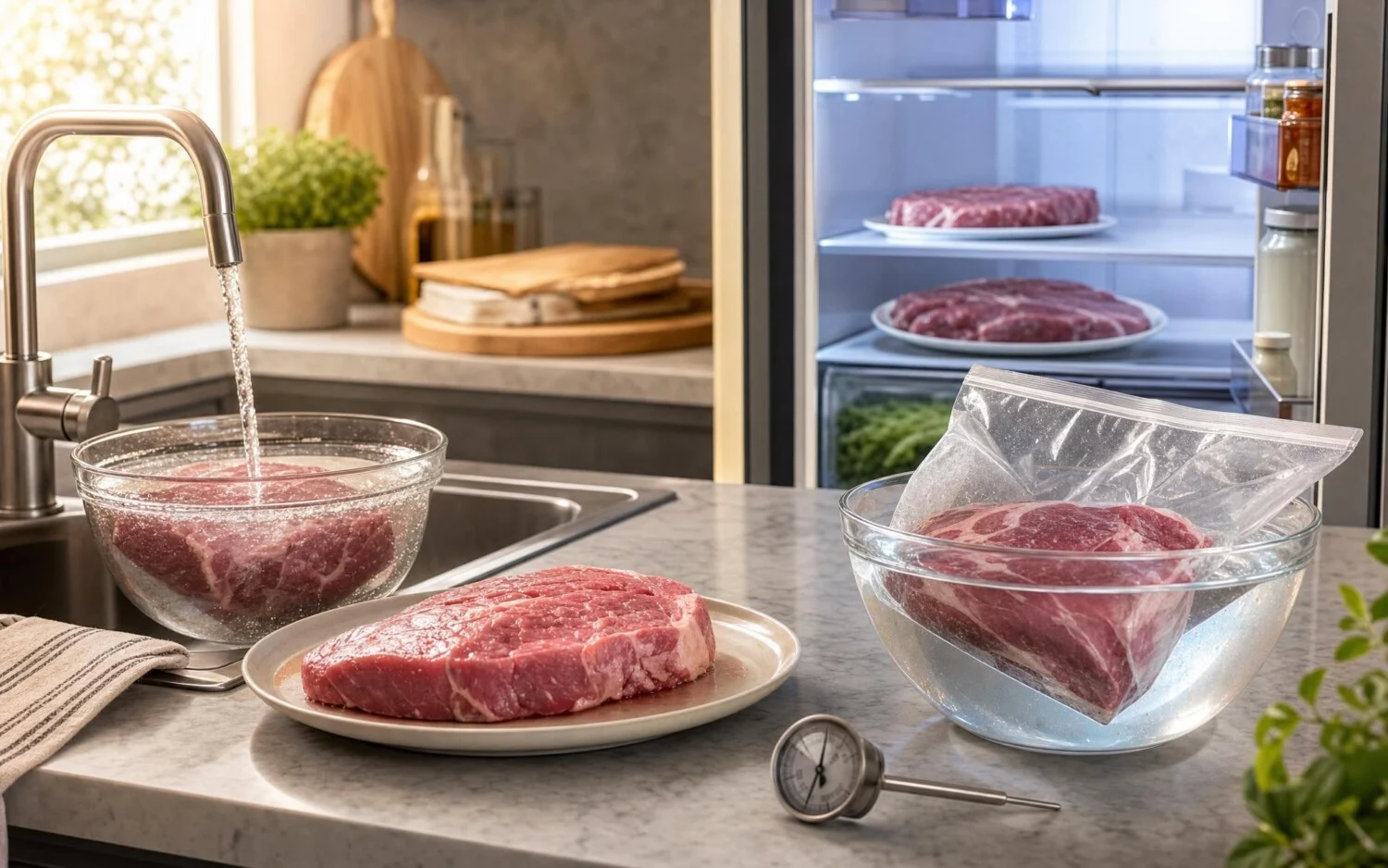
The safest method remains the refrigerator. Santé Canada recommends placing the meat in a clean dish, on the bottom shelf, to catch the juices and prevent cross-contamination. Plan about 24 hours of thawing for 2.5 kg of poultry. Once the meat feels pliable to the touch, cook it promptly.
If you’re in a hurry, a safe alternative is cold water, provided the packaging is well sealed. Thaw the meat under a cold running water stream or immerse it in a container, changing the water every 30 minutes. The microwave remains possible for a quick fix, but only if cooking follows immediately. For frozen ground beef, the Pasteur Institute even advises cooking directly without prior thawing. “The best protection against the risk of salmonellosis is proper cooking of foods, especially meats, to at least 65 °C for 5 to 6 minutes,” recalls the Pasteur Institute. Refreezing meat that is fully thawed is discouraged, except after thawing in the refrigerator followed by complete cooking, as in the case of turkey used in a blanquette.
