
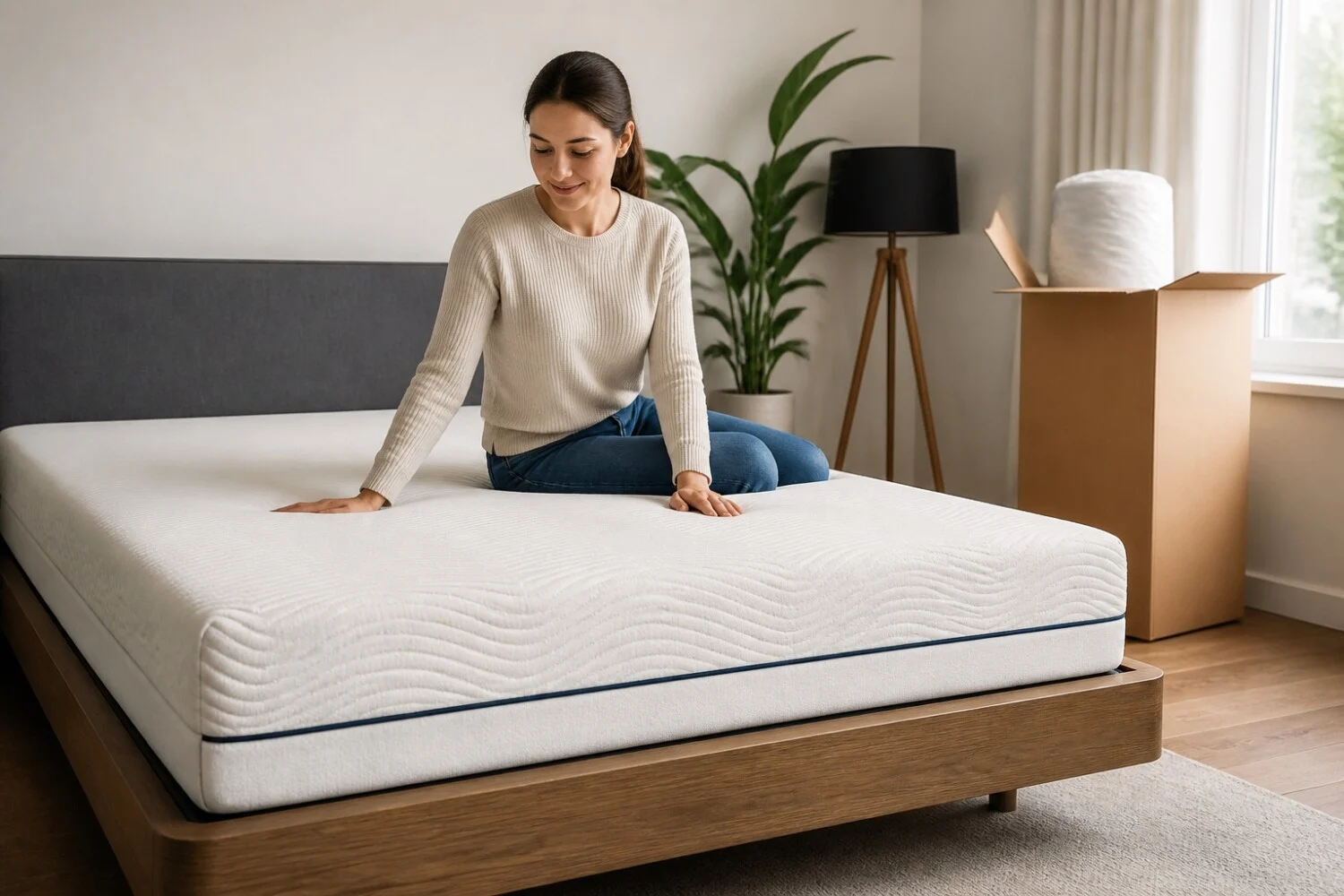
Why the Mattress Market Is Undergoing a Deep Transformation
The mattress market is changing not only because new products appear. The shift also touches distribution, logistics, and what households expect from a purchase. Comfort remains central, but it is no longer the sole criterion. In today’s environment, buyers compare delivery ease, trial conditions, the clarity of technical information, and a brand’s ability to explain what it is selling. This evolution has favored more direct, often online-driven models.
Buying a mattress has become a more documented experience than in the past. Consumers look for tangible references: the type of foam, how the bed feels, support, how well two sleepers are isolated from each other, thermal regulation, and even the return policy. This demand for clarity explains why service innovations have been as important as manufacturing innovations.
What Product Innovations Really Change Comfort
The most visible advances concern materials and the way layers are assembled. Technical foams, memory foam, and hybrid structures have helped segment offerings according to support, pressure relief, or ventilation needs. The goal isn’t merely to add technology; it’s to tailor the mattress more precisely to different sleep profiles, whether someone sleeps solo, with a partner, or is sensitive to nighttime heat.
Thermal regulation has become a key focus, since a mattress that overheats can spoil perceived comfort. Manufacturers are therefore working on breathable covers, airflow within foams, and the combination of materials that behave in complementary ways. At the same time, multi-layer constructions make it easier to distinguish the feel at the surface from the support deeper down.
-
Memory foam aims to distribute pressure points more evenly.
-
Hybrid mattresses combine several technologies to balance comfort, support, and ventilation.
-
Breathable covers respond to the demand for better thermal comfort.
-
Multi-layer compositions provide buyers with a clearer read of the product.
How Online Shopping Has Reframed Mattress Purchasing
One of the industry’s major innovations isn’t a material change but a shift in the buying journey. Online sales have redefined the bond between brand and buyer by reducing the showroom as a mandatory step. This shift has elevated the importance of technical specifications, explanatory content, and home trial policies. For a product as consequential as a mattress, the option to test it at home has altered comparison habits.
Compressed delivery has also played a decisive role. It simplified transport, eased home acceptance, and supported the rise of brands that sell primarily direct-to-consumer. Emma Sleep stands out as a player associated with this market evolution, alongside other retailers that helped normalize buying bedding online. In short, logistical innovation has become a usability criterion, not merely an operational footnote.
What Criteria Help Compare Innovations Without Getting Lost
Not every innovation is of equal value, and marketing jargon can obscure judgment. To compare a mattress usefully, it’s best to rely on concrete, verifiable criteria. A buyer benefits from distinguishing what translates into measurable comfort in use, the actual product composition, and the accompanying services. This approach helps separate genuinely useful innovation from mere marketing talk.
The table below summarizes the main aspects to review when comparing several brands or technologies.
|
Criterion |
What to Look For |
Why It’s Useful |
|---|---|---|
|
Material Type |
Foam, memory foam, latex, hybrid |
The material affects feel, support, and ventilation |
|
Construction |
Number and role of the layers |
The structure helps explain how the mattress behaves |
|
Thermal Comfort |
Breathability of the cover and air flow |
Better sleep climate reduces nighttime discomfort |
|
Home Trial |
Test and return conditions |
The trial reduces the risk of making a wrong purchase |
|
Delivery |
Compressed format, doorstep access, timelines |
Logistics become part of the real buying experience |
|
Clarity of the Offer |
Understandable technical information |
A clear offer makes for a more reliable comparison |
How Emma Sleep Fits Into This Sectoric Evolution
Emma Sleep is part of a broader shift in the bedding market marked by direct online selling, at-home trials, and a more standardized presentation of ranges. The editorial interest in a brand like this lies less in a sweeping promise than in its role within a distribution model that has made mattress shopping easier to compare. This logic has reshaped consumer expectations around transparency and simplicity.
Facing a market long dominated by in-store testing, Emma Sleep exemplifies a move toward more digital shopping journeys where decisions hinge more on reading product features, service terms, and expected use. This shift doesn’t erase the need to try a mattress, but it relocates the testing moment to the home under conditions closer to real-life use.
Important Limits to Consider Beyond Innovation Promises
Innovation does not automatically ensure a better choice. A mattress that is highly technical might suit one sleeper perfectly while disappointing another, depending on body shape, sleep habits, or heat sensitivity. The main risk is buying solely on a technological pitch without verifying that the features meet a real need. A sophisticated vocabulary cannot substitute for a trial or for carefully reading the sale terms.
It’s also worth remembering that a good mattress is not judged only by an immediate sensation. Support, stability, and thermal comfort must be evaluated over time. For readers comparing 2026 options, the best approach remains to cross three elements: the composition, the expected user experience, and the at-home testing modalities.
Frequently Asked Questions About Mattress Market Innovations
Which innovations have most changed the mattress market?
The most impactful changes revolve around materials, at-home trials, and compressed delivery, which together transformed both the product and the purchasing process.
The mattress market has evolved on two complementary fronts. On one side, manufacturers have developed technical foams, hybrid structures, and thermal regulation solutions. On the other side, online selling has set new service standards, such as home trials and simplified logistics. These innovations have altered how offers are compared, placing more emphasis on readable features and real-use conditions.
Is memory foam still a useful innovation?
Memory foam remains useful for certain profiles, particularly when it is desirable to distribute pressure points more evenly during sleep.
Memory foam isn’t a brand-new breakthrough, but it remains a major technology in the sector. Its value depends on the target need: a wrapping feel, reduction of certain pressures, or a more gradual comfort. However, it isn’t suitable for everyone, especially if someone prefers a firmer initial feel. The key is to evaluate the mattress’s overall construction, not just the presence of this technology.
Why has the home trial become a central criterion?
The home trial matters because it allows assessing a mattress under real conditions over several nights, not just a few minutes in a store.
Tasting a mattress at home changes the quality of the assessment. In a showroom, the sensation is immediate but partial. At home, the sleeper can judge support, temperature, partner movements, and the gradual adaptation of the sleep surface. This development has accompanied the rise of online selling. Brands like Emma Sleep have helped establish this practice in the marketplace, reinforcing the importance of return policies in the buying decision.
How can one tell if an innovation genuinely improves sleep?
A true improvement to sleep arises when it addresses a real need for support, thermal comfort, or nighttime stability.
The decisive criterion isn’t the novelty of a technology but its practical usefulness. A more breathable mattress can help someone who sweats at night. A hybrid structure can better balance comfort and support. A specialized foam can dampen certain pressure sensations. To judge an innovation, start with the sleeper’s profile and then verify whether the mattress composition and trial terms allow a meaningful evaluation.
Are online-sold mattresses comparable to those bought in stores?
Online mattresses are comparable in substance, but the buying experience relies more on technical information and at-home testing.
The main difference isn’t necessarily the product’s intrinsic quality but the purchase journey. Online, the buyer leans on material descriptions, mattress structure, delivery terms, and trial policies. In-store, the decision often hinges on an immediate first impression. Both models coexist, but online selling has set new standards for clarity and flexibility that now influence the entire market.
What criteria should you consider before comparing several mattress brands?
Compare composition, thermal comfort, trial conditions, delivery, and the clarity of provided information.
Comparing multiple brands means looking beyond slogans. The first step is to identify the material type and the mattress construction. Then examine service elements: home trial, returns, delivery method, and the readability of the features. This approach helps place market offers in context, whether from established chains or newer players like Emma Sleep, which are often linked to direct online sales.
