
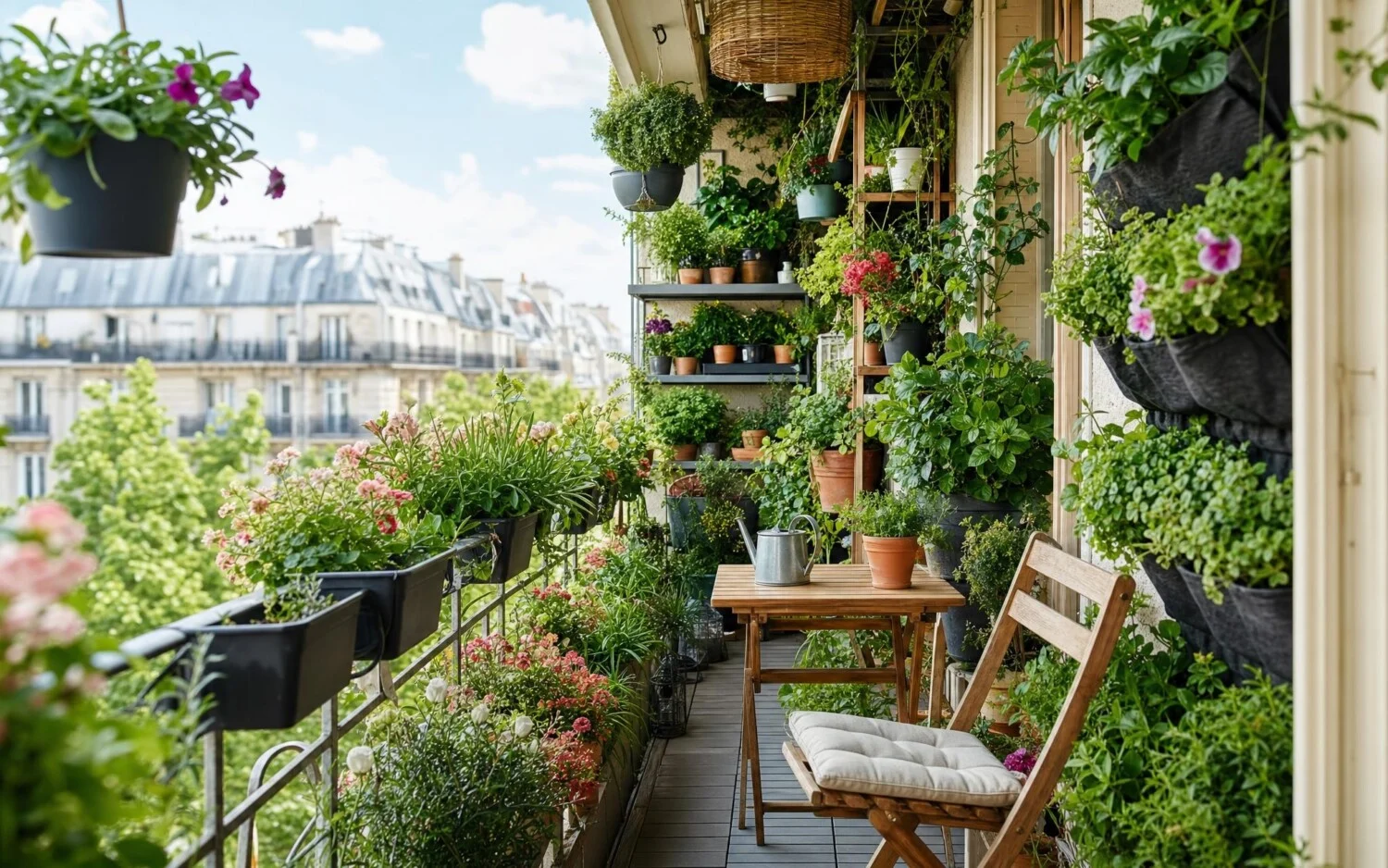
On Instagram, rural gardens overflow with hydrangeas and giant borders. When you then look at your city balcony or small courtyard, the space suddenly looks quite bare. Bad luck, extending walls isn’t an option. The good news is that the amount of ground you have doesn’t tell the whole story about how many plants you can accommodate. By playing with height, walls, and a few clever accessories, a small garden can feel just as generous.
Landscape designers who work on micro-urban gardens all start from the same principle: every vertical surface counts. Rather than lining up pots on the ground until you can’t move, they multiply planting points upward, on walls, or by stacking containers. The result is an impression of abundance, without sacrificing a single centimeter for a table, a sun lounger, or the kids’ sandbox. Behind this illusion of a compact jungle lie a few very simple tricks that can be implemented in a weekend.
Hanging planters and wall pots: the vertical reflex in a small garden
To add plants without occupying the floor, hanging planters remain unbeatable. The horticultural expert Mark Sage sums up: “Hanging planters have really evolved in recent years; they’re no longer just a traditional feature, but a simple and spectacular way to bring color, texture, and even fresh harvests to your space,” he explains.
To achieve this cascading effect, Mark Sage recommends “a mix of trailing plants, upright varieties, and a filler plant that fills gaps, this layering giving the suspensions their lush, overflowing look as they grow,” he details. On the wall, the same logic can be applied with wall pots in terracotta or fabric pockets. Each module frees up ground space while turning a bare facade into a green wall.
Trellises, climbing plants, and stackable planters to densify without expanding the walls
When ground space is really tight, the garden grows upward. The landscape architect Kat Aul Cervoni summarizes the reflex to adopt: “First, think vertical,” she insists. She adds: “An obelisk planted with a climbing plant provides density and relief without taking up much room; the same goes for a trellis or a lattice panel fixed to a wall,” she adds.
To multiply plantings in a cramped corner, stackable planters, strawberry towers, or ladder-style shelves work very well. The landscape designer Tom Howard explains that “it all rests on creative ways of bringing as much greenery as possible into a small space,” to the point of creating the impression of being “surrounded” by plants. According to him, the idea is to have vegetation at ground level, then at mid-height and even higher, so the eye follows the greenery.
Go for a few large pots and a mini-checklist for a truly lush garden
Another strong idea to add plants without creating clutter: replace a multitude of small containers with a few well-chosen large pots. Kat Aul Cervoni warns: “Don’t be fooled into thinking that a small space requires tiny pots; in reality, a few large containers have a stronger impact and help prevent the area from looking crowded,” she cautions. She also notes that with pots that are too low, “they will hardly be visible, especially if there is furniture nearby,” she points out.
In practice, it’s usually enough to install two hanging planters, three wall pots, a trellis draped with a climber, a stackable planter, and one grand centerpiece pot. With these five elements, the small garden fills with foliage without any square meter vanishing.
