
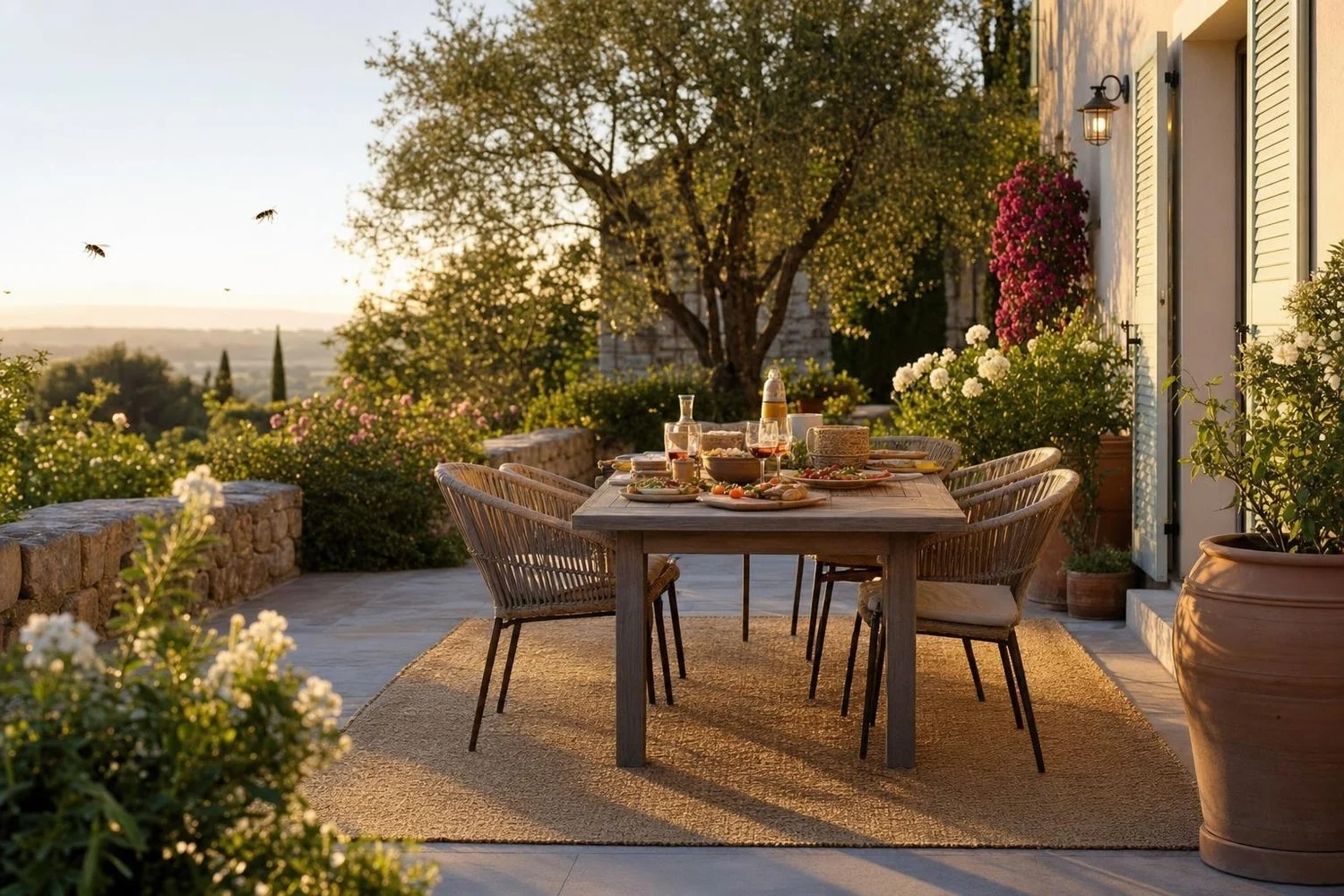
One summer evening, a long table set under the pergola, glasses beaded with condensation, children laughing… and those insistent circles of wasps around the dishes. Many people today reach for sprays and traps, whereas previous generations had a much more discreet reflex: unrolling a rug beneath the garden table. The gesture is making a comeback in 2026, and it is far from being merely a decorative fling.
Wasps belong to the order Hymenoptera, which counts more than 130,000 species worldwide, including social wasps, solitary wasps, and hornets such as Vespa crabro or Vespa velutina. Always in pursuit of food, they become more insistent toward the end of the season and can sting multiple times if they feel threatened, with a risk of severe reaction such as Quincke’s edema. Hence the interest in gentle solutions to keep them away from the plate. It all starts with a simple rug placed in the right spot.
Why the elders rolled out an outdoor rug under the garden table
On a terrace with wooden slats or with paving, crumbs and sticky drips fall into crevices that no one ever sweeps. For a wasp, these remnants are a real hidden buffet. By installing a large matte mat or an outdoor rug under the table and chairs, the elders actually created a filter: anything that falls is trapped on the surface, rather than lodging in the gaps.
On a plain or patterned textile background, crumbs, sauce stains and sugary drinks become immediately visible. A simple sweep with a broom or dustpan is enough to remove them before the insects notice. This action mainly improves the hygiene of outdoor meals, but it also reduces the food cues that attract wasps. And recently, another, more visual explanation has captured attention.
How the rug erases the wasps’ landmarks on the terrace
Light-colored tiles, polished concrete slabs, blond wood: these surfaces strongly reflect light in bright sunshine. This vertical mirroring effect creates a field of reflections that wasps use when patrolling in search of nutrients. As soon as a matte textile surface is laid down, the light is absorbed, the reflections fade, and the area around the table becomes much more uniform for the insect.
Deprived of these bright reference points, the wasp seems less inclined to circle above the furniture for long. It passes, inspects briefly, then leaves. The rug’s presence does not scare or hurt it, but the perimeter offers fewer visual and olfactory anchors. For more peaceful outdoor meals, this strategy respects the place of these Hymenoptera, useful to the garden, while avoiding drawing wasps and hornets near the guests.
Mode d’emploi du tapis anti-guêpes et petits gestes à associer
For the trick to work, it’s best to choose a large outdoor rug that covers the entire dining area, is water-resistant, and easy to sweep. It should be shaken out before each use, then laid flat. The method becomes more effective when combined with a few simple habits around the table.
- Before the meal: cover dishes with wicker or mesh domes, place sugary drinks out of reach and move the trash can away, tightly closed.
- During: immediately wipe spills on the rug, especially syrup and fruit juice, and avoid leaving very ripe fruits and uncovered grilled meats around.
- After: sweep the rug promptly, gather leftovers, and dispose of them far from the dining area.
To distract the most insistent visitors, some also set up a small offering at a distance: a bowl of syrup, a piece of spoiled melon, or a few overripe fruits placed several meters away. The wasps then focus on this highly attractive point, rather than the main table. If despite everything the presence becomes massive, this may indicate a nearby nest: better to avoid sudden movements, not attempt to destroy the nest yourself, and consult a specialized service, especially in cases of a history of allergic reactions to stings.
