
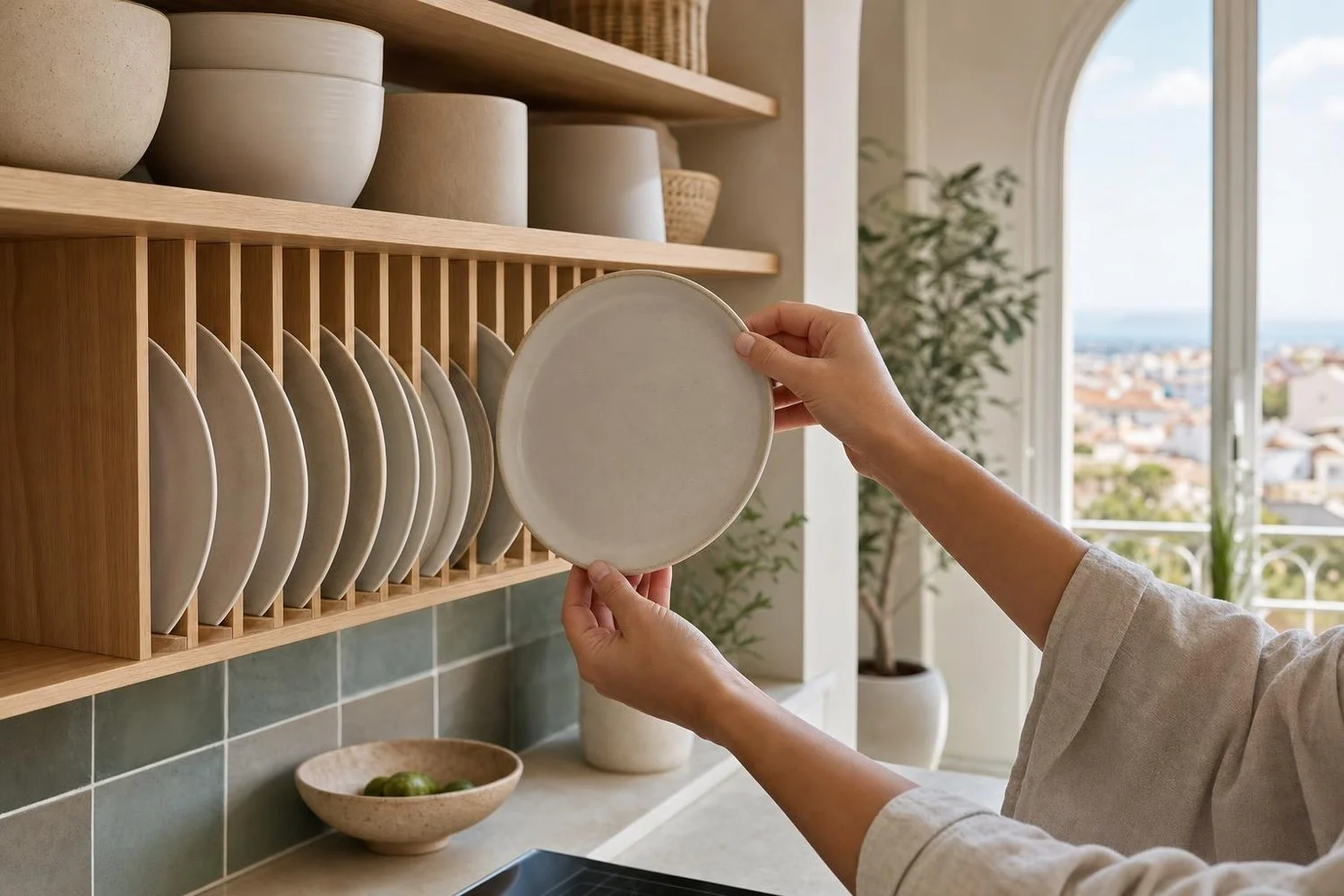
In many kitchens in Spain as in France, stacks of plates rise to the edge of the shelves and threaten to topple at the slightest movement. Iberian media speak of a near-miraculous solution to tidy everything up, taking Japan as a model. Without major renovations or new furniture, a simple way of stacking the dinnerware promises more space and less breakage.
Apartment kitchens are getting smaller, especially in cities, and every square centimeter now counts. In Spain, several articles published in spring 2026 present Japanese interiors as an example: little surface, but millimetric organization. What draws attention is the way the plates are stored. Behind a very ordinary gesture, the entire volume of cupboards changes.
Why classic plate stacks waste space
In the Maison et Travaux article, plates piled up haphazardly become unstable stacks ready to topple, giving an impression of permanent clutter on the open shelves. Before moving a single plate, the home-organizer Christelle Barthod begins with sorting. She sums up her philosophy in one sentence: “You don’t just tidy the mess, you eliminate it!”, explains Christelle Barthod.
To prevent breakage on a daily basis, Barthod recalls a simple rule: “Heavy things on the bottom, light ones on top.” Large flat plates stay on the lower levels, while small plates and bowls rise higher. She also warns about visual pollution: “If you see them all the time, there are things you stop noticing at home, but it still counts as visual pollution.”
The Japanese vertical storage method for plates
The major difference from traditional habits lies in the direction in which things are stored: in Japan, plates are often kept vertically, like files in a filing cabinet. Maison et Travaux thus cites vertical plate holders that let you slide each piece one by one. In Spain, this approach appeals because it frees up cabinet surfaces while making every plate instantly accessible.
In the spirit of this Japanese vertical plate storage, described as an “millimetric organization” by Le Journal de la Maison, the method rests on three simple steps.
- Sort: keep only the plates used daily close at hand, setting aside the service for special occasions.
- Group: plates flat together, then dessert plates, then bowls, according to how often they’re used.
- Choose a system: vertical plate rack, half-shelf, or short piles on a non-slip mat to stay stable.
Adopting the Japanese vertical plate storage at home
Once these categories are defined, each family of plates finds its place. In small kitchens, the famous half-shelves or over-shelves double the usable surface by creating a second level. Bins or baskets placed on the shelves slide out like a drawer, without moving the entire stack. To go further, IKEA offers the UPPDATERA support, designed to “fit into any cabinet or drawer,” sold at 12.99 € according to Le Journal de la Maison.
This modular support avoids friction, and thanks to its side handles, it allows moving an entire stack with a single gesture. To keep the system practical, Christelle Barthod recommends limiting the number of motions: “two or three movements maximum” to take or put away a plate. She reminds that “the proximity principle should govern: spices and oils near the cooking area; teas, coffees, and infusions near the coffee maker and kettle, etc.” Applied to plates, this logic places everyday service near the dishwasher and the more delicate pieces higher, while keeping on the open shelves a few harmonious stacks that lighten the kitchen.
Sources
- Maison & Travaux
“Plates on open shelves: 15 Japanese storage tips and the UPPDATERA plate rack from IKEA to correct the mistake everyone makes in the kitchen”
