
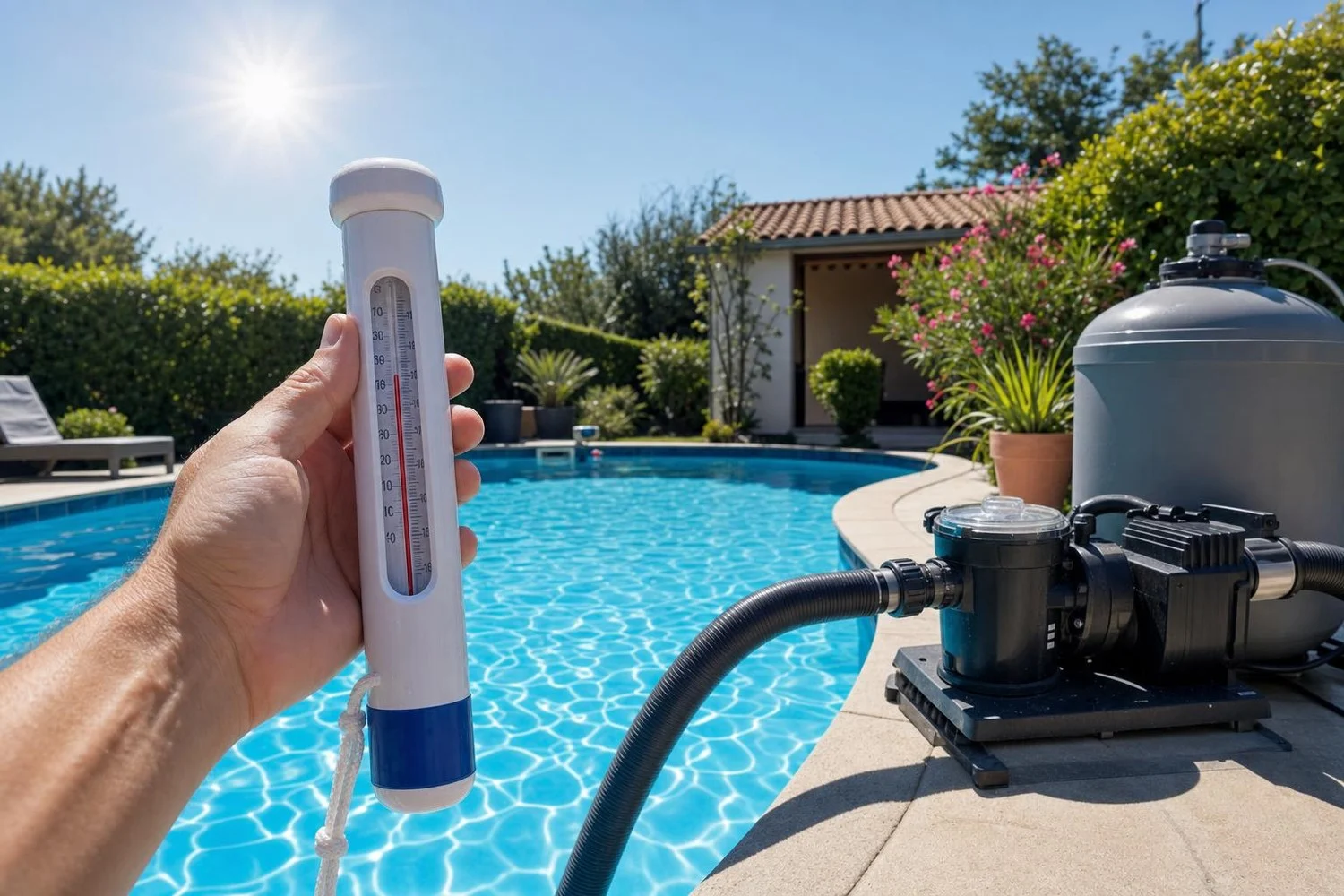
When the temperature climbs, the pool becomes the ideal refuge… until the water becomes murky and then turns green. Under the effect of a heat wave, algae grow very quickly, disinfectants are consumed more rapidly, and the slightest misadjustment can be costly. Many pool owners then see their basin transform into a pond in a matter of days, or even hours during an exceptionally hot spell.
At the heart of the problem, a simple fact: the water temperature. It is this temperature that dictates the required filtration time to keep the water clear. Professionals speak of the thermometer rule, an easy-to-remember formula that allows the pump to be adjusted day after day. For Laurent Piscine, a pool installer in the Puy-de-Dôme, this reflex often makes the difference between a blue pool and green water.
Thermometer Rule: How Many Hours Should Pool Water Be Filtered?
The rule is simple: filter every day for a number of hours equal to half the water’s temperature. Concrete example: for water at 20 °C, the pump should run about 10 hours, at 24 °C around 12 hours, at 28 °C about 14 hours. This benchmark, widely adopted by pool manufacturers, prevents water from stagnating for too long and limits the growth of algae.
Note, read the thermometer in the water, not on the weather app. The thermometer rule relies on the actual temperature of the pool, which can stay high late in the evening during a heat wave. The warmer the water, the faster organic matter decomposes and feeds the algae; if the pump does not circulate enough, these microorganisms quickly colonize the walls and produce that famous green tint.
Above What Temperature Should Filtration Run Almost 24/7 During a Heat Wave
When the water exceeds 28 °C, several pool guides recommend significantly extending filtration, or even letting the pump run almost continuously. In a heavily used pool, with frequent swims and a lot of sunscreen, short bursts quickly prove inadequate to maintain clear and disinfected water.
In the field, Laurent Piscine is even stricter: “The recommendation is that above 25 degrees, it should run 24 hours a day,” he explains. For him, the calculation is quick: “It’s better to spend 10 or 15 euros more on electricity than 200 euros on products,” sums up the professional, who sees every summer families forced to urgently catch up a water that has turned green.
Green Water, pH, Chlorine and the Cover: Reflexes to Adopt
According to Laurent Piscine, “it accelerates chlorine consumption.” The disinfectant is therefore depleted more quickly; if its level drops and the filtration remains too short, the water ends up turning green. The professional recommends checking the chlorine, keeping the pH between 6.8 and 7, and reminds us that with a sand filter it takes about three days to restore clear water.
If the water has already turned, Laurent Piscine advises to “lower the pH first, then treat with a shock chlorine.” He favors un-stabilized chlorine and believes that budget products are “the main cause of green waters.” For the cover, he reminds: “Where evaporation is greatest is when the outdoor temperature drops below the pool temperature”; better to leave the basin open during the day and cover it in the evening.
