
Fresh watermelon wedges served ice-cold are a delight for everyone. Twenty-four hours later, the same watermelon cut into pieces has released juice, the flesh has softened and the flavor already seems blander. Not surprising for a fruit that contains about 95% water, notes the Spanish Foundation of Nutrition.
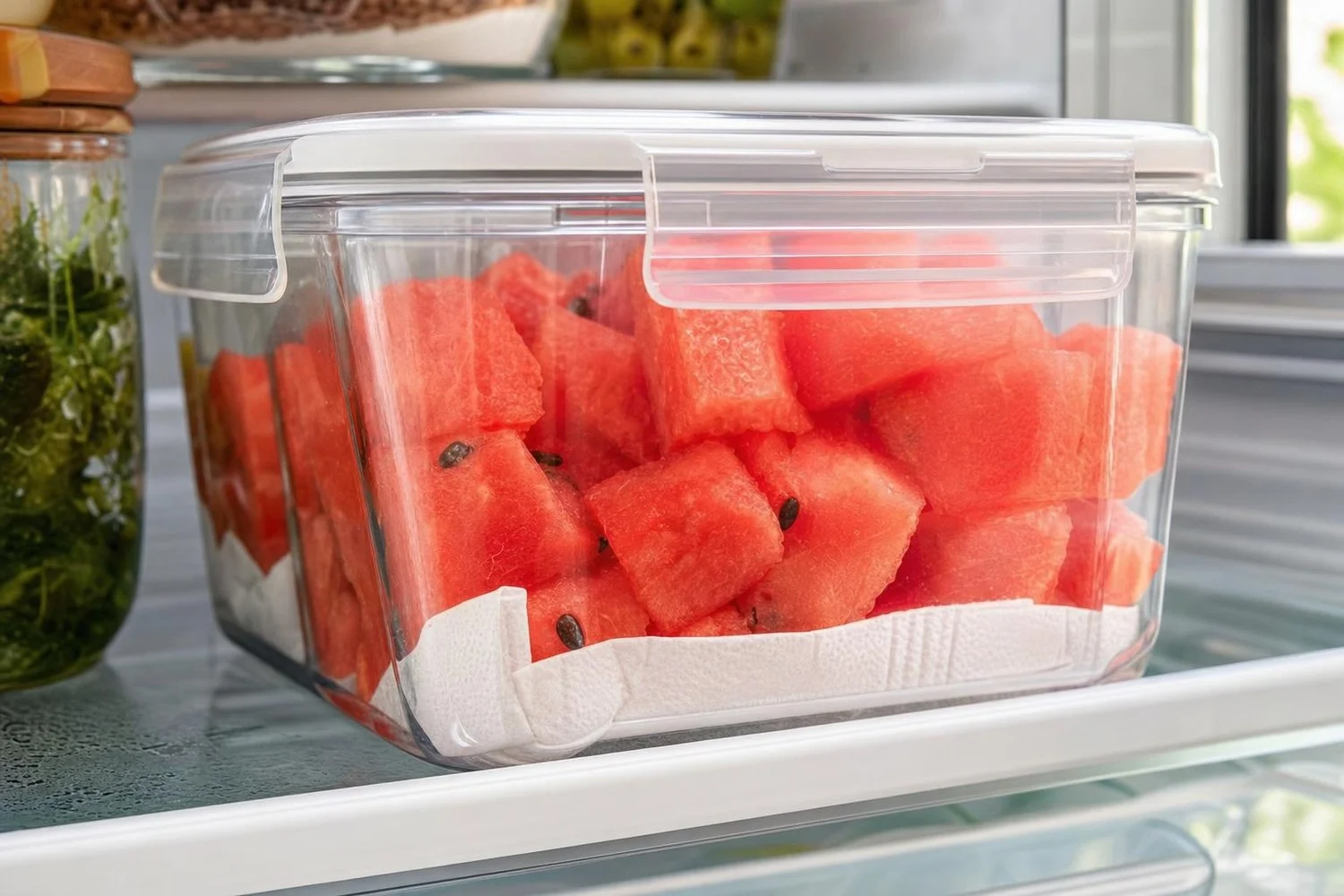
Between whole watermelon, half-cut, and cubes already ready, we often wonder how to keep it truly fresh. Grocers, though, have a simple but incredibly effective move: a single sheet of paper towel at the bottom of a closed container. A reflex that changes everything.
Storing Cut Watermelon: The Grocers’ Extra Step
As soon as a watermelon arrives already cut in two, the Spanish source insists: it is essential to put it quickly in the refrigerator. If you buy it whole, as soon as you open it, it is better to cut the remainder into smaller portions and place them in the cold. Fruit sellers add a key step to keep the texture firm: place at the bottom of the container one or two sheets of kitchen paper. This paper absorbs the excess moisture that naturally escapes from the flesh and prevents the pieces from bathing in their own juice, which speeds up the softening process.
The watermelon has at the outset a natural protective barrier: its rind. Once removed, the pulp is exposed and bacteria such as E. coli or Salmonella can develop more easily, especially for a fruit as watery as this. To limit these risks, experts recommend covering the cut portion with plastic wrap or transferring it to an airtight container. Leaving half a watermelon open directly in the fridge causes it to spoil more quickly, despite the cold.
Whole Watermelon, Half, or Cubes: Adapting Storage
As long as the watermelon remains whole, its thick rind acts as a shield. Once cut, the right reflex is to protect the cut area immediately. On a half, you can clamp plastic wrap against the flesh, or better yet, place the cut side down on a plate lined with absorbent paper, then cover everything. For cubes and slices, the ideal is to store them in one or two layers in a container with a lid, on a bed of kitchen paper, before closing and refrigerating.
For pre-cut watermelon sold in stores, the Consumers and Users Organization (OCU) calls for vigilance. It recommends ensuring that the trays are kept in the refrigerator and that the label shows the date and time of cutting. If the pieces remain at room temperature and only the price is visible, better to abstain. The OCU also recommends preferring slightly less ripe fruits to extend their storage and to refrigerate them as early as possible, without letting them stay out of the cold chain.
Freezing Watermelon and Avoiding the Mistakes That Ruin It
When you know you won’t finish a large watermelon in the days ahead, freezing becomes a good option. Before cutting, it is advised to thoroughly wash the rind to remove dirt and bacteria. Then cut into cubes, slices, or balls, laid out on a sheet of parchment paper, making sure the pieces do not touch to prevent sticking together. After about two hours in the freezer, transfer them to bags or hermetic containers, perfect later for smoothies or iced fruit-infused waters.
- leave a half watermelon unprotected in the refrigerator,
- pile the cubes in a dish where the juice pools at the bottom, without absorbing paper towels,
- believe that cold is enough and neglect washing the rind and proper hermetic sealing.
As the Spanish Foundation of Nutrition summarizes: “Watermelon is one of the most enjoyed fruits in summer due to its strong refreshing power and its high water and mineral content. In reality, it is the fruit with the greatest amount of water, since about 95% of its weight is water. Because of this, its energy content is low and, in general, its nutrient content is limited, even if it provides notable amounts of various vitamins and minerals. One of the most interesting aspects of its composition is its carotenoid content without provitamin A activity, particularly lutein and lycopene. Among them, lycopene stands out, as watermelon is one of the main dietary sources of this phytonutrient, with a concentration of about 2,454 micrograms per 100 grams of edible portion,” explains the Spanish Foundation of Nutrition (FEN).
