
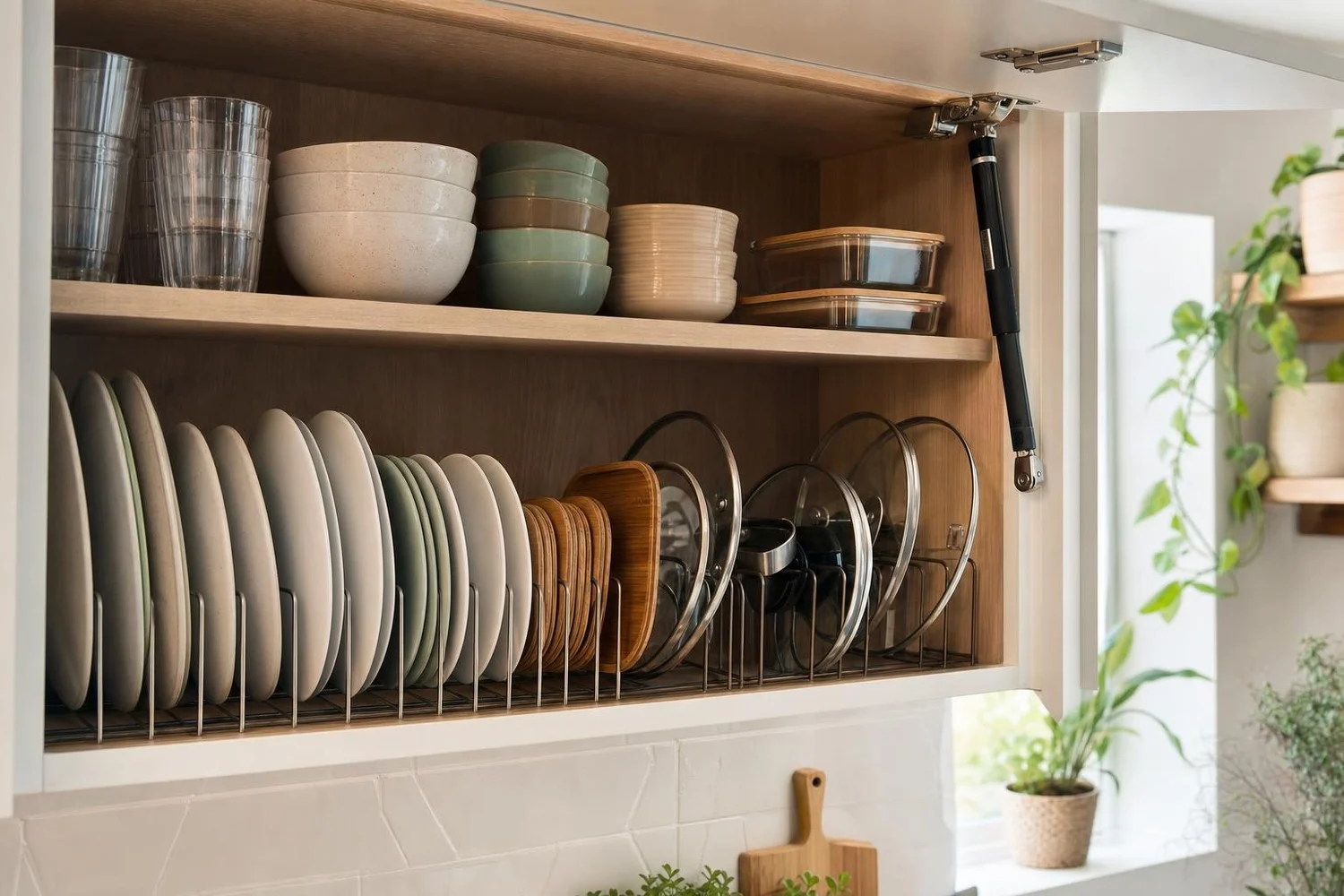
For years, I believed my kitchen was too small. The cupboards overflowed, stacks of plates threatened to topple, and every lid seemed to play hide-and-seek behind a shaky tower. Like many, I stacked everything—from Sunday service to everyday dishes. Until the day I discovered a method from Japan that made me view my cupboards in a whole new light.
That day, watching how Japanese families store their dishes in tiny apartments, I realized the problem wasn’t the size of my kitchen but how I used the space. A simple trick, inspired by this art of organization, allowed me to empty almost an entire cabinet: it all starts with a new way of placing plates.
Why stacking dishes wastes space
Stacking seems logical, yet this habit complicates everything. A pile of heavy plates requires lifting the whole stack to reach the one underneath, with a risk of breakage at every move. Sites like Marmiton also remind that the pressure between two ceramic or porcelain plates eventually creates micro-scratches. Another issue: when everything is stacked, you only see the top of the stack and you forget what you own.
This tower-like arrangement uses up the full height of the cabinet without truly exploiting it. The plates clutter the middle, the back stays hidden, the front becomes a danger zone. Home magazines nevertheless emphasize a simple decluttering rule: keep the everyday tableware within reach, and stash the rest higher up or elsewhere. To gain space, you must especially stop stacking everything.
Japanese vertical storage: plates and lids on the edge
In many Japanese interiors, dishes are stored like books. The idea is simple: place plates and lids on their edge, using separators or plate stands, instead of forming piles. The Senior Journal describes this system as a very orderly arrangement that protects ceramicware from chipping and allows you to see each piece at a glance. You choose, you take, without ever lifting an unstable tower.
This logic of Japanese vertical dish storage also applies to large platters, boards, and pot lids. They are slid also on the edge, in the same supports, to structure the inside of the cabinet or drawer. The magazine Maison et Travaux highlights metal plate holders priced around €12.99, but any sufficiently rigid separator will work. The important thing remains to keep a slight gap between each piece to prevent knocks.
Adopt the method at home: a very simple how-to
To move from theory to practice, it’s best to go zone by zone. A short ten-minute session is often enough to transform a cupboard. Storage specialists advise starting with a quick sort, then installing the new system. You can follow this very simple sequence:
- Empty the cabinet completely and group the dishware into three categories: everyday use, special occasions, seasonal dishes.
- Place the everyday plates and lids on edge in separators, making sure they are stable.
- Stack bowls by size and choose stackable glasses to free up surface.
- Gather seasonal dishware in a bin or dedicated box, to be placed on top of the unit or in another space.
Once these steps are in place, the effect is immediate: the cabinet looks almost empty, the countertop breathes, and each item finally has its place. Since I adopted this storage method, I no longer search for my lids and I bring out my pretty dishes much more often.
