
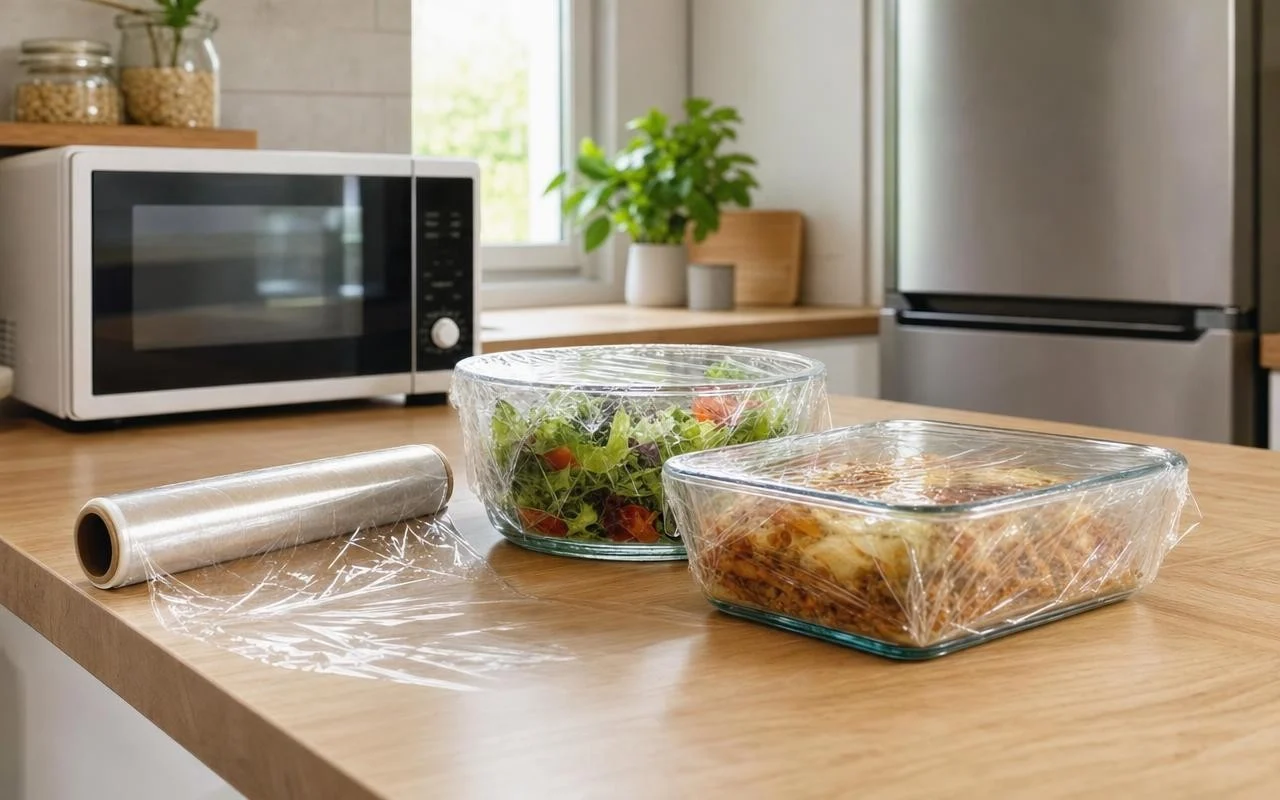
We cover leftovers of gratin, a salad, a cake… Stretch wrap seems the kitchen’s perfect ally, so practical that we hardly think as we unroll it. Yet this plastic is among materials that come into contact with food, and its use follows precise rules.
The DGCCRF notes in a briefing published on February 18, 2026 that substances can migrate from packaging into the food product. In a 2022 survey on materials in contact with food, 1,254 establishments were surveyed, 27% of the 350 samples analyzed were non-compliant, and 33 posed potential danger. It remains to determine in which cases the cling film becomes a misstep.
Safe Food Film: decoding logos before use
Food-contact stretch films are part of the MCDA, materials intended for contact with food, regulated by Regulation (EC) 1935/2004 and Regulation (EU) No 10/2011. They must stay inert so as not to alter odor, taste, or the composition of the dish, even when they contain plasticizers like certain phthalates.
For the consumer, the first indicator is the glass-and-fork pictogram indicating suitability for food contact. One should then read the notes: microwave compatibility, possible temperature range, restrictions for fatty foods or oily foods. If the packaging does not clearly specify microwave use, the DGCCRF recommends avoiding it.
Heat, fatty foods, oven: when food wrap goes astray
Studies on plastic films have shown that migration increases with temperature, duration, and direct contact, especially when the food surface is fatty. The heat-plus-fat combination thus becomes the red zone: no food wrap in the traditional oven, on a frying pan, a griddle, or near a flame.
| Usage | Verdict |
|---|---|
| Raw vegetables in the refrigerator | OK |
| Dish cooled before refrigerating | OK |
| Dough for bread or pie resting | OK |
| Bread or dry cakes to store | OK |
| Very odorous cheese in the refrigerator | OK under conditions |
| Freezing a food that is already cold | OK under conditions |
| Wrapped cooled preparation then frozen | OK under conditions |
| Opened ice cream surface protected | OK under conditions |
| Bowl covered with microwave-safe wrap | OK under conditions |
| Ordinary film placed in the microwave | To be avoided |
| Film in contact during microwaving | To be avoided |
| Greasy dish, sauce or butter reheated | To be avoided |
| Cooking in a traditional oven | To be avoided |
| Cooking en papillote in film | To be avoided |
| Film on a pan, plancha or barbecue | To be avoided |
| Recipes that cook directly in the film | To be avoided |
| Reuse of a film already used | To be avoided |
| Film that has touched raw meat or fish | To be avoided |
| Industrial pallet-type film | To be avoided |
| Imitating vacuum packing with film | To be avoided |
Another precaution is hygiene: these films are designed for single-use. Reuse should be avoided, especially after contact with raw meat or fish, and industrial non-food films, which are not regulated as MCDA, should also be avoided.
Applying the right daily reflexes of food wrap
To decide in a few seconds whether a given use falls within the twenty safe scenarios or those to avoid, a simple grid really helps.
- Is the food cold or lukewarm and not very fatty?
- Is heating planned, especially in the microwave or oven?
- Does the wrap bear the glass-and-fork pictogram, or even a microwave designation?
If any answer is uncertain, it is better to switch to a glass dish with a lid or to a jar.
