
Evenings are getting cooler, and thoughts turn already to sweaters and radiators running at full blast. In many households, fear of the cold as well as the next heating bill pushes people to get the most warmth from each radiator without changing the entire installation. A small task, often overlooked in September, can indeed make a difference in how warm the rooms feel.
In spring and summer, radiators stay off for months, while dust, lint, and pet hairs accumulate inside, between the fins and behind the upper grills. This layer acts as an insulating barrier that slows the flow of hot air and gives the impression that the radiator isn’t heating well, even when the boiler or the electric unit is running at full power. Several British and Spanish home sites remind that a simple ten-minute routine, performed before restarting the heating, is enough for them to feel warmer, thanks to a common household item stored in the bathroom.
Why a dusty radiator seems less warm
A radiator, whether hot water or electric, heats primarily by convection: air enters at the bottom, warms upon contact with the walls, and exits at the top. When the interior is filled with dust and lint, air circulates less freely between the fins, it is slowed before entering the room. According to the Spanish site Okdiario, these deposits can form a real insulating barrier that obliges the boiler to work much harder to reach the same temperature.
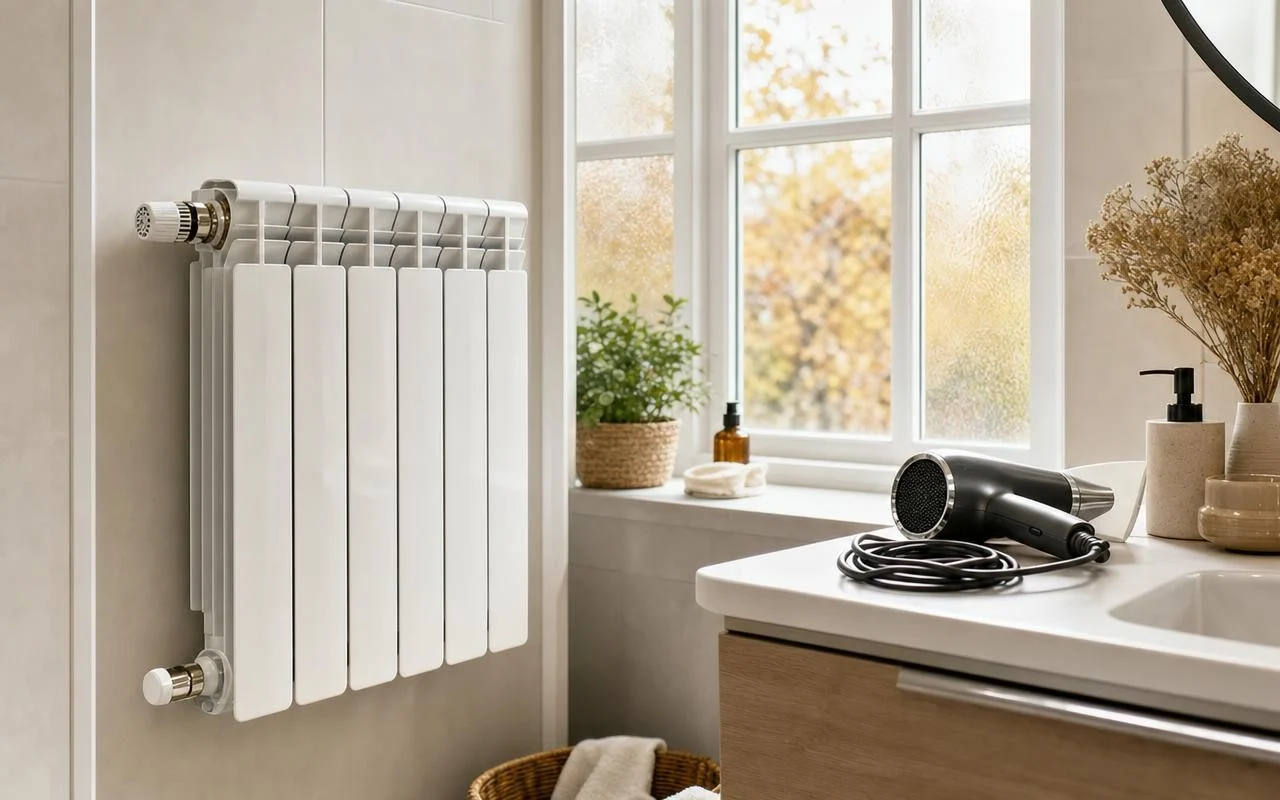
Another unpleasant effect: at first ignition, this dust can heat up abruptly and release a burning smell throughout the living room. In an article dedicated to the subject, a resident of an old Victorian house in Scotland explains that she prefers to act in September to avoid this. She says: “Taking the time to clean a radiator with a hair dryer is the simplest way to ensure that it is as hot as possible, so I don’t start autumn shivering at home.” Her secret rests solely on cleaning the radiator with a hair dryer before reigniting the heating.
Cleaning a radiator with a hair dryer: the quick method
Good news, you already have everything you need for this ten-minute operation: there’s no need to buy a specific accessory. Simply gather a towel or an old sheet, a hair dryer, a vacuum cleaner, and a lightly damp cloth. Before beginning, the radiator must be completely turned off and cool; for an electric model, also cut the power at the breaker or outlet to work safely.
Then place the towel at the base of the radiator to catch all the dust blown out. The hair dryer is set to the lowest temperature, or even to cool air, with the airflow on maximum. British articles emphasize that air that is too hot doesn’t help lift the particles and may even amplify the burnt smell. It’s enough then to aim the nozzle at the upper grills and slowly move the jet of air from top to bottom. Discard the collected dust, quickly vacuum, and wipe the front with the cloth.
When to perform this cleaning and what to do if the radiator remains lukewarm
Energy specialists, such as Engie on its consumer site, advise dusting radiators before the first switch-on. September is ideal: it isn’t too cold yet, and you can devote ten minutes per radiator, then repeat the gesture in mid-winter if dust returns quickly.
If, despite a thorough cleaning, the top of the radiator remains cold or it gurgles, the problem is probably air in the circuit; you will need to bleed or call a professional.
