
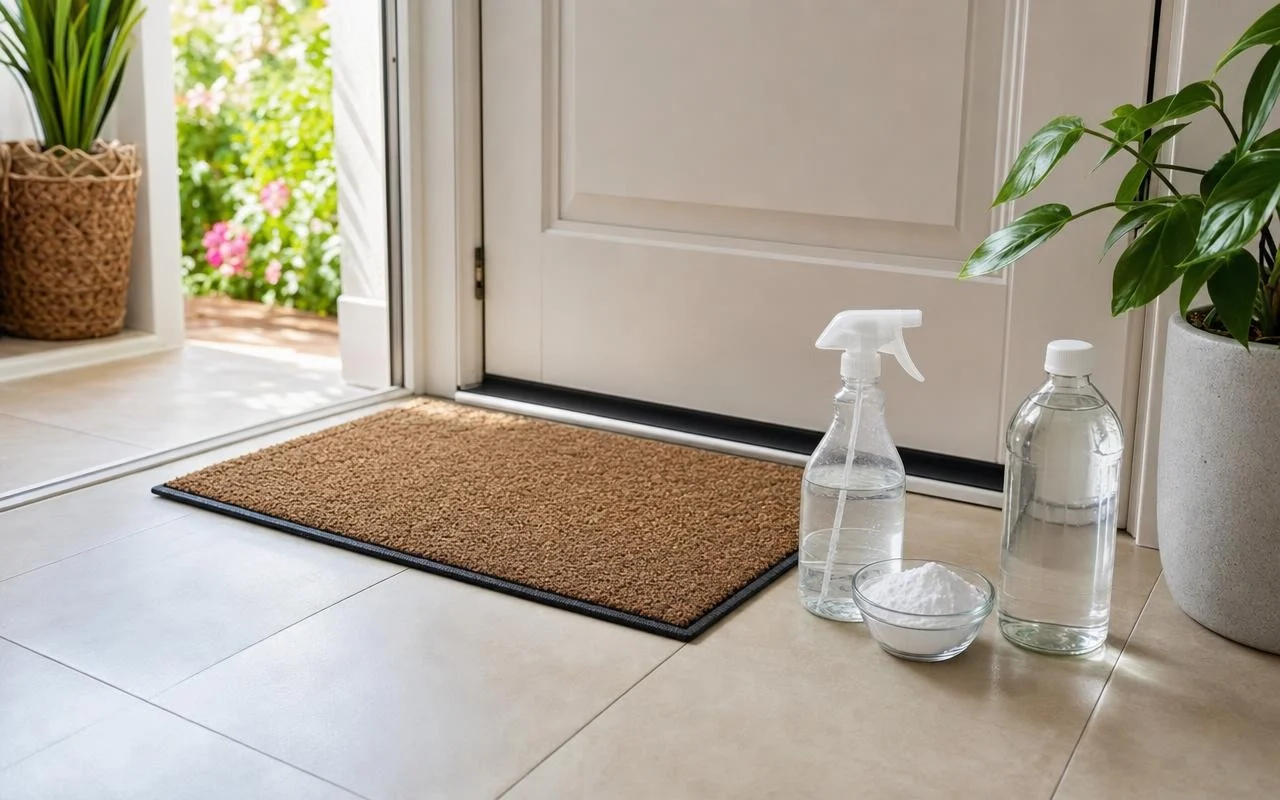
On social networks, the same piece of advice shows up every summer: prepare a homemade spray with white vinegar, liquid detergent, and baking soda, then spray generously at the entry to keep insects at bay. The idea appeals, especially since these products are already found in most cupboards.
Among mosquitoes, flies, and ants drawn to heat, many hope for a simple alternative to insecticides. Recent articles in Spanish-language press succinctly summarize the promise: a cleaner entry that smells less damp, and fewer insects tempted to cross the threshold. But does this mixture really deliver the effect it’s touted to have?
White vinegar, detergent, and baking soda spray: what it really does at the entry
The most widely circulated recipes call for a mixture in equal parts white vinegar and water, with a spoon of sodium bicarbonate and a bit of liquid detergent. Household vinegar typically contains around 5% acetic acid; when combined with baking soda, it triggers an acid–base reaction that releases carbon dioxide, that foaming fizz that the American Chemical Society uses as a classroom example.
In practice, this spray first acts as a mild cleaning product. According to the articles cited by Okdiario or Radio Mitre, it helps degrease the floor, lift dust, mud, and shoe marks on the threshold, while neutralizing certain musty or damp odors. Okdiario notes that adding baking soda to vinegar does not automatically turn the mixture into a highly powerful repellent: it should be viewed more as an entryway maintenance that makes the area less appealing to some insects.
How to prepare and use the home entry spray with white vinegar, baking soda, and detergent
El Cronista describes a simple preparation: a spray bottle filled halfway with water, halfway with white vinegar, a spoonful of baking soda, and a small dash of detergent. The reaction between acid and base releases gas; Radio Mitre therefore recommends not sealing a container too tightly or storing large quantities. The best approach is to prepare just enough for a few days.
The solution is sprayed on the door frame, the threshold, and the areas often soiled by street grime. Sources advise reapplying every few days, especially after rain or after a more thorough cleaning. Radio Mitre notes caution with sensitive materials: limestone, marble, or varnished wood may not tolerate the acidity well, hence the importance of testing first in a discreet spot. The recommendations drawn from the U.S. Environmental Protection Agency also remind not to mix this kind of preparation with bleach.
In which cases is spraying this mixture useful… and when to switch strategies
For a somewhat damp, lightly odoriferous entry, or a few ants passing through, this spray can be of service. El Cronista explains that the vinegar scent might disrupt the chemical trails left by ants, hindering their routes. However media outlets such as La Razón and Okdiario stress nevertheless: it is mainly a cleaning and prevention aid, not a pest-control treatment in the strict sense.
The specialists cited by the National Pesticide Information Center remind us that the true foundation remains integrated pest management:
- store foods in sealed containers and clean up crumbs and spills,
- empty and properly close trash bins,
- eliminate sources of standing water and fix leaks,
- seal cracks and gaps around the door,
- keep vegetation and piles of wood away from walls.
When insects continue to enter despite these measures, or when a colony of ants seems established, sources such as La Razón or Radio Mitre consider this white vinegar, detergent, and baking soda entry spray to be clearly insufficient. Visible cockroaches during the day, repeated indoor mosquito bites, or ants returning promptly point more toward a more structured intervention: species identification, targeted approved solutions, or even professional help. The homemade mix may still function as an occasional maintenance gesture, useful for keeping a threshold clean and less inviting, but it should not substitute a true pest-control strategy.
