
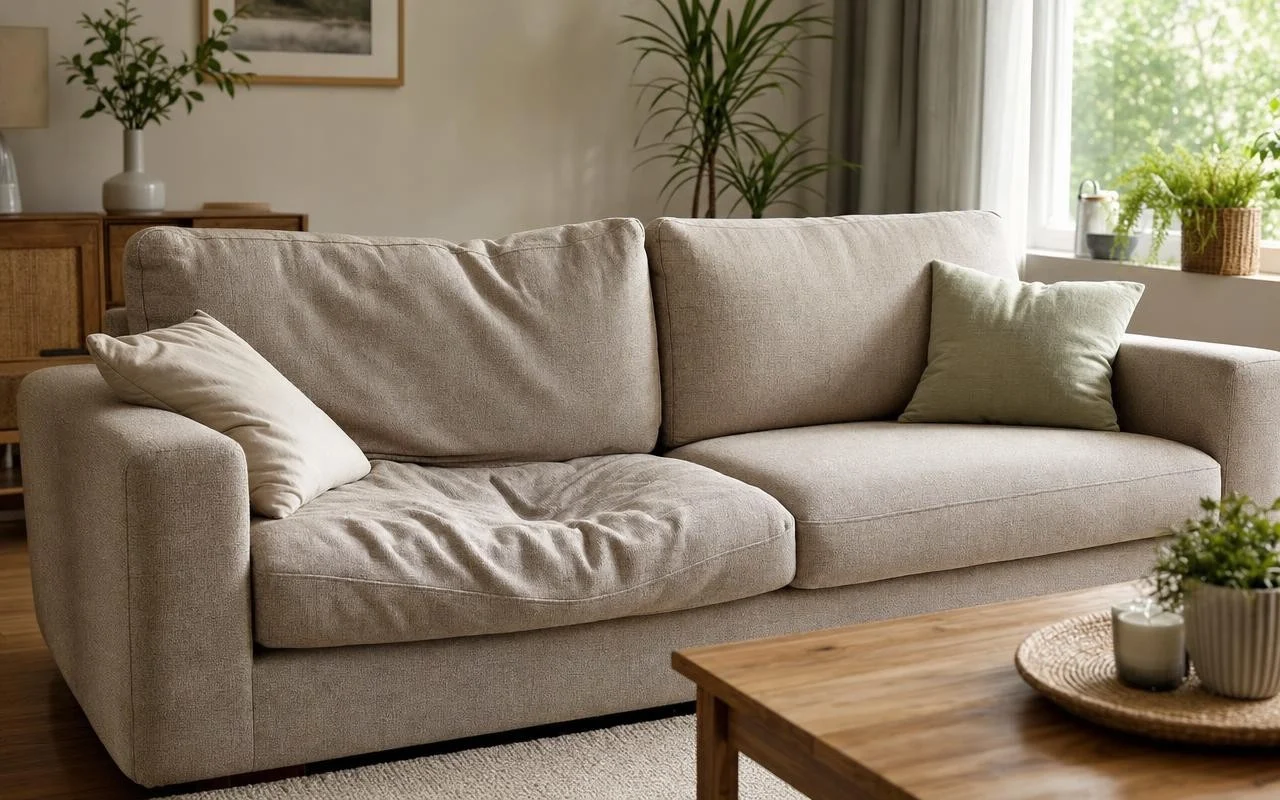
Seeing your sofa sag as soon as you’ve just settled in can quickly spoil a moment of relaxation. The seat lacks bounce, you sink in, and the fabric bunches: many people assume they’ll need to replace the entire sofa. In reality, the problem often comes solely from the cushions. And there are simple solutions to restore them to shape without breaking the bank.
A sofa remains a significant investment, and it bears daily the weight of family, guests, and sometimes even naps. According to American expert Taylar Hoffman, product director at American Leather, repeated use eventually fatigues the foam or padding, especially if the materials are basic. Before buying materials or dismantling the frame, a few quick tests can already steer the repair. You just need to know where to start to restore support to your sofa.
Réparer des coussins de canapé affaissés : commencer par un diagnostic rapide
First instinct: remove all the cushions and press directly on the base of the sofa. If the frame or springs behave like a hammock, with a hollow impression at the center, the sag comes from the structure and not just the cushions, as Lowe’s DIY tutorials detail. When the base remains firm, the culprit is almost always in the foam or padding of the cushions.
On the causes side, Taylar Hoffman sums up the situation very clearly: “It’s generally due to regular use, when the foam or padding loses its shape and support over time,” explains Taylar Hoffman, product director at American Leather. “It can also come from insufficient padding or from materials of poor quality that degrade quickly.” Placing a cushion flat on the floor helps verify it: if it collapses immediately or leaves the handprint, it needs to be reflated or replaced.
Astuces gratuites et petits budgets pour redonner du volume aux coussins
When cushions are removable and reversible, a simple flip can already change a lot. Alternating the front/back sides, but also swapping cushions around once a month limits wear in the same place; Homes & Gardens even advises a rotation every one to two months. This action does not fix foam that is completely dead, but it smooths the early sagging and delays major repairs.
Another zero-cost move: “refluffing” the padding by vigorously kneading each cushion. The batting tends to clump, and a good massage helps redistribute the fibers and regain a few centimeters of volume. When that’s no longer enough, you can add padding through the zipper or by carefully opening a seam. Polyester batting (polyester fiberfill) cited by Taylar Hoffman remains widely used, because it offers good support at a reduced price. In cases where the sofa’s structure lacks rigidity, cushion supports, thin boards, or dense foam panels slipped under the seat provide immediate reinforcement. To guide the process, many DIY enthusiasts follow this order:
- test the base and cushions separately,
- flip and refluff the cushions,
- add padding or support under the seat if needed.
Remplacer la mousse pour une réparation durable du canapé
When the cushion stays flat despite everything, the durable solution is to replace the foam entirely. Taylar Hoffman recommends paying attention to this choice: “Look for high-density foam, memory foam, or foam wrapped in a duvet for optimal comfort and longevity,” Hoffman advises. French specialists in upholstery foam often mention a density around 30 to 35 kg/m³ for a seat used daily, with firmer foam if you want a very tonic feel.
Concretely, it’s enough to unzip the cover, or properly seam one side, then remove the old block. Measure the length, width, and thickness, have a high-density foam block cut to the same dimensions, then slide it into the cover, being sure to fill the corners well. If the base of the sofa still sags, Lowe’s DIY guides suggest adding a plywood board under the cushions, or even replacing sagging springs. To limit the return of sagging, a small routine helps a lot: rotate the cushions regularly, avoid sitting in the same spot, and refluff the batting as soon as the seat starts to show indentations.
