
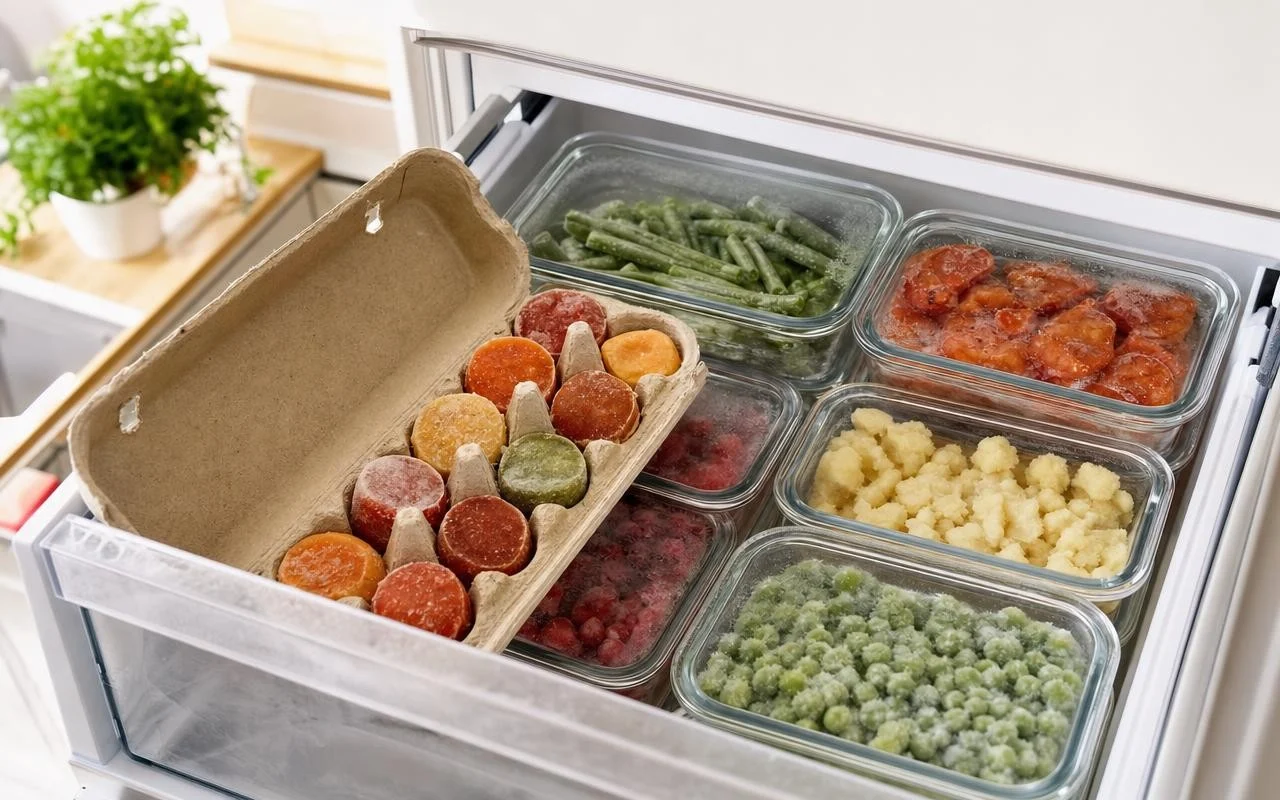
A few spoonfuls of bolognese, a leftover from homemade pesto, a curry sauce that shouldn’t go to waste… On social media, an idea is circulating: freezing sauce portions in a simple egg carton to pull out as needed. The gesture seems clever, economical, and almost eco-friendly. It feels like turning packaging destined for the trash into a magical mold for the freezer.
The principle remains the same: you pour the warmed sauce into the cavities, chill it, then unmold the “pucks” to store them longer. Some tutorials advise using plastic boxes, others cardboard, filling only up to three-quarters and covering loosely. The trick has plenty of appeal, except to food safety experts.
Viral tip: freezing sauce portions in an egg carton
In the versions most widely shared, people recycle an empty egg carton, lay it flat, distribute the sauce into each cavity, then slide the whole thing into the freezer. Once the sauce has frozen, unmold the portions and store them, or leave the carton as is to scoop as needed. The key argument: individually portioned, ready-to-use servings, with no waste.
In the United States, several cooking sites even present this “hack” as a clever form of upcycling. But official services remind that these containers were designed for a specific use: to transport raw eggs, not to serve as molds for ready-to-eat foods. The AskFSIS service, affiliated with FSIS of the U.S. Department of Agriculture, classifies egg cartons among single-use packaging, which changes a lot.
Egg carton and Salmonella: A risk of cross-contamination
The first concern is hygiene. The FDA notes that eggs that look clean can carry Salmonella. The shells and, by contact, the carton can therefore harbor the bacterium. The key concept here is cross-contamination: a surface that has touched raw eggs is not neutral, especially when one then pours a sauce that has already been cooked and that will be reheated only briefly.
A study published in 2021 by the USDA Agricultural Research Service actually showed that reusing egg cartons can allow the transfer of Salmonella Enteritidis between eggs via the carton. In other words, the material can serve as a relay for the bacteria. Or, as the University of Minnesota Extension notes, freezing does not destroy microbes: it temporarily halts their growth, but they can resume once the food thaws. Freezing a sauce in a potentially contaminated carton does not remove the risk; it merely freezes it in time.
Frozen sauce: avoid freezer burn and adopt the right containers
The quality of the sauce itself takes a hit as well. The compartments of an egg carton are not airtight. The University of Minnesota Extension reminds us that exposure to air promotes off flavors and freezer burn, that freezer burn that dries the surface and gives a fibrous texture with discolored patches. The food remains edible, but the taste and texture are clearly degraded.
Experts instead recommend using containers dedicated to freezing, well-sealed, and leaving a small headspace at the top (because liquids expand when frozen). Their “purée” method works very well for sauces: pour the sauce into a clean ice cube tray or silicone food-grade mold, freeze quickly, then transfer the cubes into a freezer-safe bag while squeezing out as much air as possible. Then store at 0°F, or about -18°C, to limit texture and flavor variations.
- Freeze the sauce in a clean ice cube tray or a silicone mold.
- Unmold once solid, then place the portions in a bag or airtight freezer-safe container.
- Label with the sauce name and date, and store at -18°C or lower.
