
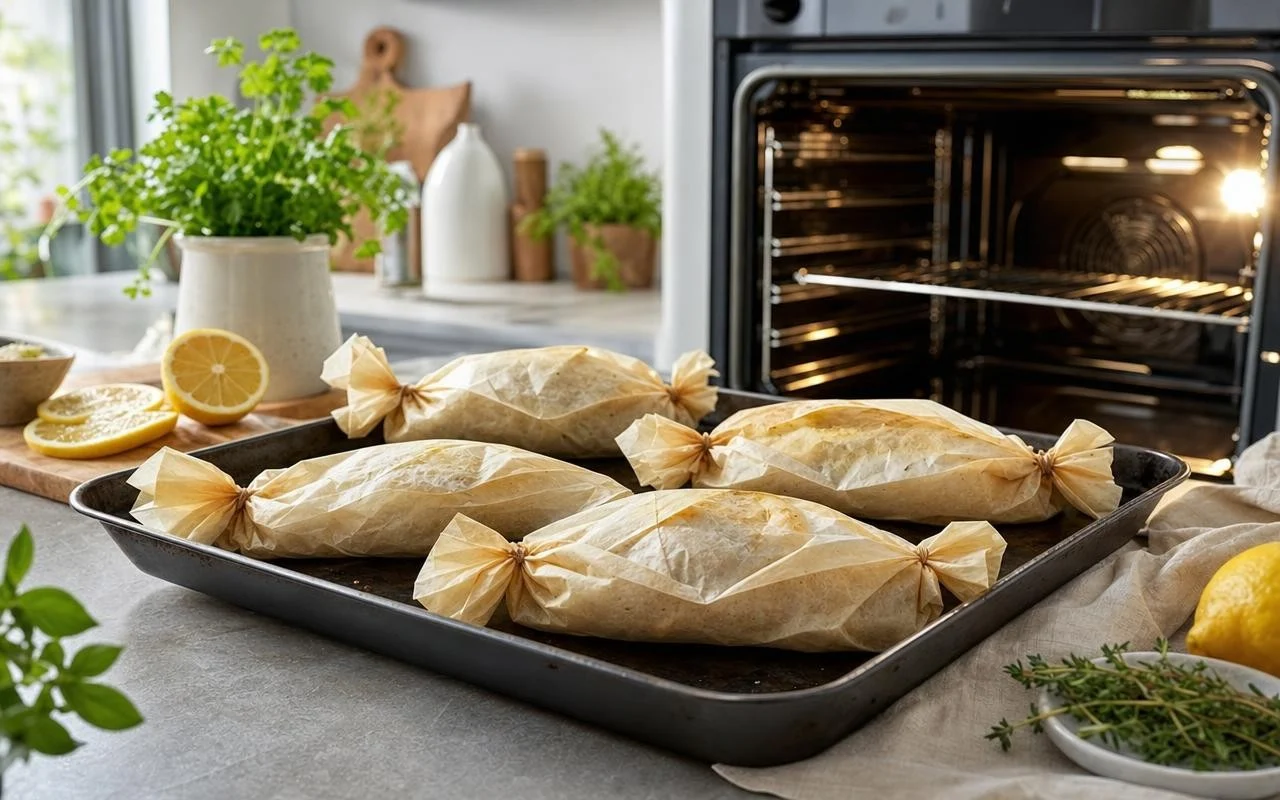
Cooking in papillote has a lot to offer: moist dishes, aromatic vegetables, and almost no clean-up. Many households instinctively use parchment paper for this, without always wondering what happens as the sheet approaches 200°C in the oven. Amid rumors of suspicious smoke, fears that the paper might catch fire, and questions about chemical substances, doubt starts to creep in.
On forums as in kitchens, one question keeps coming back: is papillote cooking with parchment paper really safe, in the oven as in the microwave, and is it preferable to aluminum for health? Manufacturers seek to reassure, oven manuals are more cautious. The task remains to understand precisely how far you can go without risk, and the few mistakes to avoid.
Parchment Paper in Papillote: What the Oven and Microwave Permit
For a classic papillote in the oven, the answer is generally yes: parchment paper is considered safe, provided you respect the limits indicated on the packaging. The Guichet du Savoir site explains that cooking parchment sold for kitchen use is treated to withstand heat up to around 220°C and is also suitable for the microwave. The Reynolds Kitchens brand provides a nearby benchmark by stating that its paper tolerates the oven up to 425°F, which is about 218°C.
On its paper cooking sachets, Reynolds Kitchens highlights an “oven-safe” product, “microwave-safe,” “BPA-free,” “chlorine-free,” and “unbleached.” The brand also notes: “Can be used in a traditional oven and there is no need to fear that foods will stick,” which confirms a use designed for family cooking. The key point remains the same across all brands: check the maximum temperature and the oven or microwave pictogram.
Papillote Cooking: Temperatures, Grill, and Problems to Watch For
The incidents described by oven manufacturers occur mostly when the parchment is misused. Instructions, such as those from the Beko brand, remind not to use parchment above the indicated maximum temperature and to remove any piece that could touch heating elements or the hot walls. A parchment that overhangs and comes close to the upper element can brown very quickly, carbonize, or even ignite if the grill is used for an extended period.
In practice, a few habits are enough to stay in the safe zone:
• set the oven to conventional or convection heat, without the grill function;
• place papillotes on a metal tray or a dish, never directly on the bottom;
• trim any paper tips that protrude too much, especially near the top heating element;
• strictly follow the temperature and cooking time indicated on the paper roll;
• in the microwave, use parchment paper only if the packaging clearly states this compatibility.
With these habits, the risk of a fire starting remains very low for everyday cooking.
Health, Aluminum, PFAS: Choosing Your Parchment Paper for Safe Papillote
From a health perspective, many sources recommend parchment paper over aluminum for papillotes. The Santé Pour Tous site notes that high heat combined with acidic foods like lemon or tomato increases the migration of aluminum into the dish. A commonly proposed solution is to wrap the foods in parchment paper, and then possibly in aluminum on the outside, to avoid direct contact between the food and the metal.
Then there is the composition of the paper itself. Some papers are simply cellulose with a silicone-based non-stick coating, while others use more complex treatments. In an article dated January 14, 2025, the Romande Consumers Federation questions parchment paper due to properties close to some packaging that can contain PFAS, these compounds used for their water-repellent properties. While awaiting more detailed data, consumers can favor clearly labeled “PFAS-free,” food-contact-safe, chlorine-free references, and strictly respect the indicated temperatures. Under these conditions, papillote cooking with parchment paper remains a practical cooking method, offering a good balance between enjoyment and caution.
