
Have you ever pulled from the freezer a compact block of steaks fused together, or a stack of crepes that’s nearly impossible to lift without breaking everything apart? The reflex is often to use hot water or to slip in a knife with force, which inevitably leads to wasted time and the risk of tearing or burning yourself.
Big brands like Reynolds Kitchens, manuals for vacuum-sealing devices, and pastry sites like King Arthur Baking describe, however, a very simple solution based on an object you already have in the drawer: parchment paper. When used correctly, it can completely change life in the freezer…
Why foods stick in the freezer and how parchment paper helps
When you pile foods that are still a little damp directly on top of one another, surface water freezes, forms tiny crystals, and acts like glue between the pieces. The weight pressure amplifies this phenomenon, hence those blocks of meat or cookies that you have to crack apart with big knife blows.
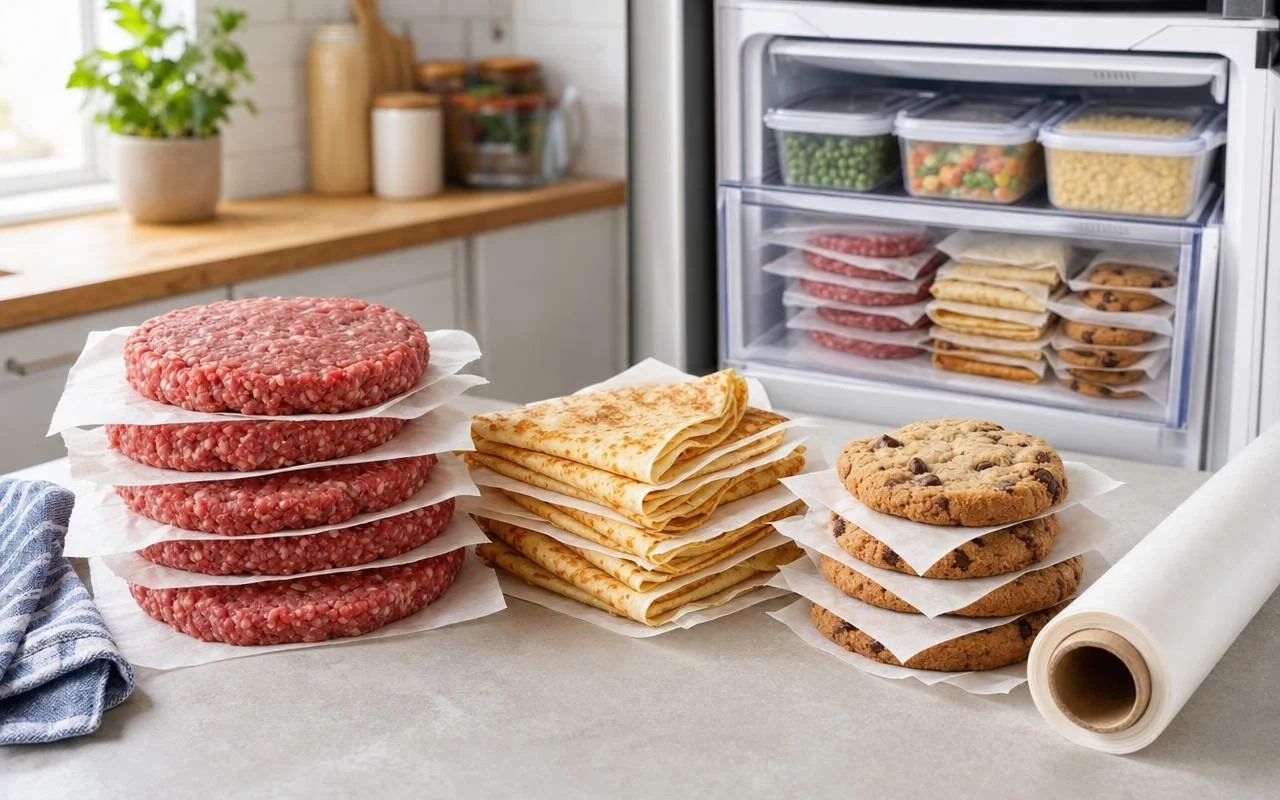
Interleaving a sheet of parchment paper simply creates a physical barrier. Reynolds Kitchens’ consumer services indicate that this paper holds up very well in the freezer and is specifically used to separate meatballs, steaks, or crepes before packaging. The same principle works for biscuits, cookie dough, or even certain sliced fruits.
La méthode simple pour séparer steaks, crêpes et biscuits avec du papier cuisson
Whatever the recipe, the basic method remains the same. It consists of a few quick steps that you’ll find echoed both in vacuum-packaging manuals and in cookie-freezing guides:
- let the meat, crepes, or cookies cool completely;
- cut squares or rectangles of parchment paper slightly larger than the pieces;
- create a stack by interleaving a sheet between each steak, crepe, or layer of cookies;
- place the stack in a freezing bag, expel the air, seal, and note the date and contents.
The manual of a Waring vacuum sealer also recommends leaving about 5 cm of margin at the bag’s edge so that the seal closes well around the pile. For red meat or thick steaks, Missouri University fact sheets suggest a double thickness of paper between the pieces so that they separate even more easily.
Astuces par aliment et idée anti-gaspi avec le papier cuisson
For steaks, burgers, or cutlets, you stack the raw or pre-cooked pieces, slipping a sheet of paper between each, and then wrap tightly. Each person can then withdraw a single steak at a time, without thawing the entire batch. This system also works for meatballs or vegetarian patties, which are very prone to sticking.
On the crepes and pancakes side, several culinary sites advise letting them cool completely, stacking them by alternating crepe and parchment paper, then freezing the stack in a bag. Another option used in batch cooking: first freeze the crepes flat on a parchment-lined tray, then bag them once they’re firm.
For biscuits already baked, bakers like Martha Stewart describe a layered stacking: a layer of biscuits, a sheet of paper, a new layer of biscuits, inside a box or bag. For dough cut into cookie rounds, two sheets between the rows prevent the discs from fusing in the cold.
One last bonus from the King Arthur Baking blog: reuse parchment paper when it’s only a little stained. After baking at moderate temperature, let the sheet cool, wipe it, fold it, and store it in a zipper bag kept in the freezer. The cold limits residual odors, helps keep sweet- and savory-scented papers separate, and you’ll have them on hand for the next batch, while discarding those that are very greasy or darkened by too-high heat.
