
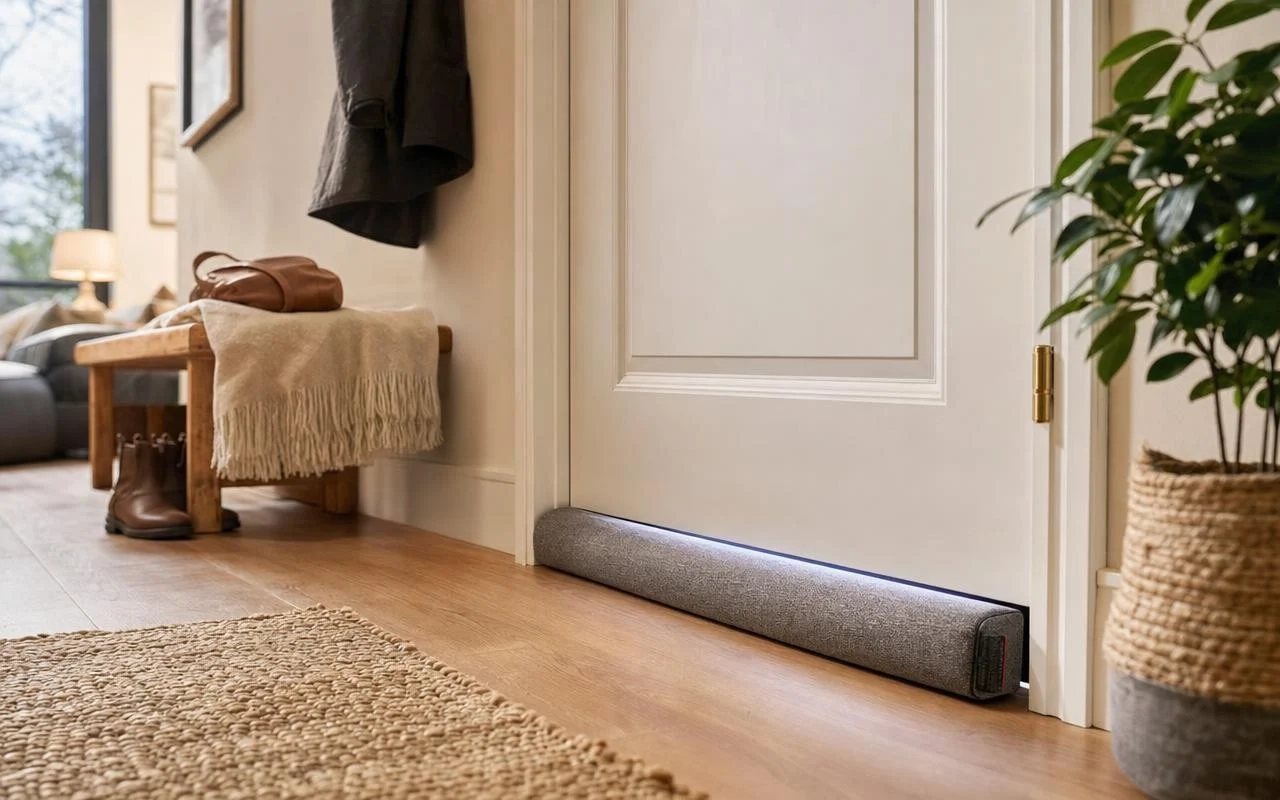
The first chilly morning, that little draft slipping under the door takes everyone by surprise. Many immediately turn up the thermostat, whereas a simple weatherstripping, available for a few euros in a hardware store, is often enough to block the cold wind and ease the boiler.
Public energy agencies have been sounding the alarm for years: a significant portion of heat escapes through poorly sealed doors and windows. The Institute for Diversification and Energy Saving (IDAE) even notes that installing weatherstrips can account for up to 10 % of energy savings on heating. The question remains to understand where these leaks hide and how to seal them intelligently.
Weatherstripping: why this autumn sealing weighs on the bill
The Le Robert Dictionary defines calfeutrage as “the action of sealing; the result of that action.” In other words, you block the gaps of a door or a window to prevent air from circulating. According to data disseminated by IDAE, nearly 40 % of heat losses occur through windows and glazing, and between 25 % and 30 % of a dwelling’s heating needs come from losses that take place there.
Doors also play a role: TotalEnergies estimates that the gaps between doors and frames can account for up to 10 % of a home’s heat losses. IDAE sums up the issue this way: “Installing weatherstrips and tapes on doors and windows allows saving between 5 % and 10 % of energy.” Autumn, just before really turning on the heating, remains the ideal period to install these door seals and limit air infiltration.
Where to install weatherstrips and how to choose the right model
Before bringing out the toolbox, you need to identify air infiltration. The method proposed by IDAE is very simple: “On a windy day, hold a lit candle near windows, doors, or ducts: if the flame flickers, you have found a point with air leaks.” The most affected areas are the bottom of exterior doors, a garage or a stairwell, the perimeter of windows and the housings of roller shutters, not forgetting gaps around the mailbox or a cat flap.
To fill these passages, IDAE recommends “simple and inexpensive means such as silicone, sealant, or weatherstripping.” In stores, there are mainly five families of products:
- foam, economical for small interior gaps,
- rubber or EPDM, sturdier for entry doors and exterior windows,
- silicone, flexible where there is friction,
- brush seal, suitable for sliding windows or uneven floors,
- the rigid door bottom or brush that closes the space with the floor.
Consumer guides cited by Selectra mention prices ranging from about €3 to €90 depending on the system chosen.
Installing weatherstripping properly in autumn and stacking the savings
A sloppy installation quickly undermines the effectiveness of door seals. The guide shared by Okdiario recalls that “experts recommend cleaning the frame with a cloth and alcohol, letting it dry completely, and sticking the weatherstrip without stretching it.” A subsequent check, with the door closed, ensures the seal sits properly without forcing it, then redoing the candle test confirms that the air flow has disappeared, while making sure not to obstruct the ventilation grilles or the ventilation system (MV).
IDAE notes that small improvements like these can account for up to 30 % of combined savings on heating and cooling when paired with good settings. The agency reminds that “for each degree you increase on the thermostat, consumption rises by about 7 %,” and recommends a daytime temperature of 19–21 °C in living areas and 15–17 °C at night in bedrooms. By complementing sealing with a brief ten-minute airing, closing shutters at night, bleeding radiators, and using appropriately sized thermostatic valves, IDAE estimates that low-cost or no-cost measures can reduce the heating bill by 10 % to 40 %. Autumn offers a comfortable window to adopt these practices before true cold weather arrives.
