
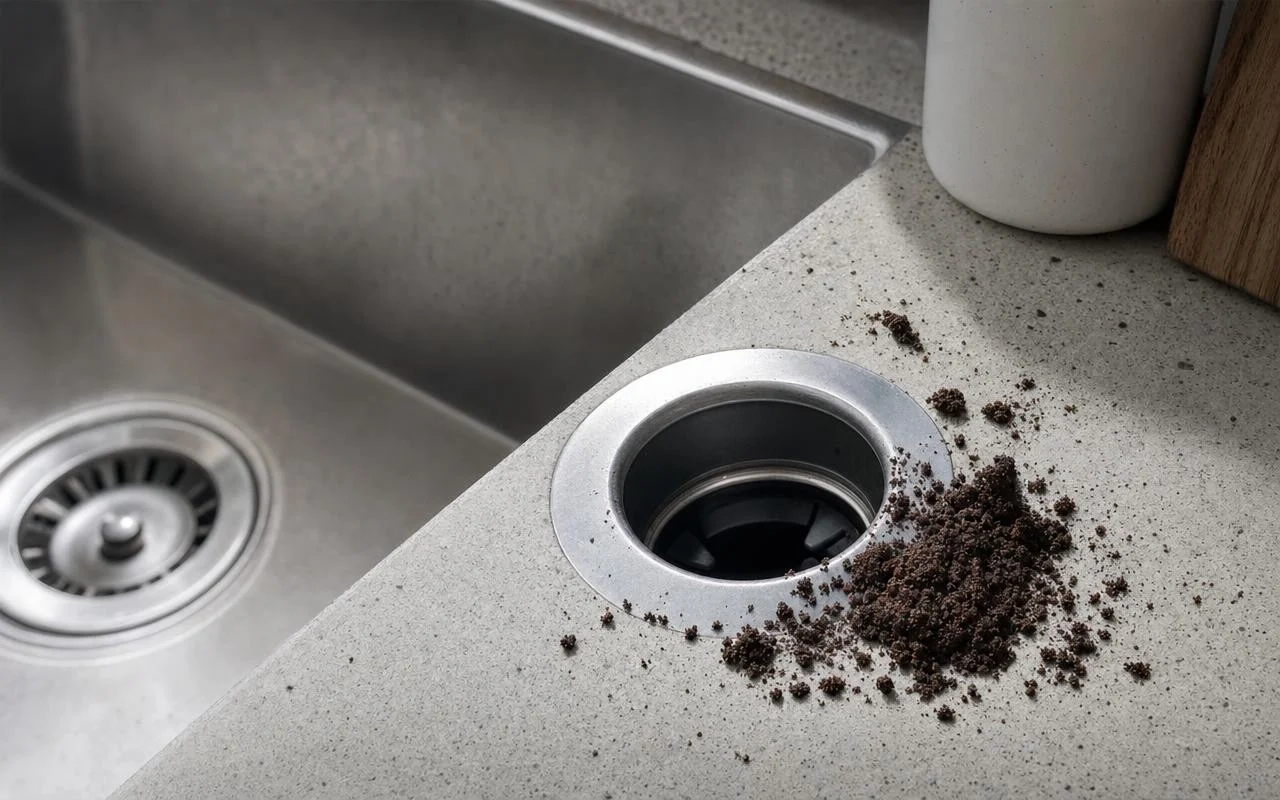
In many kitchens, a tip circulates among neighbors and social networks: put coffee grounds in a kitchen sink garbage disposal to clean it, reduce odors and even supposedly sharpen the blades. The idea seems logical, the grounds are dark, granular, and they appear abrasive. And then the pleasant coffee scent makes people think it can’t hurt.
Plumbers, however, tell a different story. The media Better Homes and Gardens reports warnings from Paul Abrams, spokesperson for the plumbing company Roto-Rooter Plumbing and Water Cleanup. According to his statements, the grounds do not polish anything at all; they mainly prepare costly clogs to undo in the pipes. And the reason often surprises those who pour it in every morning.
Garbage disposal: the myth of coffee grounds sharpening the blades
A garbage disposal does not resemble a blender filled with knives. According to the description on Wikipedia and the diagrams from manufacturers like InSinkErator, most use a rotating plate equipped with small fins, called impellers, which propel the waste against a toothed metal ring, the grinding ring. This friction shreds the leftovers into fine particles, then drawn by the water toward the P-trap.
In this context, talking about sharpening blades with grounds makes little sense, since nothing cuts like a knife inside. Paul Abrams summarizes well the rumor reported by his clients: “There exists a common myth that coffee grounds and eggshells will sharpen the blades of a garbage disposal,” he notes. For him, these hard or granular residues behave more like any extra waste to be flushed away.
Coffee grounds in a garbage disposal: what happens
When the grounds mix with water, they do not melt; they compact. Paul Abrams explains: “It takes a large amount of water pressure to push a mass of coffee grounds beyond the trap, and the coffee grounds do not dissolve in water.” The particles are heavy, they cling to each other and to the walls, especially in the elbow under the sink, the famous P-trap, where deposits tend to trap.
The problem mainly arises from accumulation. Paul Abrams explains that, if one pours small quantities of grounds regularly into the line, the grains get stuck in the deposits already present—leftover food, grease and soap residues clinging to the walls. Over weeks, this mixture forms a paste that narrows the passage. He adds that a stray coffee ring dropped while rinsing isn’t much of a problem, it’s the daily habit that eventually blocks.
What to do with coffee grounds without sending them to the disposer
In practice, the safest option is to dispose of the grounds somewhere other than the plumbing. Paul Abrams recalls that “the coffee grounds are rich in nitrogen; they can enrich a compost pile and the soil if used in good quantities.” With a garden or a few containers, simply let the grounds cool and then put them into the compost to use without threatening the pipes.
For the disposal itself, Abrams notes another possible effect: “They can get stuck between the moving parts and cause a blockage of the disposer.” It is therefore better to let the grounds cool and then pour them into a trash bag with the other waste. Some still use them as a mild abrasive for a pan or as a fridge deodorizer, but again, the safe reflex remains the trash, not the sink.
